Child Education Planning in India: How to Save for Your Child's Future (2026)
Ask any parent what worries them most financially, and education costs are almost always near the top — and for good reason. Child education planning in India has become harder precisely because the cost of good education has been rising faster than general inflation for years. This guide shows you how to estimate a realistic target and build a SIP plan to reach it, without guessing.
India’s official CPI education inflation runs around 3–3.5% annually — a number that badly understates what parents actually experience. Independent research suggests real-world education inflation, factoring in tuition, coaching, hostel and related costs, has been running in the 8–12% range annually for several years. Household spending on education in India reached roughly ₹8.43 lakh crore by FY25 — more than 4.5 times what it was 12 years earlier — a scale of increase that outpaces general consumer inflation by a wide margin.
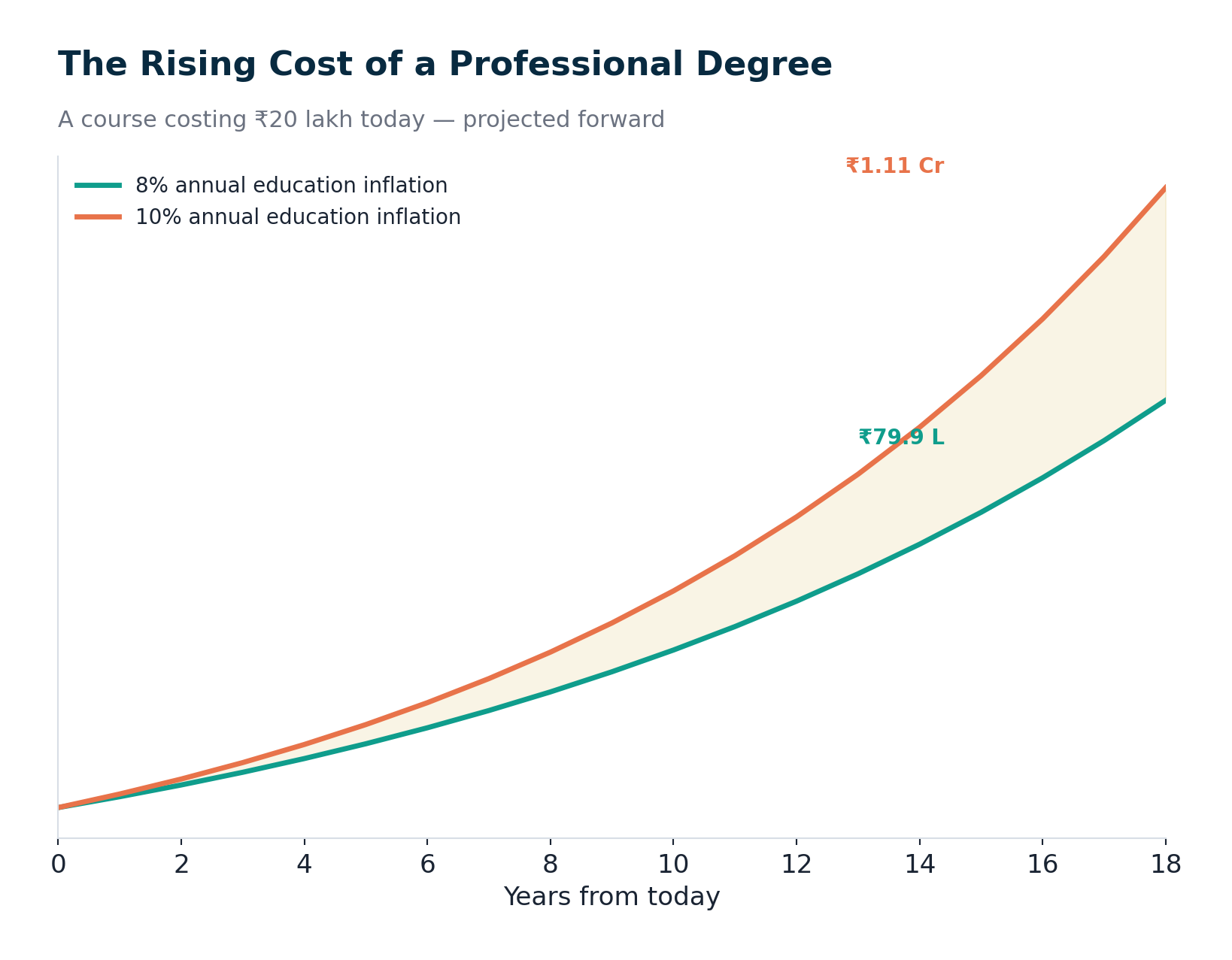
Ask any parent what worries them most financially, and education costs are almost always near the top — and for good reason. Child education planning in India has become harder precisely because the cost of good education has been rising faster than general inflation for years. This guide shows you how to estimate a realistic target and build a SIP plan to reach it, without guessing. Why Education Costs Are Rising Faster Than You Think India’s official CPI education inflation runs around 3–3.5% annually — a number that badly understates what parents actually experience. Independent research suggests real-world education inflation, factoring in tuition, coaching, hostel and related costs, has been running in the 8–12% range annually for several years. Household spending on education in India reached roughly ₹8.43 lakh crore by FY25 — more than 4.5 times what it was 12 years earlier — a scale of increase that outpaces general consumer inflation by a wide margin. The practical implication: planning for your child’s education using today’s fee structure as your target, without adjusting for years of compounding cost increases, is one of the most common ways parents underfund this goal. Projecting the Real Cost of Education Line chart showing a course costing 20 lakh rupees today projected to cost 80 lakh at 8% inflation or 1.11 crore at 10% inflation after 18 years A professional degree costing ₹20 lakh today, projected forward at two different inflation assumptions. Take a professional degree (engineering, medicine, an MBA, or a foreign university programme) costing roughly ₹20 lakh in today’s terms. Projected forward: Years from now At 8% inflation At 10% inflation 10 years ₹43.2 lakh ₹51.9 lakh 15 years ₹63.4 lakh ₹83.5 lakh 18 years ₹79.9 lakh ₹1.11 crore The gap between the 8% and 10% lines widens dramatically over time — by year 18, the difference between the two assumptions alone is over ₹30 lakh. This is exactly why a single, conservative-looking estimate made when your child is a toddler can turn out significantly short by the time they’re applying to college. How to Estimate Your Own Goal Research today’s actual cost for the type of education you’re targeting — a government engineering college, a private university, or study abroad have wildly different costs, so use a realistic reference point rather than a generic number. Choose an inflation assumption. Given the data above, 8–10% is a more realistic planning assumption for education specifically than the 5–6% often used for general expenses. When in doubt, planning for the higher end costs you a bit more in monthly savings now but protects you from a shortfall later. Count the actual years to goal , based on your child’s current age and the age they’ll likely start the target course (typically 17–18 for undergraduate, later for postgraduate). Add related costs — hostel/accommodation, study materials, and for international education, currency risk (fees denominated in a foreign currency add another layer of uncertainty an India-only estimate misses). Monthly SIP Needed, by Years to Goal Bar chart showing the monthly SIP needed to reach a 1 crore rupee goal at 12% return, ranging from about 1.2 lakh per month with 5 years to go down to 13,000 per month with 18 years to go Illustrative — assumes a 12% annual return and a ₹1 crore target corpus. For an illustrative ₹1 crore target (adjust to your own projected number from the table above), assuming a 12% annual return: Years to goal Monthly SIP required 5 years ₹1,21,232 10 years ₹43,041 15 years ₹19,819 18 years ₹13,064 The pattern is unmistakable: the same ₹1 crore goal costs nine times more per month if you start with 5 years to go compared to 18. This is the single strongest argument for starting a child education fund in the year your child is born, not the year they enter secondary school. See our SIP planning guide (/insights/sip-planning-guide-india) for more on why time matters more than the amount you start with. Where to Invest for a Child’s Education Goal Long horizon (10+ years to goal): a predominantly equity mutual fund portfolio — flexi-cap or a mix of large-cap and mid-cap funds — gives the growth needed to outpace education-specific inflation. See our mutual fund planning guide (/insights/mutual-fund-planning-guide-india) for how to choose funds. Medium horizon (5–10 years): a gradually more balanced mix of equity and debt, shifting toward stability as the goal approaches, similar to the general asset allocation glide path in our mutual fund guide. Short horizon (under 5 years): predominantly debt instruments and safer options, since a market fall shortly before you need the money would be difficult to recover from in time. Sukanya Samriddhi Yojana (SSY), for a girl child under 10, is a strong option for the fixed-income portion of the goal — currently earning 8.2% (July–September 2026 quarter), fully tax-free on both interest and maturity, though as a debt instrument it works best as part of a mix rather than the sole investment for a long-dated goal. Avoid bundled child insurance-cum-investment plans as the primary vehicle. As covered in our insurance planning guide (/insights/insurance-planning-guide-india) , separating pure term insurance (to protect the goal if a parent isn’t there to keep funding it) from pure investment (mutual funds/SSY, to grow the corpus) generally outperforms combined products that do both jobs less efficiently. Protecting the Goal, Not Just Funding It A child education plan is incomplete without protection: if the earning parent isn’t there to keep contributing, does the goal still get funded? This is exactly what adequate term life insurance is for — see our insurance planning guide (/insights/insurance-planning-guide-india) for how much cover to hold. Consider the education goal itself as one of the amounts you add when calculating your required term cover. Common Child Education Planning Mistakes Using today’s fees as the target, unadjusted for inflation. Covered above — this is the single biggest underfunding risk. Starting late because “college feels far away.” The SIP-by-years-to-goal numbers above show exactly what delay costs — waiting from birth to age 8 to start can more than double the required monthly investment for the same goal. Putting the entire goal in fixed-income instruments. Safe, but for a goal 15+ years away, an all-debt approach likely won’t outpace real education inflation, leaving a shortfall despite disciplined saving. Not revisiting the target as costs and plans become clearer. Your child’s actual interests and the realistic cost of their likely path become clearer over time — revisit and adjust the goal amount every couple of years rather than setting it once at birth and never checking again. Dipping into the fund for unrelated expenses. A dedicated, clearly labelled investment (a separate folio or account) is less likely to get redirected to a different goal than money sitting in a general investment pool. Where This Fits in Your Plan Child education planning draws directly on the SIP planning (/insights/sip-planning-guide-india) and mutual fund planning (/insights/mutual-fund-planning-guide-india) pillars, and depends on adequate insurance (/insights/insurance-planning-guide-india) to protect it. See the complete financial planning guide (/insights/financial-planning-in-india-complete-guide) for how this goal fits alongside retirement and your other priorities. More on planning for children Sukanya Samriddhi vs mutual funds for a daughter's education (/insights/sukanya-samriddhi-vs-mutual-funds-education) Protecting the corpus when college is 3–5 years away (/insights/education-planning-3-to-5-years) Planning for study abroad: currency risk and LRS (/insights/study-abroad-education-planning-india) Children's funds explained (/insights/childrens-funds) Frequently Asked Questions How much does education inflation run in India? Official CPI education inflation typically runs around 3–3.5% annually, but independent studies suggest the real-world cost of professional and higher education has been rising considerably faster — commonly estimated in the 8–12% range annually — as fees, coaching and living costs all climb together. How much should I invest monthly for my child’s education? It depends entirely on your target amount and how many years remain until you need it. As an illustration, reaching a ₹1 crore goal at an assumed 12% annual return needs roughly ₹1.2 lakh/month with 5 years to go, versus about ₹13,000/month with 18 years to go — the earlier you start, the less it costs you monthly. Should I use a child education plan (insurance) or mutual funds to save for my child? For most families, a combination of pure term insurance (to protect the goal if something happens to the parent) and mutual fund SIPs (to grow the corpus) tends to outperform bundled child insurance-cum-investment plans, which typically offer lower effective returns and less flexibility than the two kept separate. What is Sukanya Samriddhi Yojana and is it good for education planning? Sukanya Samriddhi Yojana (SSY) is a government savings scheme exclusively for a girl child under 10, currently earning 8.2% per year (July–September 2026 quarter) with tax-free interest and maturity. It’s a strong, safe option for the debt portion of a daughter’s education or marriage goal, though as a fixed-income product it shouldn’t be the only investment for a long-dated goal where equity can add meaningfully higher growth. Want to know exactly what your child's goal will cost, and what to invest monthly? We’ll help you set a realistic, inflation-adjusted target and build the right mix of investments to reach it. Talk to Money n Wealth (/contact) for a free financial plan review. This article is for general educational purposes only and does not constitute investment advice. Mutual fund investments are subject to market risks; please read all scheme-related documents carefully. Figures, inflation assumptions and returns shown are illustrative, not guaranteed. Please consult a qualified financial adviser before investing. Money n Wealth (Predics Fintech Services Pvt Ltd) is an AMFI-registered Mutual Fund Distributor (ARN-121995) and APMI-registered PMS Distributor (APRN07444); it is not a SEBI-registered investment adviser and may earn distribution commission on investments made through it.