Debt Management in India: How to Get Out of Debt Faster (2026 Guide)
Not all debt is a problem — a home loan funding an appreciating asset is very different from a credit card balance funding a vacation you’ve already forgotten. Debt management in India starts with telling the two apart, then applying a structured payoff strategy to the debt that’s actually working against you.
This guide covers good debt vs bad debt, the two most effective payoff strategies (with real numbers), how to handle credit card debt specifically, and how to rebuild your credit score once you’re out.
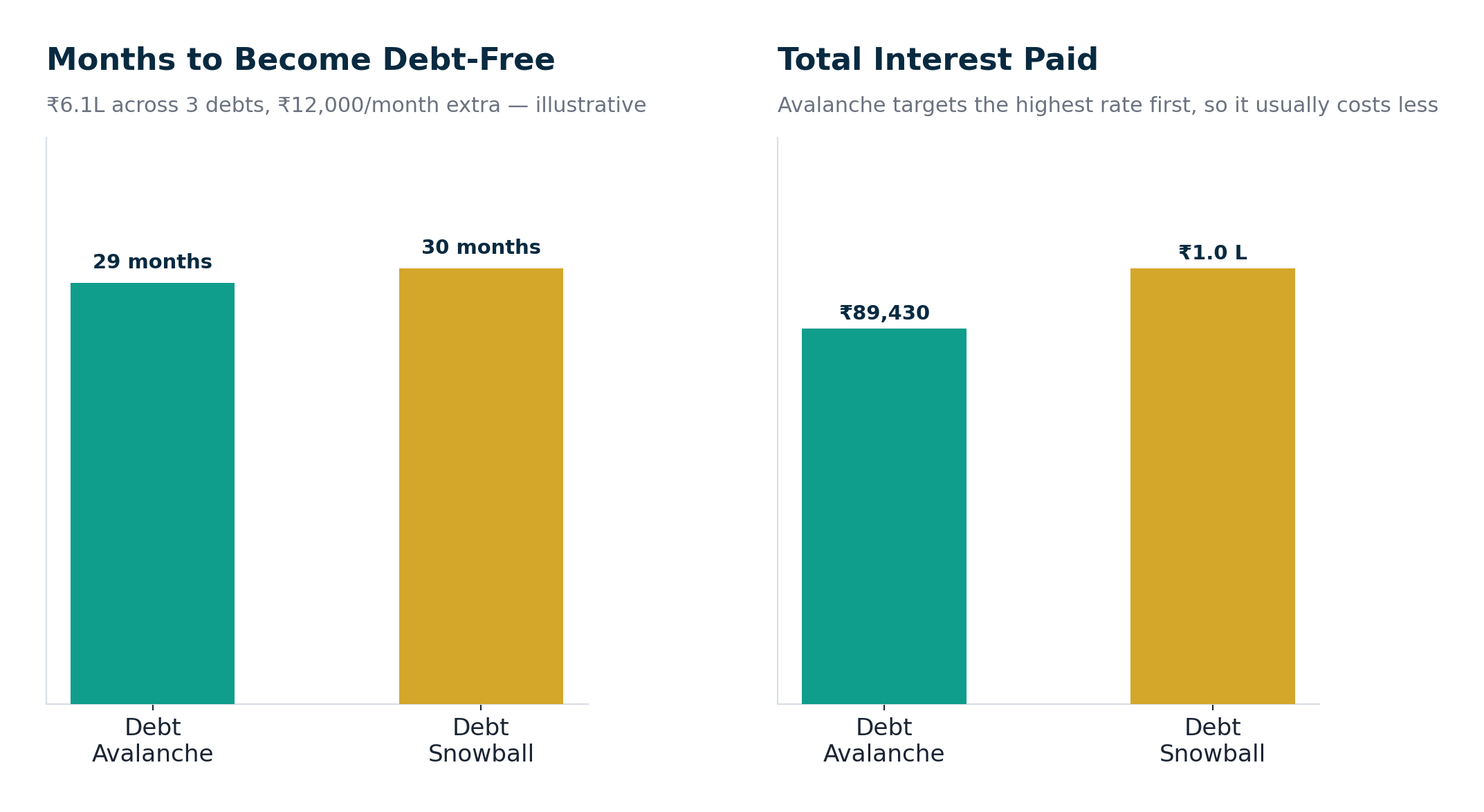
Not all debt is a problem — a home loan funding an appreciating asset is very different from a credit card balance funding a vacation you’ve already forgotten. Debt management in India starts with telling the two apart, then applying a structured payoff strategy to the debt that’s actually working against you. This guide covers good debt vs bad debt, the two most effective payoff strategies (with real numbers), how to handle credit card debt specifically, and how to rebuild your credit score once you’re out. Good Debt vs Bad Debt Comparison of good debt that can build wealth versus bad debt that erodes it Judge debt by what it funds and what it costs — not just by the EMI. Good debt typically funds an appreciating asset or your future earning capacity, and usually carries a comparatively lower interest rate: a home loan (which also carries tax benefits), an education loan (which raises your future income), or a business loan that grows income beyond its cost. Bad debt typically funds a depreciating purchase or pure consumption, and usually carries a high interest rate: a revolving credit card balance, a personal loan for a vacation or wedding expenses, or EMIs for consumer durables and gadgets that lose value the moment you buy them. The practical takeaway isn’t “avoid all debt” — it’s to be deliberate about what you borrow for, and to treat bad debt as a fire to put out, not a permanent monthly line item. Debt Avalanche vs Debt Snowball Chart comparing months to debt-free and total interest paid using debt avalanche versus debt snowball, for an illustrative ₹6.1 lakh across three debts Illustrative example: ₹6.1 lakh across a credit card, a consumer loan and a car loan, with ₹12,000/month extra toward payoff. Both strategies pay the minimum on every debt , then direct all extra payment capacity toward one target debt at a time, moving to the next once it’s clear. Debt avalanche targets the highest interest rate debt first, regardless of balance. This minimises total interest paid — mathematically, it’s always the cheaper method. In the example above (a ₹1.5 lakh credit card at 36%, a ₹60,000 consumer loan at 15%, and a ₹4 lakh car loan at 9%, with ₹12,000/month extra), the avalanche method clears all debt in 29 months and costs about ₹89,400 in total interest. Debt snowball targets the smallest balance first, regardless of interest rate, to generate quick wins and build momentum. In the same example, snowball takes 30 months and costs about ₹1,03,700 in total interest — about ₹14,000 more and a month longer, because it delayed attacking the 36% credit card balance in favour of the smaller 15% loan. Which should you use? Avalanche wins on the math almost every time. Snowball can still be the right choice if you’ve tried avalanche before and lost motivation partway through — the “best” method is the one you’ll actually stick with to the end. A Step-by-Step Debt Payoff Plan Step 1: List every debt with its balance, interest rate and minimum payment. You can’t build a strategy without seeing the full picture in one place. Step 2: Keep paying the minimum on everything. Missing minimums damages your credit score and often triggers penalty rates — never skip this, even while focusing extra payments elsewhere. Step 3: Find extra payment capacity in your budget. Review your budget (/insights/budgeting-guide-india) specifically for this — even ₹5,000–₹10,000 a month redirected from discretionary spending meaningfully shortens the payoff timeline, as shown above. Step 4: Choose avalanche or snowball, and direct all extra payment to one debt at a time. Splitting extra payments across multiple debts feels balanced but is mathematically slower — concentrate it. Step 5: Redirect the freed-up payment as each debt closes. Once the target debt is paid off, roll its entire former payment (minimum + extra) into the next target. This is what makes the payoff accelerate rather than stay linear. Step 6: Keep a small buffer, don’t drain your emergency fund. Using your entire emergency fund (/insights/emergency-fund-guide-india) to pay debt can force you to re-borrow — often at a worse rate — the next time something unexpected happens. A partial allocation toward very high-interest debt can make sense; wiping it out rarely does. Handling Credit Card Debt Specifically Credit card debt deserves special attention because of one number: the minimum due trap . Paying only the minimum due keeps the account “current” while the remaining balance continues accruing interest — commonly 30%+ annually — meaning a balance can take years to clear and cost multiples of the original amount if only minimums are paid. If you’re carrying a revolving balance: stop using the card for new spending until it’s cleared, pay as far above the minimum as your budget allows, and consider whether a lower-interest personal loan to consolidate the card debt could reduce the effective rate — this only helps if you don’t run the card balance back up afterward. Debt Consolidation and Balance Transfers Moving high-interest debt (typically credit card) to a lower-interest personal loan or a balance-transfer offer can reduce the total interest paid, provided the new rate is genuinely lower after fees, and provided the freed-up credit limit doesn’t simply get spent again. Consolidation is a tool to reduce cost and simplify payments — it doesn’t reduce the underlying balance, and it works best paired with the budgeting discipline that prevents the debt from recurring. Rebuilding Your Credit Score After Debt Three factors matter most for your CIBIL score during and after a payoff: paying on time, every time (payment history is the single biggest factor), reducing your credit utilisation ratio (the percentage of your credit limit you’re using — lower is better, and below 30% is a common benchmark), and being cautious about closing old accounts entirely, since a longer average credit history generally helps your score — a paid-off card kept open with zero balance is often better for your score than a closed one. Common Debt Management Mistakes Only ever paying the minimum. This is the single most expensive habit in personal finance — it maximises the interest you pay and the time it takes to be debt-free. Taking on new debt while paying off old debt. A payoff plan can’t outrun new spending on the same or another card. Pause new discretionary debt until existing high-interest debt is cleared. Splitting extra payments evenly across all debts. Feels fair, but mathematically slower than concentrating extra payments on one target debt at a time (avalanche or snowball). Ignoring the debt entirely and hoping it shrinks. Interest compounds whether or not you’re paying attention to it — a debt that isn’t actively being paid down above the minimum is, in real terms, growing. Not investing at all until debt-free — or the reverse, investing while carrying very high-interest debt. As a rough guide, prioritise clearing debt costing more than roughly 12–15% interest before investing meaningfully, since few investments reliably beat that after-tax. For lower-cost debt like many home loans, paying the minimum and investing in parallel (see SIP planning (/insights/sip-planning-guide-india) ) can be the better trade-off. Where Debt Management Fits in Your Plan Getting free of high-interest debt is what makes every later pillar — insurance, investing, retirement — actually affordable on a sustainable basis. Once you’re debt-free (or carrying only low-cost “good” debt), the surplus that was going to extra debt payments becomes available for SIP planning (/insights/sip-planning-guide-india) and other goals. See the complete financial planning guide (/insights/financial-planning-in-india-complete-guide) for the full picture. Avalanche vs snowball at a glance Debt avalanche Debt snowball Order of payoff Highest interest rate first Smallest balance first Total interest paid Lowest Higher Motivation Slower early wins Quick early wins Best for Disciplined borrowers with high-rate cards People who need momentum to stay on track Typical borrowing costs Debt type Typical annual cost Priority to repay Credit card revolving balance 36–45% Highest Personal loan 10–24% High Loan against mutual funds 9–13% Medium Gold loan 9–18% Medium Car loan 8–11% Medium-low Home loan 7.5–9.5% Lowest (often tax-efficient in the old regime) Indicative ranges; check your lender's actual rate. RBI rules do not allow foreclosure charges on floating-rate loans taken by individuals for non-business purposes. Credit score band What it usually means 750+ Best rates and fastest approvals 700–749 Approvals likely, rates slightly higher 650–699 Limited options, higher rates Below 650 Rebuild before applying Compare borrowing options in personal loan vs loan against mutual funds vs gold loan (/insights/personal-loan-vs-lamf-vs-gold-loan) . Frequently Asked Questions What is the difference between debt avalanche and debt snowball? The debt avalanche method pays off the highest-interest debt first, which minimises total interest paid. The debt snowball method pays off the smallest balance first, which builds motivation through quick wins. Avalanche usually saves more money; snowball often has a higher completion rate for people who need momentum. Is a personal loan or credit card debt worse? Credit card debt is typically far more expensive — revolving balances commonly carry 30%+ annual interest — compared to a personal loan, which usually carries meaningfully lower rates. If you’re carrying both, credit card debt should almost always be paid off first. Should I use my emergency fund to pay off debt? Generally no, beyond perhaps a small portion for very high-interest debt like credit cards. Wiping out your emergency fund to pay debt can force you to borrow again — often at a worse rate — the next time something unexpected happens. How does paying off debt affect my credit score in India? Consistently paying at least the minimum on time, reducing your credit utilisation ratio (balance versus limit), and paying off high-interest debt all improve your CIBIL score over time. Closing very old credit accounts entirely can sometimes shorten your credit history and have a mixed effect, so it’s often better to keep a paid-off card open and unused than to close it. Carrying multiple debts and not sure where to start? A personalised payoff order — accounting for every rate, balance and your monthly capacity — clears debt faster than a generic rule. Talk to Money n Wealth (/contact) for a free financial plan review. This article is for general educational purposes only and does not constitute financial advice. Figures and examples are illustrative. Please consult a qualified financial adviser for guidance specific to your situation. Money n Wealth (Predics Fintech Services Pvt Ltd) is an AMFI-registered Mutual Fund Distributor (ARN-121995) and APMI-registered PMS Distributor (APRN07444); it is not a SEBI-registered investment adviser and may earn distribution commission on investments made through it.