Emergency Fund in India: How Much You Need and Where to Keep It (2026 Guide)
A job loss, a medical emergency, or a broken-down two-wheeler you rely on for work all have one thing in common: they don’t wait for a convenient month. An emergency fund is the one piece of a financial plan whose entire job is to absorb these moments without derailing everything else you’ve built — no debt, no broken investments, no panic.
This guide covers exactly how much to save, where to keep it so it’s both safe and accessible, and how to build it without stalling your other goals.
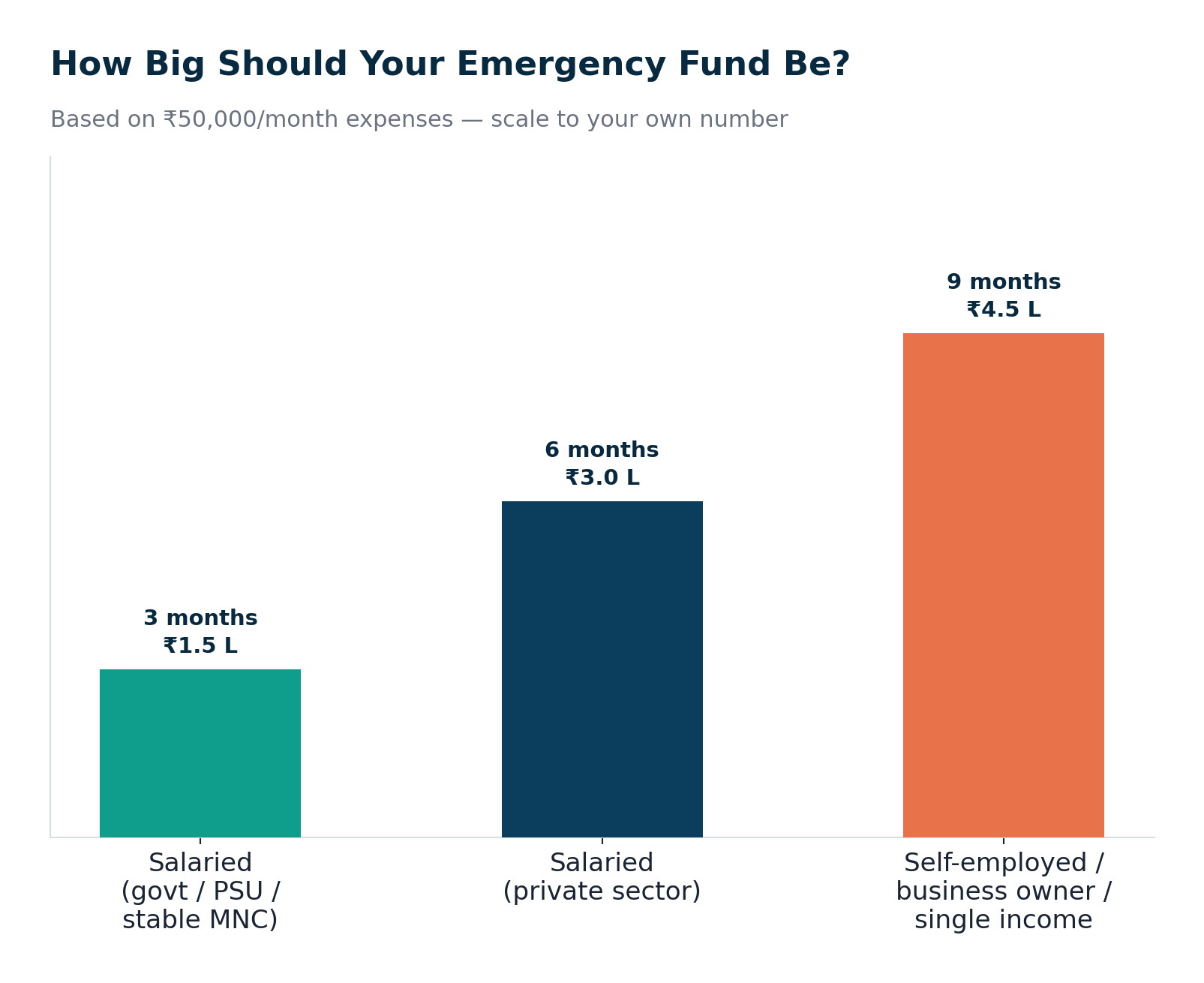
A job loss, a medical emergency, or a broken-down two-wheeler you rely on for work all have one thing in common: they don’t wait for a convenient month. An emergency fund is the one piece of a financial plan whose entire job is to absorb these moments without derailing everything else you’ve built — no debt, no broken investments, no panic. This guide covers exactly how much to save, where to keep it so it’s both safe and accessible, and how to build it without stalling your other goals. What Actually Counts as an “Emergency” An emergency fund exists for events that are urgent, necessary, and unplanned — all three at once. A sudden medical bill qualifies. A once-in-a-lifetime sale on a laptop you didn’t plan to buy does not, no matter how good the discount looks in the moment. Common genuine uses: job loss or a gap between jobs, a medical expense not fully covered by insurance, urgent home or vehicle repairs that affect safety or your ability to work, and supporting family through a sudden crisis. If you find yourself justifying a purchase as an “emergency” that was actually discretionary, that’s a budgeting decision, not an emergency fund withdrawal — see our budgeting guide (/insights/budgeting-guide-india) for building that habit separately. How Much Emergency Fund Do You Actually Need? Bar chart: emergency fund target by profile — 3 months for stable government/PSU jobs, 6 months for private sector salaried, 9 months for self-employed or single income Based on ₹50,000/month expenses — scale the months to your own number. The right number depends far more on how stable and how singular your income is than on your income level itself. 3–6 months of expenses is a reasonable range if you’re salaried in a stable role — government, PSU, or a large, established private employer — where notice periods and severance norms make sudden zero-income months less likely. 6–9 months of expenses fits most private-sector salaried employees, especially in industries with variable hiring cycles (startups, IT services during slow periods, sales roles with a variable-pay component). 9–12 months of expenses is the safer range for self-employed professionals, business owners, freelancers, and single-income households, where there’s no second earner to fall back on and income itself can be irregular even without a “crisis.” Critically, this is 3–12 months of essential expenses — rent/EMI, groceries, utilities, insurance premiums, minimum loan payments, school fees — not your full lifestyle spending. To calculate your own number: total your essential monthly expenses, then multiply by the months that fit your profile. Where to Keep Your Emergency Fund Bar chart comparing liquidity and typical returns of savings accounts, sweep-in fixed deposits, and liquid mutual funds Balance instant access with a little extra return — don’t sacrifice access for yield here. The single most important quality for emergency fund money is accessibility , not returns. A fund that earns 1% more but takes five working days to access has failed at its one job. Savings account. Instant access, fully liquid, but returns are the lowest of the options (typically 2.5–4% depending on the bank and balance slab). Good for 1–2 months of the fund you might need with zero delay. Sweep-in / auto-sweep fixed deposit. Your bank automatically moves idle savings balance above a threshold into a short-term FD that earns FD-like interest, and sweeps it back the moment you need it — no manual FD-breaking process. A good middle ground for a large chunk of the fund. Liquid mutual funds. Typically redeem within one working day (some offer instant redemption up to a limit), with historically better post-tax returns than a plain savings account over time. A sensible home for the portion of your emergency fund you’re less likely to touch on short notice. A practical split many households use: 1–2 months of expenses in a savings account for true instant access, and the remaining months in a sweep-in FD or liquid fund. Avoid equity mutual funds, real estate, gold jewellery, ULIPs, or any instrument with a lock-in — none of them are built for the specific job an emergency fund does. How to Build an Emergency Fund Fast Open a separate account. Keeping emergency money in the same account as your everyday spending makes it too easy to “borrow” from without noticing. A dedicated savings account or liquid fund folio creates a useful mental and practical barrier. Automate a fixed transfer every month. Treat it like a bill you owe yourself — an automatic transfer on salary day, even a modest one, builds the fund without relying on willpower each month. This is the same automation principle covered in our budgeting guide (/insights/budgeting-guide-india) . Redirect windfalls before you get used to spending them. Bonuses, tax refunds, and gifts are the fastest way to top up an emergency fund without touching your monthly cash flow at all. Temporarily boost your savings rate. If your target feels far away, consider pausing discretionary spending increases (not existing SIPs) for 6–12 months specifically to reach your emergency fund goal, then return to your normal budget split. Sell what you don’t use. Unused electronics, furniture, or a second vehicle sitting idle can meaningfully jump-start the fund without touching monthly income at all. Common Emergency Fund Mistakes Building it after starting to invest, not before. It’s tempting to chase SIP returns first, but an emergency fund is what protects those very investments from being sold at a loss during a crisis. Sequence matters: emergency fund first, then aggressive investing. Keeping it all in cash at home. Beyond the security risk, cash at home earns nothing and is easy to dip into casually. A bank or liquid fund adds a small but meaningful barrier plus some return. Using it and never replenishing. After a genuine emergency draws the fund down, treat rebuilding it as the top financial priority again — ahead of resuming discretionary investing — until it’s back to target. Confusing a credit card limit with an emergency fund. A credit line is borrowed money, typically at 30%+ annual interest if not paid in full within the grace period, and can be reduced or frozen by the issuer at the worst possible time. It’s a reasonable backup, never the primary plan. Over-funding at the cost of long-term goals. Once you hit your target (say, 6–9 months), redirect further surplus to SIPs (/insights/sip-planning-guide-india) and other goals rather than continuing to stockpile cash that could be compounding elsewhere. What Comes Next Once your budget is running and your emergency fund is fully funded, the next pillar to secure is protection — making sure a health event or death doesn’t create a financial emergency insurance was supposed to prevent in the first place. See our insurance planning guide (/insights/insurance-planning-guide-india) , or step back to the complete financial planning guide (/insights/financial-planning-in-india-complete-guide) to see how every piece fits together. How big should it be? Household Suggested months of essential expenses Example (essentials ₹50,000/month) Single, salaried, stable job 3–6 months ₹1.5–3 lakh Family with one earner and EMIs 6–9 months ₹3–4.5 lakh Freelancer or business owner 9–12 months ₹4.5–6 lakh Retired 1–2 years of withdrawals in liquid form ₹6–12 lakh Where to keep it Option Access Risk Tax Savings account / sweep-in FD Instant None (DICGC cover up to ₹5 lakh per bank) Interest at slab rate Liquid fund Next working day; instant up to ₹50,000 Very low Gains at slab rate on redemption Overnight fund Next working day Negligible Gains at slab rate on redemption Short FD ladder Premature withdrawal with penalty None Interest at slab rate See overnight and liquid funds (/insights/overnight-liquid-funds) and, for irregular incomes, money management for freelancers (/insights/money-management-for-freelancers-and-self-employed) . Frequently Asked Questions How much emergency fund should I have in India? A common benchmark is 3–6 months of essential expenses for salaried employees in stable jobs, 6–9 months for private-sector salaried employees, and 9–12 months for self-employed individuals or single-income households, since their income is less predictable. Where should I keep my emergency fund in India? Split it between a savings account or sweep-in fixed deposit for instant access, and a liquid mutual fund for the portion you’re less likely to need immediately. Avoid equity, real estate, ULIPs or any locked-in instrument for this money — accessibility matters more than returns here. Is a credit card limit a substitute for an emergency fund? No. A credit card is borrowed money at typically 30%+ annual interest if not paid in full, and the limit can be reduced or the card frozen at the worst possible time — for instance during a job loss. It can be a backup, never the primary emergency fund. Should I invest my emergency fund in equity mutual funds for better returns? No. Equity markets can be down 20–30% exactly when a personal emergency hits — a recession that costs you your job often coincides with a falling market. Emergency money needs to be stable and available, not growing; that’s what the rest of your portfolio is for. Not sure how many months of expenses you actually need? The right target depends on your income stability, dependants and existing cover — not a generic rule. Talk to Money n Wealth (/contact) for a free portfolio and financial plan review. This article is for general educational purposes only and does not constitute financial advice. Figures and examples are illustrative. Please consult a qualified financial adviser for guidance specific to your situation. Money n Wealth (Predics Fintech Services Pvt Ltd) is an AMFI-registered Mutual Fund Distributor (ARN-121995) and APMI-registered PMS Distributor (APRN07444); it is not a SEBI-registered investment adviser and may earn distribution commission on investments made through it.