Estate Planning in India: Will, Nomination and Succession Guide (2026)
Estate planning is the part of a financial plan almost everyone delays — it requires thinking about your own mortality, and there’s rarely an urgent deadline forcing the decision. But the cost of delay doesn’t fall on you; it falls on the family left sorting things out, often during the hardest weeks of their lives. Estate planning in India doesn’t require wealth or complexity to start — it requires a Will, correct nominations, and a clear record of what you own.
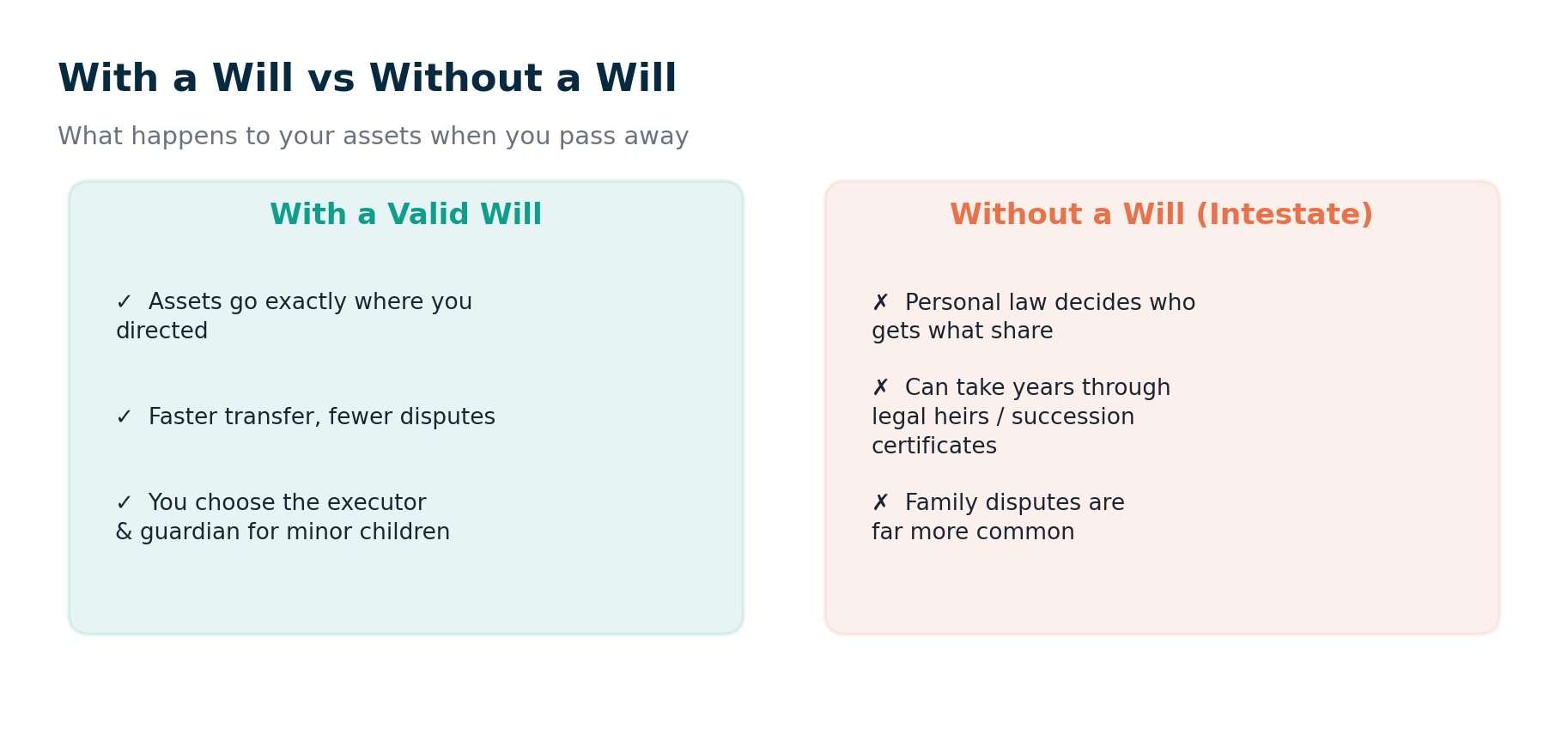 The difference isn’t just paperwork — it directly affects how fast, and how fairly, your family receives what you intended for them.
Estate planning is the part of a financial plan almost everyone delays — it requires thinking about your own mortality, and there’s rarely an urgent deadline forcing the decision. But the cost of delay doesn’t fall on you; it falls on the family left sorting things out, often during the hardest weeks of their lives. Estate planning in India doesn’t require wealth or complexity to start — it requires a Will, correct nominations, and a clear record of what you own. With a Will vs Without One Comparison of outcomes with a valid Will versus dying intestate without a Will in India The difference isn’t just paperwork — it directly affects how fast, and how fairly, your family receives what you intended for them. With a valid Will, your assets go where you directed, the process is typically faster with fewer disputes, and you get to choose your executor and, if relevant, a guardian for minor children. Without a Will — legally termed dying intestate — your assets are distributed according to the succession law that applies to you, based on your religion, which may not match what you would have chosen, the process typically takes longer and requires more documentation (like a succession certificate or legal heir certificate), and family disputes over the estate become considerably more common. Why Nomination Is Not the Same as Ownership This is the single most misunderstood concept in Indian estate planning. Naming a nominee on a bank account, mutual fund folio, insurance policy, EPF account or demat account tells the institution who to pay first after your death — it is a mechanism for the institution’s convenience and speed, not a transfer of legal ownership. Indian courts have repeatedly held that, in most circumstances, a nominee receives the asset as a trustee or custodian on behalf of the legal heirs , unless that nominee is also entitled under a Will or succession law. In practice, this means: if your Will (or succession law, absent a Will) says your assets should be split between your spouse and children, but your bank nominee is only your spouse, your spouse may legally be obligated to share the asset with your children per the Will — even though the bank paid the full amount to the nominee first. Keep your nominations updated and, ideally, consistent with your Will , to avoid exactly this kind of conflict for your family. How Succession Law Works Without a Will If you die intestate (without a Will), the applicable law depends on your religion: Hindus, Sikhs, Jains and Buddhists are generally governed by the Hindu Succession Act , while many other communities fall under the Indian Succession Act or their respective personal law. These laws specify exactly which relatives inherit, and in what proportion — rules that can differ meaningfully from what any individual might have intended, particularly around how much a spouse versus children versus parents receive. This is a genuinely technical area of law; if you want to understand exactly how intestate succession would apply to your specific family situation, it’s worth a conversation with a lawyer rather than relying on a general guide. How to Write a Will in India A Will doesn’t require extremely formal language — a handwritten (holograph) Will, clearly stating your intentions, signed by you and attested by two witnesses, is legally valid in India. That said, for anything beyond the simplest estate, professional drafting substantially reduces the risk of ambiguity, missing assets, or wording that makes the Will harder to execute or easier to contest. A Will typically includes: a clear statement revoking any previous Wills, a full list of your assets (bank accounts, investments, property, insurance, business interests), how you want each divided and among whom, your chosen executor (the person responsible for carrying out the Will), and, if relevant, a guardian for minor children. Registration is optional but valuable. An unregistered Will is still legally valid, but registering it with the local Sub-Registrar adds a layer of authenticity and makes it harder to dispute or claim as forged — worth the modest cost and effort for most estates. Probate — check if it applies to you. Probate (court validation of a Will) is generally mandatory for Wills made by certain communities in respect of immovable property located within the original jurisdiction of the Mumbai, Chennai and Kolkata High Courts, and is often advisable elsewhere even where not strictly required, since it strengthens the Will’s legal standing when assets are eventually transferred. Whether probate applies to your specific situation depends on where your property is and your community — confirm this with a lawyer rather than assuming either way. The Estate Planning Checklist A six-step estate planning checklist: write a Will, update nominations, add a joint holder, buy adequate life cover, list all assets and liabilities, and register the Will or consider a Trust Work through these roughly in order of urgency and impact. 1. Write a Will. The single highest-impact step, and the one most people postpone indefinitely. 2. Update nominations everywhere. Bank accounts, mutual fund folios, insurance policies, EPF/PPF, and demat accounts each have separate nomination records — a life event (marriage, divorce, a child) should trigger a full review across all of them, not just the most recent account you opened. 3. Add a joint holder where appropriate. For key bank accounts and property, a joint holder (with clear “either or survivor” instructions where relevant) can simplify access for a spouse during a difficult time, alongside — not instead of — a Will. 4. Buy adequate life insurance. As covered in our insurance planning guide (/insights/insurance-planning-guide-india) , term insurance ensures your family isn’t left with a financial gap while other assets are being formally transferred, a process that can take time even with a clear Will. 5. List every asset, liability and account in one place. A single document (updated periodically, stored securely) listing bank accounts, investments, insurance policies, loans, property documents and key contacts saves your family from the difficult task of discovering what you had, often while managing grief. 6. Register your Will, or consider a Trust for larger or complex estates. A private family trust can be useful for more complex situations — a minor or special-needs dependant, a wish to control how and when heirs receive assets, or a desire to minimise the chance of disputes — though it adds cost and complexity that isn’t necessary for most simpler estates. Digital Assets and Passwords An increasingly overlooked part of estate planning: your family may not know your email, investment platform, or digital wallet logins even when they legally inherit what’s inside them. Consider a secure (not plain-text) way to pass on access instructions — a password manager with an emergency access feature, or clear instructions left with your executor or lawyer — as part of the same planning exercise. Common Estate Planning Mistakes Assuming a Will is only for the wealthy. Anyone with a bank account, insurance policy, or any asset benefits from clarity about who gets what — the value of the estate doesn’t change the value of avoiding disputes and delay. Letting nominations go stale. A nominee named a decade ago — an ex-spouse, an estranged relative — remains valid until actively changed, regardless of your current wishes. Treating nomination as a substitute for a Will. As covered above, nomination and legal entitlement are legally distinct concepts, and confusing the two is one of the most common and consequential estate planning mistakes in India. No record of what you own. Assets that your family doesn’t know exist — an old insurance policy, a forgotten mutual fund folio, an EPF account from a previous job — often go unclaimed entirely. Writing a Will once and never updating it. A Will should be revisited after marriage, a child, a major asset purchase or sale, or any significant change in family circumstances — a Will written at 30 may no longer reflect your intentions or family structure at 50. Where Estate Planning Fits in Your Plan Estate planning is the final pillar — it protects everything you’ve built through insurance (/insights/insurance-planning-guide-india) , investing (/insights/mutual-fund-planning-guide-india) and retirement planning (/insights/retirement-planning-guide-india) from being undermined by poor succession, disputes or delay. See the complete financial planning guide (/insights/financial-planning-in-india-complete-guide) for how it connects to every other pillar. Nomination rules by asset (as of 2026) Asset How many nominees Points to note Bank accounts and deposits Up to 4 (simultaneous or successive), under the Banking Laws (Amendment) Act, 2025 Nominee receives the money; legal heirs' rights still follow the Will or succession law Demat accounts and mutual funds Up to 10, under SEBI's 2025 nomination framework Specify percentage shares; opt-out must be explicit EPF Family members as defined; others only if you have no family Update after marriage NPS Up to 3 Update on the CRA portal Life insurance One or more nominees; "beneficial nominees" (spouse, parents, children) get full title to the claim Assignment overrides nomination Property Nomination does not transfer ownership Succession follows the Will or personal law; housing-society nomination is only for membership transfer With a Will vs without one With a valid Will Without a Will (intestate) Who inherits The people you name Legal heirs under personal law (e.g. Hindu Succession Act Class I heirs: spouse, children, mother equally) Time to transfer Usually faster Often slower; succession certificate or legal heir certificate may be needed Disputes Less likely if the Will is clear and properly witnessed More likely Cost Drafting cost; registration optional Court and documentation costs Probate is compulsory only in certain cases, such as Wills made in or covering property in the former presidency towns (Mumbai, Kolkata, Chennai). Take legal advice for your situation. Related: retirement planning for couples (/insights/retirement-planning-for-couples-india) , family offices and trusts (/insights/family-offices-india) and cross-border estate risk (/insights/foreign-investing-tax-estate-risk-india) . Frequently Asked Questions Do I need a lawyer to write a Will in India? Not strictly — a handwritten (holograph) Will, signed and attested by two witnesses, is legally valid in India. However, for anything beyond a very simple estate, professional drafting reduces the risk of ambiguity or errors that could make the Will difficult to execute or open to challenge later. Is a nominee the legal owner of an asset after death? Not automatically. Courts in India have repeatedly held that a nominee generally receives the asset as a trustee or custodian on behalf of the legal heirs, unless the nominee is also the legal heir under the Will or succession law. Nomination simplifies who a bank or company pays first — it does not override a Will or succession law on who is ultimately entitled to the asset. What happens if I die without a Will in India? Your assets are distributed according to the succession law that applies to your religion (for example, the Hindu Succession Act, or the Indian Succession Act for many other communities), not necessarily according to what you would have wanted. This process, called intestate succession, is typically slower and more prone to family disputes than a clear Will. Is probate mandatory for a Will in India? It depends on where the property is located and the community the Will-maker belongs to. Probate is generally mandatory for Wills made by certain communities for immovable property within the original jurisdiction of the Mumbai, Chennai and Kolkata High Courts, and is often advisable elsewhere too, even where not strictly mandatory, as it strengthens the Will’s legal standing. Haven't started your Will or reviewed your nominations yet? We can help you think through your estate alongside the rest of your financial plan, and point you to the right legal resources for drafting. Talk to Money n Wealth (/contact) for a free financial plan review. This article is for general educational purposes only and does not constitute legal advice. Succession laws vary by religion, state and individual circumstances, and are subject to change. Please consult a qualified lawyer for drafting a Will or advice on succession planning specific to your situation. Money n Wealth (Predics Fintech Services Pvt Ltd) is an AMFI-registered Mutual Fund Distributor (ARN-121995) and APMI-registered PMS Distributor (APRN07444); it is not a SEBI-registered investment adviser and may earn distribution commission on investments made through it.