Financial Planning in India: A Complete Guide to Building Your Financial Plan
Most people in India start thinking seriously about money for the wrong reason: a market crash, a medical emergency, a friend’s SIP screenshot, or a looming tax deadline. Financial planning in India works best the other way around — as a calm, structured process you control, not a reaction to whatever just happened to your money.
This guide walks through exactly that process: how to assess where you stand, set goals that actually mean something, and build a plan across budgeting, insurance, investments, tax, retirement and estate planning. Each section links to a deeper, dedicated guide, so think of this as the map — and the linked guides, plus the full Insights library, as the roads.
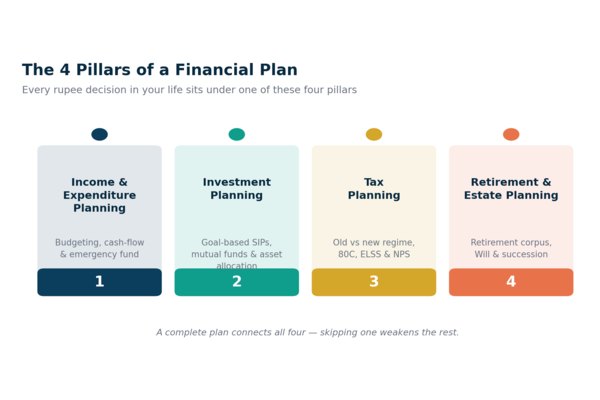
Most people in India start thinking seriously about money for the wrong reason: a market crash, a medical emergency, a friend’s SIP screenshot, or a looming tax deadline. Financial planning in India works best the other way around — as a calm, structured process you control, not a reaction to whatever just happened to your money. This guide walks through exactly that process: how to assess where you stand, set goals that actually mean something, and build a plan across budgeting, insurance, investments, tax, retirement and estate planning. Each section links to a deeper, dedicated guide, so think of this as the map — and the linked guides, plus the full Insights library (/insights) , as the roads. What Financial Planning Actually Means Financial planning is the process of matching your money — what comes in, what goes out, and what you’ve saved — to your goals across time. It is not the same as investing. Investing is one tool inside the plan; financial planning is the plan itself. A financial plan usually needs to answer five questions: Where does my money go every month, and how much is actually left over? What happens to my family financially if I’m unable to earn tomorrow? Am I keeping enough of what I earn after tax, legally? Will I have enough to retire — and to fund goals like my child’s education — before I need the money? What happens to what I’ve built if I’m not around to manage it? Financial planning in India carries a few local realities that make it different from a generic global template: extended family obligations, a large event-driven expense (weddings), limited employer-provided benefits outside government and PSU jobs, healthcare costs that can derail a plan overnight without insurance, and inflation in categories like education that runs well above the headline number. A good plan is built around these realities, not around a textbook. The 4 Pillars of a Financial Plan Every financial decision you make — from your grocery budget to your Will — falls under one of four pillars. Skipping a pillar doesn’t remove the risk; it just leaves it unmanaged. The four pillars of a financial plan: income and expenditure planning, investment planning, tax planning, and retirement and estate planning The four pillars of a financial plan — a complete plan connects all of them. 1. Income & Expenditure Planning. This is the foundation: knowing your cash flow, budgeting deliberately, and holding an emergency fund so a single bad month doesn’t force you into debt. See our budgeting guide (/insights/budgeting-guide-india) and emergency fund guide (/insights/emergency-fund-guide-india) . 2. Investment Planning. Turning savings into goal-linked investments — SIPs, mutual funds, and a sensible asset allocation across equity, debt and gold. See our SIP planning guide (/insights/sip-planning-guide-india) and mutual fund planning guide (/insights/mutual-fund-planning-guide-india) . 3. Tax Planning. Choosing the tax regime that suits you and using eligible deductions legitimately, so you keep more of what you earn without taking on products you don’t need. See our tax planning guide (/insights/tax-planning-guide-india) . 4. Retirement & Estate Planning. Making sure you don’t outlive your money, and that what you’ve built transfers smoothly to the people you intend. See our retirement planning guide (/insights/retirement-planning-guide-india) and estate planning guide (/insights/estate-planning-guide-india) . Insurance planning and child education planning sit across these pillars — insurance is what protects pillars 1 and 4 from being wiped out by a single bad event, and education planning is a goal that draws on pillar 2’s investment discipline. We’ve covered both in dedicated guides: insurance planning (/insights/insurance-planning-guide-india) and child education planning (/insights/child-education-planning-guide-india) . The Financial Planning Process, Step by Step The financial planning process: assess where you stand, set goals, budget and build an emergency fund, protect with insurance, invest with SIPs toward goals, and review every year Financial planning is a repeatable process, not a one-time event. Step 1: Assess where you stand List everything you own (bank balances, investments, property, PF/PPF balances) and everything you owe (credit card dues, loans). The difference is your net worth — your starting line. Alongside this, track your monthly income and expenses for at least one full month, ideally three, to see your real cash flow rather than a guessed one. Step 2: Set clear, timed goals “Save more” is not a goal. “Build a ₹10 lakh emergency and short-term fund in 3 years, and a ₹1 crore retirement corpus by 55” is. Every goal needs three things: a rupee amount, a timeframe, and a monthly contribution derived from the two. Split goals into short-term (0–3 years — emergency fund, a planned expense), medium-term (3–7 years — a car, a home down payment, a child’s school years) and long-term (7+ years — child’s higher education, retirement). Step 3: Budget, then build your emergency fund A budget isn’t a restriction — it’s what tells you how much you can actually commit to every goal without breaking under an unexpected expense. Most people in India do well starting with the 50/30/20 rule : 50% of take-home pay to needs, 30% to wants, 20% to savings and investing, then adjusting the split to their own city and life stage. Once your budget is running, the very next priority — before any investing — is 3 to 12 months of expenses set aside in an easily accessible emergency fund. Our budgeting (/insights/budgeting-guide-india) and emergency fund (/insights/emergency-fund-guide-india) guides walk through both in detail. Step 4: Protect what you’ve already built Insurance is not an investment — it’s the pillar that stops a single event (a death, a hospitalisation, a disability) from undoing everything else in your plan. At minimum, this means term life insurance if anyone depends on your income, and health insurance that isn’t only your employer’s group cover, which typically ends the day you leave the job. Full detail, including how much cover you actually need, is in our insurance planning guide (/insights/insurance-planning-guide-india) . Step 5: Invest with purpose, not with tips Once your emergency fund and insurance are in place, direct your surplus into investments matched to each goal’s timeframe — not into whatever a friend or a forwarded message recommended. For most salaried Indians, this means a Systematic Investment Plan (SIP) into mutual funds, chosen by asset allocation and time horizon rather than by last year’s returns. See our SIP planning (/insights/sip-planning-guide-india) and mutual fund planning (/insights/mutual-fund-planning-guide-india) guides for how to structure this. Step 6: Plan for retirement and what happens after Retirement is the largest goal most people will ever fund, and the one with zero flexibility on timing — you can delay a car purchase, but you can’t easily delay needing income at 60. Alongside this sits estate planning: a Will, updated nominations and a clear record of what you own, so your family isn’t left navigating both grief and paperwork at the same time. See our retirement planning (/insights/retirement-planning-guide-india) and estate planning (/insights/estate-planning-guide-india) guides. Step 7: Review at least once a year Your income changes, your goals change, tax rules change, and markets move. A financial plan reviewed once and never revisited quietly goes stale. Set a fixed date each year — a birthday, the start of the financial year — to check every pillar. A Financial Planning Checklist by Life Stage Life stage Primary focus Typical priorities 20s, early career Foundation Build the budgeting habit, start an emergency fund, buy term insurance early (it’s cheapest now), start a SIP even if small 30s, growing income & family Acceleration Increase SIPs as income rises, buy adequate health & term cover for the family, start a child education fund, use tax-saving investments deliberately 40s, peak earning years Consolidation Maximise retirement contributions, review asset allocation, clear high-cost debt, write or update your Will 50s and approaching retirement Protection Shift a growing share of the portfolio toward debt and stable instruments, stress-test your retirement number, finalise estate planning, review nominations Common Financial Planning Mistakes in India Treating insurance as an investment. Traditional endowment and money-back plans that bundle insurance with poor investment returns remain heavily sold precisely because they pay high commissions. A cleaner approach is usually to buy term insurance for protection and mutual funds for growth, separately. No emergency fund before investing. Starting a SIP is exciting; sitting on idle cash in a savings account is not. But without a buffer, the first job loss or medical bill forces you to break your investments — often at a loss — undoing months of discipline. Chasing last year’s best-performing fund. Past performance is one of the weakest predictors of future returns. Fund selection should follow your goal, time horizon and risk profile, not a leaderboard. Ignoring the cost of inflation on long-term goals. ₹20 lakh for a child’s education today will not buy the same degree in 15 years — education costs in India have historically risen well above general inflation. Planning in today’s rupees for a tomorrow’s-money goal is one of the most common underfunding mistakes. Delaying because “I’ll start when I earn more.” The single biggest lever in long-term investing is time, not amount. A smaller SIP started at 25 comfortably outgrows a larger SIP started at 35 — see the numbers in our SIP planning guide (/insights/sip-planning-guide-india) . No Will, no updated nominee. People spend years building wealth and almost no time deciding who gets it and how quickly. Nomination is not the same as legal ownership, and dying without a Will leaves succession to personal law rather than your intent — details are in our estate planning guide (/insights/estate-planning-guide-india) . How Much Do You Need to Start? None of the above requires wealth to begin. A ₹500 or ₹1,000 monthly SIP, a basic term plan, and a simple expense-tracking habit are a complete starting financial plan for someone early in their career. What compounds over the next 20–30 years is the habit and the structure, not the starting amount. The goal is to get every pillar moving, even modestly, rather than waiting for a “better” time that rarely arrives on its own. DIY Financial Planning vs Working With an Adviser Plenty of financial planning can be done yourself: budgeting, building an emergency fund, buying a straightforward term and health policy, and starting SIPs in a couple of well-chosen diversified funds. Where a SEBI-registered investment adviser or an AMFI-registered mutual fund distributor tends to earn their fee is in the harder parts — building an asset allocation that matches your real risk capacity (not just your risk appetite on a good day), coordinating tax planning with investment planning instead of treating them separately, stress-testing whether your retirement number actually holds up, and simply keeping you invested through the market cycles where most self-directed investors panic and exit at the wrong time. Neither path is “correct” for everyone — it depends on the complexity of your finances, how much time you can commit, and how you behave when markets fall 20%. Where to Go From Here Use this guide as your checklist, and go deeper into each pillar as you work through it: Budgeting: the 50/30/20 rule and practical guide (/insights/budgeting-guide-india) Emergency fund: how much you need and where to keep it (/insights/emergency-fund-guide-india) Insurance planning: term, health and life cover (/insights/insurance-planning-guide-india) Debt management: how to get out of debt faster (/insights/debt-management-guide-india) SIP planning: the complete guide (/insights/sip-planning-guide-india) Mutual fund planning: how to choose the right funds (/insights/mutual-fund-planning-guide-india) Tax planning: old vs new regime for FY 2026-27 (/insights/tax-planning-guide-india) Child education planning: saving for your child’s future (/insights/child-education-planning-guide-india) Retirement planning: how much corpus you need (/insights/retirement-planning-guide-india) Estate planning: Will, nomination and succession (/insights/estate-planning-guide-india) Where to go next, by topic If you want to… Start with Then read Choose a tax regime and plan taxes Tax planning (FY 2026-27) (/insights/tax-planning-guide-india) Tax for salaried families (/insights/tax-planning-salaried-families-india) Build an emergency fund and budget Emergency fund (/insights/emergency-fund-guide-india) Budgeting (/insights/budgeting-guide-india) Protect the family Insurance planning (/insights/insurance-planning-guide-india) Term insurance (/insights/term-insurance-advisor-pune) Invest for goals Mutual fund planning (/insights/mutual-fund-planning-guide-india) SIP planning (/insights/sip-planning-guide-india) Plan for children Child education planning (/insights/child-education-planning-guide-india) Study abroad (/insights/study-abroad-education-planning-india) Plan retirement Retirement corpus (/insights/retirement-planning-guide-india) Retirement income (/insights/retirement-income-strategy-india) Invest ₹50 lakh or more PMS guide (/insights/pms-india) Category II AIFs (/insights/category-ii-aif-guide) Invest abroad Global diversification (/insights/global-diversification-indian-investors) LRS and TCS (/insights/lrs-tcs-overseas-investing-india) Pass wealth on Estate planning (/insights/estate-planning-guide-india) Family offices (/insights/family-offices-india) Browse everything by topic: Financial Planning (/insights/category/financial-planning) , Mutual Funds (/insights/category/mutual-funds) , PMS (/insights/category/pms) , AIF (/insights/category/aif) , Insurance (/insights/category/insurance) , Direct Equity (/insights/category/direct-equity) and IPO & OFS (/insights/category/ipo-ofs) . Frequently Asked Questions What are the 4 pillars of financial planning? The four pillars are income and expenditure planning (budgeting and cash flow), investment planning (SIPs, mutual funds and asset allocation), tax planning (choosing a regime and using eligible deductions), and retirement and estate planning (building a retirement corpus and protecting your family with a Will). A complete financial plan connects all four rather than focusing on just one. How much money do I need to start financial planning? You don’t need a large income to start. Financial planning begins with tracking what you earn and spend, building a small emergency fund, and starting a SIP of even ₹500–₹1,000 a month. The habit and structure matter far more at the start than the amount. What is the first step in financial planning? The first step is assessing where you currently stand — your income, expenses, assets, debts and existing insurance. You cannot set realistic goals or a workable budget until you know your starting point. Should I make a financial plan myself or hire a financial planner? Simple situations — a single income, few dependants, straightforward goals — are often manageable on your own with discipline and the right tools. As your income, family responsibilities, tax complexity or investable surplus grow, a SEBI-registered investment adviser or AMFI-registered mutual fund distributor can help you avoid costly mistakes and stay disciplined through market cycles. How often should I review my financial plan? Review your financial plan at least once a year, and immediately after any major life event — a new job, marriage, a child, buying property, a loan, or a health event. Markets, income and goals all change, and your plan needs to change with them. Want a plan built around your actual numbers, not a generic template? This guide gives you the framework — a personalised plan accounts for your income, goals, existing investments and risk profile. Talk to Money n Wealth (/contact) for a free portfolio and financial plan review. This article is for general educational purposes only and does not constitute investment, tax or legal advice. Mutual fund investments are subject to market risks; please read all scheme-related documents carefully. Figures and examples are illustrative. Please consult a qualified financial adviser before making investment decisions specific to your situation. Money n Wealth (Predics Fintech Services Pvt Ltd) is an AMFI-registered Mutual Fund Distributor (ARN-121995) and APMI-registered PMS Distributor (APRN07444); it is not a SEBI-registered investment adviser and may earn distribution commission on investments made through it.