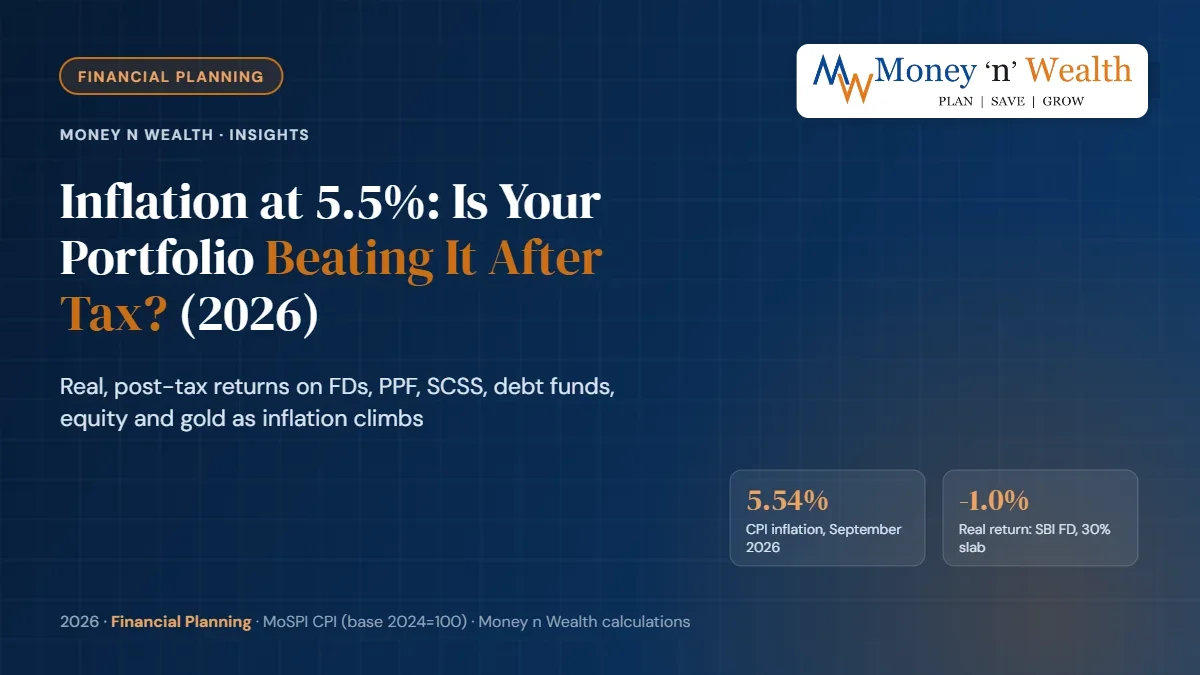
Inflation at 5.5%: Is Your Portfolio Beating It After Tax? (2026)
Last updated: 13 October 2026
Quick answer: Your real return after inflation and tax is roughly your post-tax yield minus inflation. With CPI at 5.54% in September 2026, a 30%-slab investor in a 6.45% bank FD earns about -1% a year in real terms. Tax-free PPF (+1.5%) and EPF (+2.6%) stay ahead. Over long periods, only growth assets such as equity have reliably delivered meaningful real returns.
Last updated: 13 October 2026 Quick answer: Your real return after inflation and tax is roughly your post-tax yield minus inflation. With CPI at 5.54% in September 2026, a 30%-slab investor in a 6.45% bank FD earns about -1% a year in real terms. Tax-free PPF (+1.5%) and EPF (+2.6%) stay ahead. Over long periods, only growth assets such as equity have reliably delivered meaningful real returns. Key takeaways Inflation is back: CPI rose from 2.74% in January 2026 to 5.54% in September, a 23-month high. FDs lose for high earners: at the 30% slab, a 6.45% FD yields 4.44% post-tax, below inflation. Tax-free wins: PPF (7.1%) and EPF (8.25%) are among the few safe products still ahead of inflation. Equity has been patchy lately: Nifty 50 TRI returned 6.38% a year over five years to September 2026, only about 1.5% above inflation. Long-run average: CPI averaged about 4.8% a year from FY15 to FY26; plan with 5-6%, not last year's 2%. For most of 2025-26, Indian savers could ignore inflation. CPI averaged just 2.1% that year, and a plain fixed deposit looked like a decent deal. That window has closed. The Ministry of Statistics (MoSPI) (https://www.mospi.gov.in/uploads/latestreleasesfiles/1789382372004-Press%20Release%20of%20CPI%20for%20August%202026.pdf) data shows retail inflation has climbed every single month of 2026, and the September print released on 12 October came in at 5.54%. Food inflation hit 7.74%. The Reserve Bank responded on 7 October by raising the repo rate to 5.50%, its first hike since February 2023 (our repo rate hike explainer (/insights/rbi-repo-rate-hike-october-2026-emi-fd-debt-funds) covers what that means for EMIs and deposits). The question for your money is simpler: after tax, are your investments actually growing your purchasing power, or quietly shrinking it? This guide works out the real return after inflation and tax for each major Indian asset, shows what history says about inflation, and gives a practical checklist to inflation-proof a portfolio. What is a real return, and how do you calculate it? A real return is the growth in your purchasing power: what your money earns after removing the effect of rising prices. A 7% return when prices rise 5% leaves you only about 2% richer in terms of what you can buy. The quick approximation is nominal return minus inflation . The exact version, known as the Fisher equation, is: Real return = (1 + nominal return) ÷ (1 + inflation) − 1 For Indian investors, one more step matters more than the formula: tax comes first. Interest on FDs, post-office deposits and most debt funds is added to your income and taxed at your slab rate. So the right sequence is: Start with the stated rate (say, 6.45% on an FD). Subtract tax at your slab plus 4% cess (30% slab: 6.45% × (1 − 0.312) = 4.44%). Adjust for inflation: (1.0444 ÷ 1.0554) − 1 = −1.04% . That negative number means a ₹10 lakh FD would buy about ₹10,400 less in goods and services after one year, even though the passbook shows more rupees. Our guide on XIRR vs CAGR vs absolute return (/insights/xirr-vs-cagr-vs-absolute-return) explains how to measure the nominal return correctly before you adjust it. How high is inflation in India right now? As of October 2026, the latest All-India CPI inflation is 5.54% for September 2026 (provisional), up from 4.83% in August and 4.45% in July. Rural inflation was 6.08% and urban 4.88%. The index now uses a 2024 base year, introduced in February 2026. Line chart of India CPI inflation 2026 rising from 2.74% in January to 5.54% in September, above the 4% target The RBI's October policy projects FY27 CPI at 5.2%, with core inflation around 4.4%. The Government has retained the inflation target at 4%, with a tolerance band of 2% to 6%, for the five years from 1 April 2026 to 31 March 2031. Why the headline may understate your personal inflation Two quirks in the August 2026 CPI data matter for households. First, gold jewellery prices were up 35.5% year on year and silver jewellery over 100%, which pushed up the "personal care and miscellaneous" group. Second, the official health and education indices rose only 1.3% and 3.7%. Many urban families experience far higher increases in hospital bills and school fees than these averages suggest. Consulting firm Aon's 2026 medical trend report (https://www.aon.com/apac/in-the-press/asia-newsroom/2025/india-outpaces-global-average-with-2026-medical-trend-at-11-5-percent-aon-reports) projects India's employer health-cost inflation at 11.5% for 2026, against a 9.8% global average. For financial planning, assume your own inflation is higher than CPI if you are a metro family with school-going children or ageing parents. Which investments beat inflation after tax in 2026? The table below uses current rates (as of October 2026) and September's 5.54% inflation. Interest-bearing products are taxed at slab plus 4% cess; we ignore surcharge for simplicity. The equity row is an illustrative 11% annual return held for 10 years, with 12.5% long-term capital gains tax charged on the full gain (the ₹1.25 lakh annual exemption would make it slightly better). Investment (rate) No tax / 0% slab 10% slab 20% slab 30% slab Savings account (2.5%) −2.88% −3.13% −3.37% −3.62% SBI FD, 2-3 years (6.45%) +0.86% +0.23% −0.41% −1.04% Post office 5-yr TD (7.5%) +1.86% +1.12% +0.38% −0.36% SCSS (8.2%) +2.52% +1.71% +0.90% +0.10% Debt fund (7%, illustrative) +1.38% +0.69% 0.00% −0.69% PPF (7.1%, tax-free) +1.48% +1.48% +1.48% +1.48% EPF (8.25%, tax-free*) +2.57% +2.57% +2.57% +2.57% Equity fund (11%, illustrative, 10 yrs) +4.25% +4.25% +4.25% +4.25% *EPF interest on employee contributions above ₹2.5 lakh a year is taxable. Small savings rates are for October-December 2026; SBI FD rate is the general public card rate in October 2026. Real return = (1 + post-tax return) ÷ 1.0554 − 1. Bar chart of real return after inflation and tax for savings, FD, debt fund, post office deposit, SCSS, PPF, EPF and equity in India 2026 Bank FDs and post-office deposits For investors with low or no taxable income, FDs and the post-office time deposit still deliver a small positive real return. For anyone in the 20% or 30% slab, the after-tax yield falls below inflation. Senior citizens earn an extra 0.50% on most bank FDs, which helps, but the slab problem remains. If you are weighing whether to lock in now, read Lock in FDs now or wait for December's policy (/insights/lock-in-fd-now-or-wait-rate-hike-2026) . PPF, EPF and SCSS Tax-free compounding is the quiet hero of an inflationary year. PPF (/insights/ppf-complete-guide) at 7.1% and EPF at 8.25% (rate for 2025-26) stay ahead of 5.5% inflation for every taxpayer. SCSS at 8.2% beats inflation for most seniors, but the interest is taxable, so the edge narrows to nearly zero in the 30% slab. See the full small savings rates for October-December 2026 (/insights/small-savings-interest-rates-oct-dec-2026) . Debt mutual funds Since 1 April 2023, gains on debt funds bought after that date are taxed at slab rates regardless of holding period. That removed the indexation advantage that once helped debt funds beat FDs after inflation. What debt funds still offer is tax deferral (you pay only on redemption) and flexibility. Rising rates also cause short-term mark-to-market losses on longer-duration funds; our guide to debt funds in a rising-rate cycle (/insights/debt-funds-rising-interest-rates-2026) explains which categories to prefer now. Equity: the long-run inflation beater, with recent caveats Equity is a claim on company earnings, and companies can usually pass higher costs to customers over time. That makes it the most dependable long-run hedge. But it is not a short-run hedge. According to the NSE Nifty 50 factsheet (https://archives.nseindia.com/content/indices/ind_nifty50.pdf) for 30 September 2026, the Nifty 50 Total Return Index returned −7.09% over one year and 6.38% a year over five years. Against average CPI of roughly 4.8% over that period, the five-year real return was only about 1.5% a year. Since its inception in 1995, the same index has compounded at 12.12% a year, comfortably ahead of inflation. The lesson: equity beats inflation over decades, not every five-year window. Hold enough safe assets that you never have to sell equity during a bad patch. Gold Gold has been the standout inflation story of the past year. The 24-carat price was roughly ₹1.23 lakh per 10 grams in major cities on 13 October 2025 and about ₹1.51 lakh on 10 October 2026, a rise of roughly 23%. Over very long periods the record is more modest. The UBS Global Investment Returns Yearbook 2026 (https://www.ubs.com/global/en/media/display-page-ndp/en-20260303-global-investment-returns-yearbook-2026.html) estimates gold's real return in US dollars at about 1.3% a year since 1900, and notes gold fell in 13 of the 28 years when US inflation exceeded 3%. For Indians, rupee depreciation has added to gold's returns. Treat it as a 5-15% diversifier, not a core growth asset. Our gold vs silver guide (/insights/gold-vs-silver-investment-india) covers the trade-offs. What does India's inflation history tell us? Annual CPI averages over the past 12 financial years show why planning on last year's number is risky. Inflation was 6.7% in FY23, then fell steadily to 2.1% in FY26, the lowest in the series. The 12-year average from FY15 to FY26 works out to about 4.8% a year. Bar chart of India CPI inflation by financial year from FY15 to FY26, averaging about 4.8% In compounding terms, a basket of goods that cost ₹1 lakh in 2013-14 cost about ₹1.75 lakh by 2025-26. Put the other way, ₹1 lakh held in cash since then now buys only what ₹57,000 did. For long-term goals, we suggest using 5-6% for general inflation, 8-10% for education and 10% or more for medical costs. Our companion piece, What will ₹1 crore be worth in 20 years? (/insights/inflation-value-of-1-crore-future) , has the full purchasing-power tables. How do other countries protect savers from inflation? Several countries offer government bonds whose principal rises with consumer prices: US Treasury Inflation-Protected Securities (TIPS) and I-Bonds, UK index-linked gilts, and similar issues in Canada and Australia. Retirees in those markets can lock in a guaranteed real return. India's experiment with Inflation Indexed Bonds in 2013-14 attracted little retail interest and has not been repeated. The closest current substitutes are RBI Floating Rate Savings Bonds, whose coupon is linked to the NSC rate plus 0.35%, and the government's quarterly reset of small savings rates. Neither adjusts directly for CPI. That puts more of the burden on Indian investors to build inflation protection through asset allocation. The global long-run evidence is consistent. The UBS Yearbook finds that US equities delivered about 6.6% a year above inflation from 1900 to 2025, bonds about 1.6% and Treasury bills about 0.5%. Cash-like assets roughly preserve value; only growth assets meaningfully increase it. Comparison of Indian assets that lag inflation, keep pace with inflation, and can beat inflation over the long run How do you inflation-proof your portfolio? You cannot control CPI, but you can control how exposed your goals are to it. A practical checklist: Calculate your personal inflation. Compare this year's household spending, category by category, with last year's. School fees, rent and medical costs often run well above CPI. Match assets to time horizon. Money needed within three years belongs in FDs, liquid or short-term debt funds, where inflation loss is small and certainty matters. Money for goals seven or more years away needs a meaningful equity allocation. Use tax-free wrappers first. Fill PPF (up to ₹1.5 lakh a year) and keep EPF/VPF contributions; these beat inflation without needing market risk. Cut idle cash. Keep an emergency fund (/insights/emergency-fund-guide-india) of six months of expenses, but move surplus savings-account balances to a sweep FD or liquid fund. Step up investments with income. A SIP that stays flat loses real value every year; a 10% annual step-up SIP (/insights/step-up-sip-calculator-guide) keeps contributions growing ahead of prices. Review annually. Rebalance when equity drifts more than 5 percentage points from target, and re-test goals with current inflation assumptions using our goal and retirement calculators (/tools) . A worked example: retired couple in Pune Consider a retired couple with ₹60 lakh in bank FDs at 7% (senior rate) and pension income placing them in the 20% slab. Post-tax yield is about 5.54%, exactly matching September's inflation. Their real return is zero, and every rupee they withdraw for expenses shrinks the corpus in real terms. A more resilient structure might put ₹30 lakh in SCSS (the per-person limit allows ₹30 lakh each), keep two years of expenses in FDs and liquid funds, and place the balance in a conservative or balanced hybrid fund for growth. That is a framework, not a prescription; the right mix depends on health, other income and risk tolerance. Our guide on FD vs SCSS vs RBI Floating Rate Bonds (/insights/senior-citizen-fd-vs-scss-vs-rbi-floating-rate-bonds) compares the income options. Is lifestyle inflation a bigger risk than CPI? For many salaried professionals, the bigger threat is not the 5.5% CPI figure but their own spending growing at 10-12% a year as income rises: a bigger flat, a second car, foreign holidays, premium schools. Lifestyle inflation is not bad in itself, but it raises the corpus you need for retirement and delays financial independence. A simple discipline: whenever your salary rises, direct at least half of the increase to investments before upgrading spending. If expenses grow faster than investments for several years, revisit your retirement corpus estimate (/insights/retirement-planning-guide-india) . Related reading What Will ₹1 Crore Be Worth in 20 Years? (/insights/inflation-value-of-1-crore-future) RBI Hikes Repo Rate to 5.50%: EMIs, FDs and Debt Funds (/insights/rbi-repo-rate-hike-october-2026-emi-fd-debt-funds) FD vs Debt Mutual Funds: Post-Tax Returns (/insights/fixed-deposit-vs-debt-mutual-funds-which-gives-better-post-tax-returns-now) Debt Funds in a Rising-Rate Cycle (/insights/debt-funds-rising-interest-rates-2026) PPF vs ELSS vs SIP (/insights/ppf-vs-elss-vs-sip-which-tax-saving-investment-actually-wins-in-2026) Frequently Asked Questions What is the current inflation rate in India? All-India CPI inflation was 5.54% in September 2026 (provisional), released by MoSPI on 12 October 2026. It was 4.83% in August and has risen every month since January's 2.74%. Food inflation was 7.74%. The RBI projects average CPI inflation of 5.2% for FY27. The October 2026 figure is due on 12 November 2026. Do fixed deposits beat inflation in 2026? Only for investors with low tax rates. At 5.54% inflation, a 6.45% FD gives a real return of about +0.9% if your income is below the taxable limit, but about −1% in the 30% slab. Senior citizens get roughly 0.50% more, which helps but does not fully close the gap for higher-slab retirees. Is PPF still a good hedge against inflation? Yes, for its safety level. At 7.1% tax-free, PPF delivers roughly 1.5% a year above 5.54% inflation, regardless of your tax slab, and is fully government-backed. The limit is ₹1.5 lakh a year and the 15-year lock-in, so it suits long-term debt allocation rather than emergency money. How do I calculate real return after inflation and tax? First reduce the nominal return for tax: multiply by (1 − slab rate × 1.04). Then apply the Fisher equation: real return = (1 + post-tax return) ÷ (1 + inflation) − 1. For example, 7.5% at the 20% slab becomes 5.94% post-tax, and (1.0594 ÷ 1.0554) − 1 gives a real return of about 0.4%. Does equity always beat inflation in India? Over long periods it has, but not in every window. The Nifty 50 TRI compounded at 12.12% a year since 1995, well above inflation, yet returned only 6.38% a year over the five years to September 2026, about 1.5% above inflation. Equity suits goals at least seven years away, held through downturns. What inflation rate should I use for financial planning? CPI averaged about 4.8% a year from FY15 to FY26, with a range of 2.1% to 6.7%. A prudent planning assumption is 6% for general household expenses, 8-10% for education and 10% or more for healthcare. Using last year's unusually low 2.1% would seriously understate your future needs. Is gold a good inflation hedge? Partly. Indian gold prices rose about 23% in the year to October 2026, far above inflation, but gold can stagnate for years. Global data from the UBS Yearbook shows gold's long-run real return near 1.3% a year in dollars. In India it has also benefited from rupee depreciation. A 5-15% allocation is a common diversification range. Sources: MoSPI CPI release, August 2026 (https://www.mospi.gov.in/uploads/latestreleasesfiles/1789382372004-Press%20Release%20of%20CPI%20for%20August%202026.pdf) ; PIB/MoSPI CPI release, March 2026 (https://static.pib.gov.in/WriteReadData/specificdocs/documents/2026/apr/doc2026413845701.pdf) ; Economic Survey 2025-26, Chapter 5 (https://www.indiabudget.gov.in/economicsurvey/doc/eschapter/echap05.pdf) ; NSE Nifty 50 factsheet, 30 Sep 2026 (https://archives.nseindia.com/content/indices/ind_nifty50.pdf) ; Business Today, small savings rates Q3 FY27 (https://www.businesstoday.in/personal-finance/story/small-savings-scheme-interest-rates-unchanged-for-q3-fy27-check-ppf-scss-ssy-rates-558892-2026-09-30) ; Aon Global Medical Trend Rates 2026 (https://www.aon.com/apac/in-the-press/asia-newsroom/2025/india-outpaces-global-average-with-2026-medical-trend-at-11-5-percent-aon-reports) ; UBS Global Investment Returns Yearbook 2026 (https://www.ubs.com/global/en/media/display-page-ndp/en-20260303-global-investment-returns-yearbook-2026.html) . September 2026 CPI as reported on 12 October 2026 (provisional). Worked examples are Money n Wealth calculations. Is your portfolio keeping up with your real cost of living? Your personal inflation, tax slab and goals decide the right mix, and a generic table cannot. Talk to Money n Wealth (/contact) for a free portfolio review. This article is for general educational purposes only and does not constitute financial advice. Figures and examples are illustrative. Please consult a qualified financial adviser for guidance specific to your situation. Money n Wealth (Predics Fintech Services Pvt Ltd) is an AMFI-registered Mutual Fund Distributor (ARN-121995) and APMI-registered PMS Distributor (APRN07444); it is not a SEBI-registered investment adviser and may earn distribution commission on investments made through it.
Frequently Asked Questions
What is the current inflation rate in India?
All-India CPI inflation was 5.54% in September 2026 (provisional), released by MoSPI on 12 October 2026. It was 4.83% in August and has risen every month since January's 2.74%. Food inflation was 7.74%. The RBI projects average CPI inflation of 5.2% for FY27. The October 2026 figure is due on 12 November 2026.
Do fixed deposits beat inflation in 2026?
Only for investors with low tax rates. At 5.54% inflation, a 6.45% FD gives a real return of about +0.9% if your income is below the taxable limit, but about −1% in the 30% slab. Senior citizens get roughly 0.50% more, which helps but does not fully close the gap for higher-slab retirees.
Is PPF still a good hedge against inflation?
Yes, for its safety level. At 7.1% tax-free, PPF delivers roughly 1.5% a year above 5.54% inflation, regardless of your tax slab, and is fully government-backed. The limit is ₹1.5 lakh a year and the 15-year lock-in, so it suits long-term debt allocation rather than emergency money.
How do I calculate real return after inflation and tax?
First reduce the nominal return for tax: multiply by (1 − slab rate × 1.04). Then apply the Fisher equation: real return = (1 + post-tax return) ÷ (1 + inflation) − 1. For example, 7.5% at the 20% slab becomes 5.94% post-tax, and (1.0594 ÷ 1.0554) − 1 gives a real return of about 0.4%.
Does equity always beat inflation in India?
Over long periods it has, but not in every window. The Nifty 50 TRI compounded at 12.12% a year since 1995, well above inflation, yet returned only 6.38% a year over the five years to September 2026, about 1.5% above inflation. Equity suits goals at least seven years away, held through downturns.
What inflation rate should I use for financial planning?
CPI averaged about 4.8% a year from FY15 to FY26, with a range of 2.1% to 6.7%. A prudent planning assumption is 6% for general household expenses, 8-10% for education and 10% or more for healthcare. Using last year's unusually low 2.1% would seriously understate your future needs.
Is gold a good inflation hedge?
Partly. Indian gold prices rose about 23% in the year to October 2026, far above inflation, but gold can stagnate for years. Global data from the UBS Yearbook shows gold's long-run real return near 1.3% a year in dollars. In India it has also benefited from rupee depreciation. A 5-15% allocation is a common diversification range.
Is your portfolio keeping up with your real cost of living?
Your personal inflation, tax slab and goals decide the right mix, and a generic table cannot. Talk to Money n Wealth for a free portfolio review.