Mutual Fund Planning in India: How to Choose the Right Funds (2026 Guide)
India’s mutual fund industry crossed ₹82 lakh crore in assets under management by mid-2026, and equity mutual funds have now recorded over five years of continuous positive monthly inflows. Mutual funds have become the default vehicle most Indians use to invest in markets — but “buy a mutual fund” isn’t a plan. Mutual fund planning is about matching the right fund category to the right goal, and building a portfolio that doesn’t quietly duplicate itself.
A mutual fund pools money from many investors and is managed by an AMC (asset management company) that invests it according to the scheme’s stated mandate — say, large-cap Indian equities, or short-duration debt. Your money buys units of the fund at that day’s NAV (net asset value per unit); as the fund’s underlying investments grow (or fall), the NAV moves with them. The AMC charges an annual expense ratio — a small percentage of your investment — to cover fund management and, in regular plans, distributor commission.
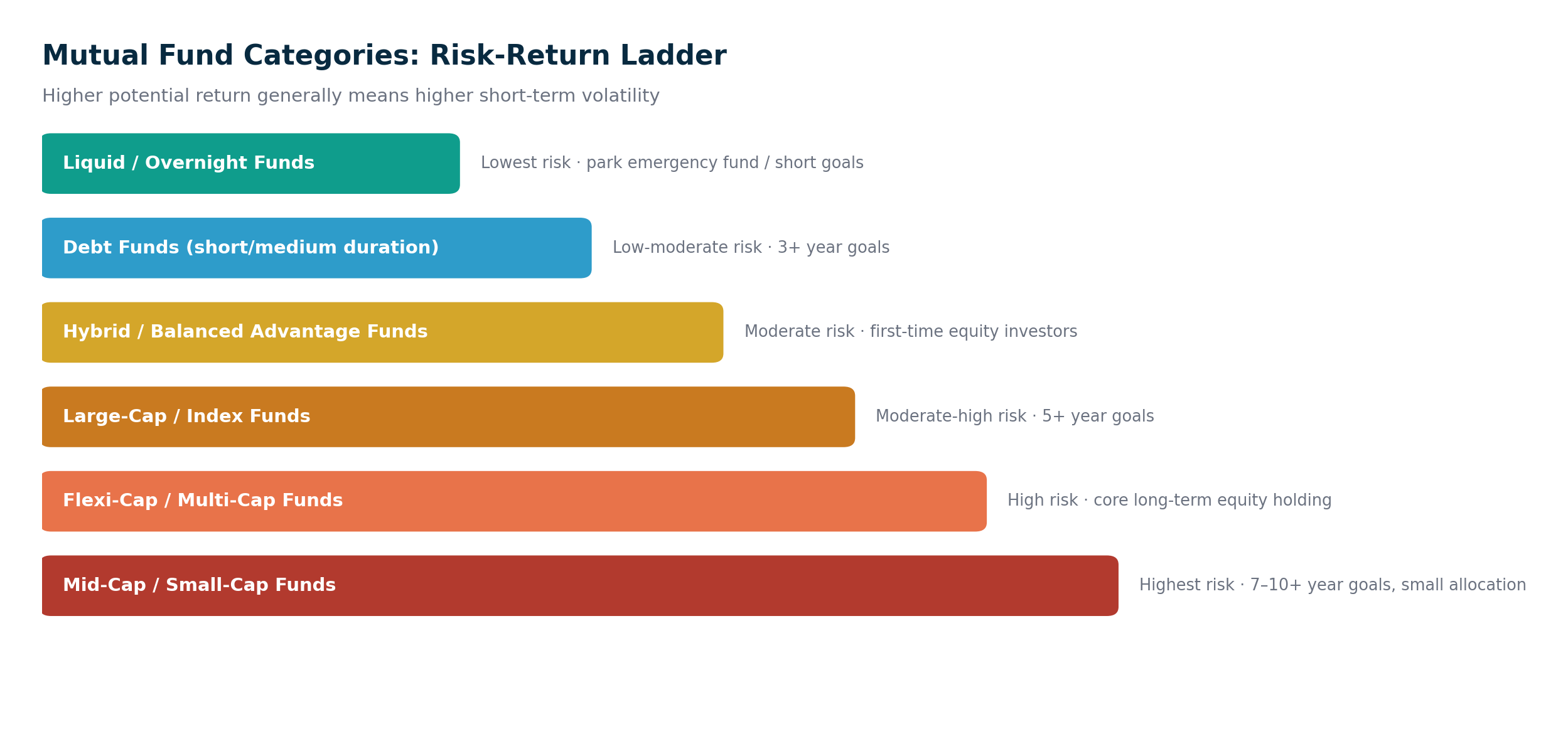
India’s mutual fund industry crossed ₹82 lakh crore in assets under management by mid-2026 , and equity mutual funds have now recorded over five years of continuous positive monthly inflows. Mutual funds have become the default vehicle most Indians use to invest in markets — but “buy a mutual fund” isn’t a plan. Mutual fund planning is about matching the right fund category to the right goal, and building a portfolio that doesn’t quietly duplicate itself. How a Mutual Fund Works, Briefly A mutual fund pools money from many investors and is managed by an AMC (asset management company) that invests it according to the scheme’s stated mandate — say, large-cap Indian equities, or short-duration debt. Your money buys units of the fund at that day’s NAV (net asset value per unit); as the fund’s underlying investments grow (or fall), the NAV moves with them. The AMC charges an annual expense ratio — a small percentage of your investment — to cover fund management and, in regular plans, distributor commission. Types of Mutual Funds: The Risk-Return Ladder Diagram of mutual fund categories from lowest to highest risk: liquid, debt, hybrid, large-cap/index, flexi-cap/multi-cap, mid-cap/small-cap Higher potential return generally comes with higher short-term volatility — match the category to your goal’s timeline, not just its return. Liquid / overnight funds. The lowest-risk category, designed for money you might need within days — a natural home for part of your emergency fund (/insights/emergency-fund-guide-india) , not a long-term holding. Debt funds (short/medium duration). Invest in bonds and fixed-income instruments; lower volatility than equity, suited to 3+ year goals where capital protection matters more than high growth. Note that since April 2023, gains on debt mutual funds are taxed at your income slab rate regardless of holding period — see our tax planning guide (/insights/tax-planning-guide-india) . Hybrid / balanced advantage funds. Blend equity and debt, automatically adjusting the mix based on market valuations in some variants. A reasonable entry point for first-time equity investors who want a smoother ride than pure equity funds. Large-cap and index funds. Invest in India’s largest, most established companies (or simply track an index like the Nifty 50). Comparatively more stable among equity categories, suited to 5+ year goals. Flexi-cap and multi-cap funds. Invest across large, mid and small companies without a fixed mandate on the split (flexi-cap) or with a mandated minimum in each (multi-cap). Often used as the core, long-term holding in an equity portfolio. Mid-cap and small-cap funds. The highest-risk category among mainstream equity funds, with correspondingly higher long-term return potential and sharper short-term swings. Best suited to 7–10+ year goals and typically a smaller portion of a portfolio, not the core. ELSS (Equity Linked Savings Scheme). Equity funds that additionally qualify for a Section 80C tax deduction (up to ₹1.5 lakh) under the old tax regime, with a mandatory 3-year lock-in — the shortest lock-in of any 80C investment option. Covered in detail in our tax planning guide (/insights/tax-planning-guide-india) . Mutual Fund Categories at a Glance SEBI defines each category by what the fund must hold. Use this table to match a category to your goal's horizon, then read the detailed guide for each. Category SEBI rule (summary) Typical horizon Tax treatment Large cap (/insights/large-cap-funds) At least 80% in the 100 largest listed companies 5+ years Equity Mid cap (/insights/mid-cap-funds) At least 65% in companies ranked 101–250 by market cap 7+ years Equity Small cap (/insights/small-cap-funds) At least 65% in companies ranked 251 and below 7–10 years Equity Flexi cap (/insights/flexi-cap-funds) At least 65% in equity, any market cap, no fixed split 5+ years Equity Multi cap (/insights/multi-cap-funds) At least 25% each in large, mid and small caps 5–7 years Equity Index funds (/insights/index-funds) Replicate an index such as the Nifty 50 5+ years Equity (for equity indices) Aggressive hybrid (/insights/aggressive-hybrid) 65–80% equity, 20–35% debt 3–5 years Equity Balanced advantage (/insights/balanced-advantage) Equity–debt mix shifts dynamically with a model 3–5 years Usually equity (check the scheme) Conservative hybrid (/insights/conservative-hybrid) 10–25% equity, 75–90% debt 2–3 years Slab rate Arbitrage (/insights/arbitrage-funds) Hedged cash–futures positions, at least 65% equity 3–12 months Equity Retirement funds (/insights/retirement-funds) Lock-in of 5 years or until retirement age, whichever is earlier Long term Depends on equity share Children's funds (/insights/childrens-funds) Lock-in of 5 years or until the child turns 18, whichever is earlier Long term Depends on equity share Long duration (/insights/long-duration-funds) Portfolio Macaulay duration above 7 years 5+ years (rate view) Slab rate Ultra short duration (/insights/ultra-short-funds) Macaulay duration of 3–6 months 3–6 months Slab rate Overnight and liquid (/insights/overnight-liquid-funds) Securities maturing in 1 day (overnight) or up to 91 days (liquid) Days to 3 months Slab rate Gold ETFs (/insights/gold-etf) Physical gold of specified purity Long term (diversifier) 12.5% LTCG after 12 months; slab rate otherwise Silver ETFs (/insights/silver-etf) Physical silver of specified purity Long term (diversifier) 12.5% LTCG after 12 months; slab rate otherwise "Equity" tax treatment: short-term gains (held up to 12 months) taxed at 20%; long-term gains taxed at 12.5% above ₹1.25 lakh a year. "Slab rate": gains on debt-oriented units bought on or after 1 April 2023 are taxed at your income-tax slab regardless of holding period. Funds with 35–65% equity follow separate rules (12.5% LTCG after 24 months). Rules as applicable for FY 2026-27; check each scheme's documents. Direct vs Regular Plans Every mutual fund scheme is available in two plan types. Direct plans are bought straight from the AMC (via its website, app, or a direct platform) with no distributor commission built in, resulting in a lower expense ratio and a small but compounding return advantage over time. Regular plans are bought through a distributor or adviser and include a trail commission in the expense ratio, which compensates the distributor for fund selection help, service, and ongoing support. Neither is universally “better” — a direct plan saves cost but assumes you’re comfortable researching, selecting, and monitoring funds yourself; a regular plan costs a little more but includes ongoing guidance, which many investors find valuable enough to justify the difference, particularly through market volatility where behavioural mistakes (like panic-selling) often cost far more than the expense ratio gap ever would. Building a Portfolio: Asset Allocation by Age Stacked bar chart showing illustrative equity, debt and gold/cash allocation shifting from 80/15/5 in your 20s to 30/55/15 by your 60s Illustrative only — your actual allocation should reflect your goals and risk capacity, not age alone. A common (though not universal) principle is to hold a higher equity allocation earlier in life, when you have more years to recover from short-term volatility, and gradually shift toward debt and stable instruments as goals approach and the time to recover from a downturn shrinks. The chart above shows one illustrative glide path — the right allocation for you depends on your specific goals’ timelines at least as much as your age, so a 45-year-old investing purely for a goal 20 years away can reasonably hold more equity than this generic curve suggests. How to Choose a Fund: A Practical Process Start from the goal, not the fund. A goal 3 years away needs a very different fund category than one 15 years away — see our child education (/insights/child-education-planning-guide-india) and retirement planning (/insights/retirement-planning-guide-india) guides for goal-specific examples. Shortlist by category first, fund second. Decide whether you need large-cap, flexi-cap, mid-cap, debt, or hybrid exposure based on the goal and risk tolerance, then compare funds within that category — comparing an equity fund to a debt fund’s returns is not a meaningful comparison. Look at consistency across market cycles, not a single year’s return. A fund that performed reasonably across both up and down years is generally a more reliable signal than one with an outstanding single year followed by mediocre ones. Check the expense ratio , especially for direct plans in the same category — lower isn’t automatically better if it comes with a materially different mandate, but among similar funds it’s a real, guaranteed drag on returns worth comparing. Check fund size and manager tenure. Extremely small or new funds carry less track record to evaluate; extremely large funds in the small-cap category can face liquidity constraints. Manager changes are worth noting, though not automatically disqualifying. Avoid over-diversification. Beyond roughly 4–6 well-chosen funds across complementary categories, additional funds typically overlap in holdings rather than genuinely diversifying risk — more funds is not the same as more diversification. Growth vs IDCW (Dividend) Option Most funds offer a Growth option , where all gains are reinvested and reflected in a rising NAV, and an IDCW (Income Distribution cum Capital Withdrawal, formerly “dividend”) option , which periodically pays out a portion of gains as cash, reducing the NAV accordingly. For long-term wealth building, the Growth option is generally preferred, since it keeps the full amount compounding rather than periodically withdrawing part of it (and each IDCW payout is also taxable in the year received). Common Mutual Fund Mistakes Chasing last year’s top performer. Covered in our SIP planning guide (/insights/sip-planning-guide-india) — past performance, especially over a single year, is a weak predictor of future results. Over-diversifying across too many funds. More funds beyond 4–6 well-chosen ones usually just means more overlapping holdings, more paperwork, and no meaningful reduction in risk. Ignoring the fund’s actual mandate. A “flexi-cap” fund that has drifted heavily into mid- and small-caps behaves differently than its category name suggests — read the portfolio composition, not just the category label. Redeeming during a downturn out of panic. Reacting to short-term volatility in a fund meant for a long-term goal tends to lock in losses right before a recovery. Not accounting for taxation when planning withdrawals. How and when you redeem affects your tax outcome — see our tax planning guide (/insights/tax-planning-guide-india) for current capital gains rules on equity and debt funds. Where Mutual Fund Planning Fits in Your Plan Mutual funds are the vehicle; SIPs are how you invest into them regularly; your goals (retirement, a child’s education, general wealth) determine which categories and how much. See our SIP planning guide (/insights/sip-planning-guide-india) for the investing mechanism, and the complete financial planning guide (/insights/financial-planning-in-india-complete-guide) for how this pillar connects to the rest of your plan. Frequently Asked Questions What are the main types of mutual funds in India? Broadly: equity funds (large-cap, mid-cap, small-cap, flexi-cap, multi-cap), debt funds (short and medium duration), hybrid/balanced funds, liquid/overnight funds, index funds, and ELSS (tax-saving equity funds). Each sits at a different point on the risk-return spectrum and suits different goals and time horizons. What is the difference between direct and regular mutual fund plans? Direct plans are bought straight from the AMC (asset management company) with no distributor commission, so they carry a lower expense ratio and slightly higher long-term returns than regular plans of the same scheme. Regular plans include a distributor’s trail commission built into the expense ratio, which pays for the advice, service and support the distributor provides. How many mutual funds should I have in my portfolio? For most individual investors, 4–6 well-chosen funds across a couple of categories (say, a large-cap or flexi-cap fund, a mid/small-cap fund, and a debt or hybrid fund) provide adequate diversification. Owning 15–20 funds usually just creates overlapping holdings without meaningfully reducing risk. Should I choose mutual funds based on past returns? Past returns are a weak predictor of future performance, especially over short periods. A more reliable approach looks at consistency across market cycles, the fund’s mandate matching your goal, expense ratio, and the fund house’s track record, rather than chasing whichever fund topped last year’s chart. Want a fund portfolio actually built around your goals? The right categories, number of funds and allocation depend on your goals, timeline and risk capacity — not a generic model portfolio. Talk to Money n Wealth (/contact) for a free portfolio review. This article is for general educational purposes only and does not constitute investment advice. Mutual fund investments are subject to market risks; please read all scheme-related documents carefully before investing. This is not a recommendation to buy or sell any specific scheme. Please consult a qualified financial adviser before investing. Money n Wealth (Predics Fintech Services Pvt Ltd) is an AMFI-registered Mutual Fund Distributor (ARN-121995) and APMI-registered PMS Distributor (APRN07444); it is not a SEBI-registered investment adviser and may earn distribution commission on investments made through it.