Mutual Fund Transmission After Death: Documents and Limits (2026)
Last updated: 13 October 2026
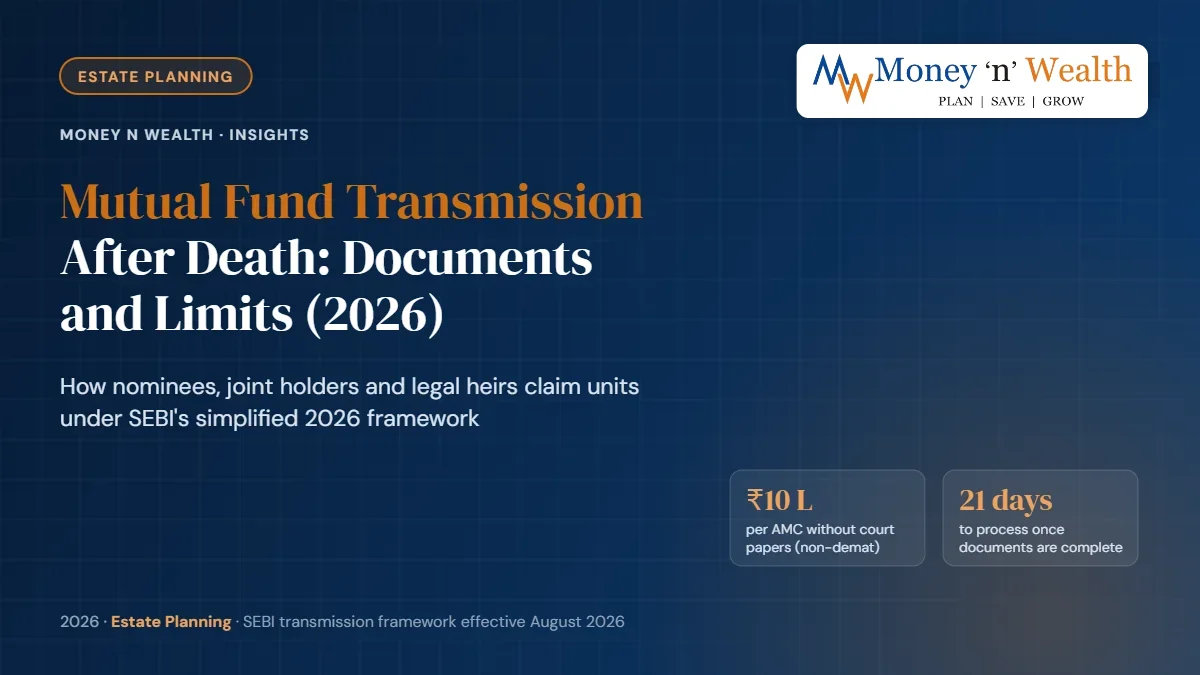
Quick answer: Mutual fund transmission is the transfer of a deceased investor's units to a surviving joint holder, nominee or legal heir. Joint holders and nominees need only a request form, death certificate, KYC and bank proof. Without a nominee, heirs need an indemnity and an affidavit-cum-NOC up to ₹10 lakh per AMC, and a will, heirship certificate or court document above that. AMCs must finish within 21 days of complete papers.
Last updated: 13 October 2026 Quick answer: Mutual fund transmission is the transfer of a deceased investor's units to a surviving joint holder, nominee or legal heir. Joint holders and nominees need only a request form, death certificate, KYC and bank proof. Without a nominee, heirs need an indemnity and an affidavit-cum-NOC up to ₹10 lakh per AMC, and a will, heirship certificate or court document above that. AMCs must finish within 21 days of complete papers. Key takeaways New framework: SEBI's circular of 23 July 2026 standardised transmission across AMCs, companies and depositories from about 22 August 2026. Quick route: up to ₹10,000 (non-demat) or ₹30,000 (demat), close family can claim with a plain-paper undertaking. Simplified route: up to ₹10 lakh (non-demat) or ₹30 lakh (demat) needs no court document. Probate optional: a will no longer has to be probated for transmission. Tax: receiving units is not taxed; the heir inherits the original cost and holding period. When a parent dies, the mutual fund statements keep arriving. The units sit there, often for months, because the family does not know which form to fill, which office to visit or whether a court order is needed. Complicated claims are one reason money ends up in unclaimed folios that families later have to trace. That changed in 2026. SEBI raised the limits for simplified claims, dropped the need for probate, introduced a quick route for small holdings and set a 21-day deadline. This guide explains, as of October 2026, who can claim, what each route needs, how the KYC and bank checks work, what it means for tax, and what you can do today so your own family has an easy time later. What is mutual fund transmission? Transmission is the process by which units move from a deceased unitholder to the person entitled to receive them. It is different from a transfer or a sale. The units are not redeemed; they are re-registered in the claimant's name, usually in the same scheme, and the claimant can then hold, switch or redeem them. Who receives the units depends on how the folio was held: Joint folio: on the death of one holder, the units pass to the surviving holder(s). Sole holder with nominee: units go to the registered nominee(s). Sole holder without nominee: units go to the legal heirs, as decided by a will or by succession law. Our guides to joint holding vs nomination (/insights/joint-holding-vs-nomination) and nominee vs legal heir (/insights/nominee-vs-legal-heir-india) explain the legal differences in detail. Mutual fund transmission routes for joint holders, nominees and legal heirs What changed in 2026? On 23 July 2026, SEBI issued a circular titled "Simplification and standardisation of the framework for transmission of securities" (HO/38/13/11(14)2026-MIRSD-POD/I/17111/2026). It applies to listed companies, registrars, depositories, depository participants and AMCs, and took effect 30 days after issue, around 22 August 2026. The main changes: Higher limits: the simplified-documentation limit rose from ₹5 lakh to ₹10 lakh for securities held in physical or statement-of-account form, and from ₹15 lakh to ₹30 lakh for demat holdings. A quick route for small claims: Quick Transmission Processing (QTP) for holdings up to ₹10,000 (non-demat) or ₹30,000 (demat), open only to the spouse, children, parents and parents-in-law. Probate no longer mandatory: a copy of the will plus an indemnity bond is enough above the limit. One combined document: a single affidavit-cum-NOC from legal heirs replaces separate affidavits and no-objection letters. Easier death proof: QR-coded death certificates are accepted, and more officials can certify death certificates issued abroad. A deadline: processing within 21 calendar days of receiving all documents, with written reasons for any delay or rejection. Mutual fund units held in statement-of-account (non-demat) form are treated like physical securities, with limits applied per AMC. Units held in a demat account are claimed through the depository participant under the demat limits. AMC forms were still being aligned when this guide was updated, so confirm the current form with the registrar before you submit. Holding type Quick route (QTP) Simplified route Above the limit Non-demat MF units (per AMC) Up to ₹10,000 Up to ₹10 lakh (earlier ₹5 lakh) Will, heirship certificate or court document Demat securities, including MF units Up to ₹30,000 Up to ₹30 lakh (earlier ₹15 lakh) Will, heirship certificate or court document The framework does not apply where heirs dispute the claim. Contested cases still need a court decision. SEBI 2026 limits for mutual fund transmission to legal heirs without nomination What documents are needed for mutual fund transmission? Every claim starts with the same core set, and adds papers depending on the route. Common to all claims Transmission request form, signed by the claimant. Death certificate: the original, a copy attested by a notary or gazetted officer, or a QR-coded certificate that can be verified online. Copy of the statement of account (or the demat client master list for demat units). Claimant's KYC acknowledgement, or a fresh KYC form with documents. Claimant's bank proof: a cancelled cheque with the name printed, or a bank statement or passbook not older than three months. PAN of the claimant, and an ID proof of the deceased (PAN, masked Aadhaar, passport or similar), according to AMFI's procedure. Surviving joint holder The survivor submits the request form and death certificate. Under AMFI's procedure, the survivor must be KYC-compliant, and if the bank account changes, must give a cancelled cheque or recent statement. A fresh nomination is advisable. For listed shares, the July 2026 circular goes further and bars companies from asking survivors for anything beyond the death certificate. Registered nominee The nominee submits the common documents. No indemnity bond, affidavit or notarisation is needed if the nominee's details are already on record. If the nominee is a minor, the guardian signs and gives their own KYC, along with the minor's birth certificate or similar proof of age. Where there are several nominees, each gets the percentage stated in the nomination, or equal shares if none was specified. No nominee: legal heirs Value of holding Additional documents Quick route (up to ₹10,000 non-demat / ₹30,000 demat) Plain-paper request-cum-undertaking and proof of relationship; only spouse, children, parents or parents-in-law qualify Simplified route (up to ₹10 lakh non-demat / ₹30 lakh demat) Notarised indemnity bond, plus a notarised affidavit-cum-NOC from all legal heirs or a notarised family settlement deed Above the limit Affidavit-cum-NOC from all legal heirs, plus one of: copy of the will with an indemnity bond; a legal heirship certificate (from a revenue authority not below Tehsildar) with an indemnity bond; or a succession certificate, letter of administration or court decree If heirs already hold a succession certificate, letter of administration or similar court document, the indemnity bond and the other heirs' affidavits are not required. Above the limit, the AMC may ask for further documents, but must record its reasons in writing. How does the KYC of the claimant work? Units cannot be transmitted to someone whose KYC is incomplete. The claimant's status at the KYC registration agency must be "validated" or "registered". If it is "on hold", fix that first; our guide to MF KYC status (/insights/mutual-fund-kyc-status-validated-registered-on-hold) explains each status and the fix. AMFI's procedure adds several fraud checks you should expect: Name match: apart from the deceased's name, at least one more detail (father's or spouse's name, or address) must match the folio. Bank validation: the claimant's bank account is verified by a penny-drop test, and the name must match. Address check: a letter may go to the deceased's registered address. Cooling-off: after transmission, redemptions may be held for 10 business days, the same as after a bank-mandate change. Other folios: once informed of the death, the AMC flags and freezes the deceased's other folios under the same PAN, and SIPs stop. Step-by-step: how to claim mutual funds after a death Find every folio. Request a consolidated account statement for the deceased's PAN from CAMS, KFintech or MF Central, and check the Annual Information Statement on the income-tax portal. Our CAS guide (/insights/consolidated-account-statement-cas-guide) explains how. For long-forgotten holdings, see how to trace unclaimed mutual funds (/insights/unclaimed-mutual-fund-money-mitra) . Identify the route for each folio. Joint, nominee or legal heir. A family may need different routes for different AMCs. Value each AMC's holding. This decides whether the quick, simplified or full route applies. Complete KYC for the claimant before submitting, to avoid a rejected file. Collect and attest documents. Get notarisation where required and make attested copies of the death certificate. Submit to the registrar. CAMS and KFintech service most AMCs, so one visit can cover several fund houses where the deceased and claimants are the same. Track the claim. The AMC must acknowledge it, point out missing papers and, once the file is complete, finish within 21 days. Register your own nominee on the transmitted folios straight away. Step-by-step mutual fund transmission process after death A worked example Suresh, a retired Pune engineer, dies without a will. He held mutual funds as sole holder in three AMCs: ₹8.5 lakh, ₹6 lakh and ₹9,000, all in statement-of-account form, with no nominees. His wife and two adult children are his legal heirs. Under the 2026 rules, the ₹9,000 holding qualifies for the quick route: his wife signs a plain-paper undertaking and shows proof of relationship. The ₹8.5 lakh and ₹6 lakh holdings each fall under the ₹10 lakh simplified limit, so his wife can claim with a notarised indemnity bond and an affidavit-cum-NOC signed by all three heirs. No succession certificate is needed. Under the old ₹5 lakh limit, both larger holdings would have needed a court document or heirship certificate, a process that can take months. Is the nominee the final owner? Not necessarily. SEBI's framework states that nominees receive the assets as trustees for the legal heirs, and that the AMC is fully discharged once it transmits to the nominee. Indian courts have treated nomination as a convenience for the payer, not a substitute for succession law. If the will or succession law gives the money to someone else, those heirs can claim it from the nominee. That is why nomination and a will work together. Nomination gets the money out quickly; the will decides who keeps it. See how to write a valid will in India (/insights/how-to-write-valid-will-india) . Is there tax on transmission of mutual fund units? No. Inheriting units is not income, and transfers under a will are excluded from capital gains under section 70(1)(b) of the Income-tax Act, 2025. The heir takes over the deceased's original purchase cost and holding period. Tax arises only when the heir redeems, at the rates that apply then: for equity funds, 12.5% on long-term gains above ₹1.25 lakh a year and 20% on short-term gains. Details are in our guide to capital gains tax on mutual funds (/insights/capital-gains-tax-mutual-funds-2026) . Remember too that the deceased's final income-tax return, including any gains realised before death, has to be filed by the legal representative. How to make transmission easy for your own family Most transmission delays are avoidable. A new SEBI circular dated 29 May 2026 simplified nomination from 1 September 2026: up to three nominees per folio, with only the nominee's name and relationship mandatory. Our guide to nomination rules for mutual funds and demat in 2026 (/insights/nomination-rules-mutual-funds-demat-2026) covers the detail. Checklist to make mutual fund transmission easy for your family For a full checklist covering bank accounts, insurance, EPF and demat as well as mutual funds, read claiming a parent's investments after death (/insights/claim-deceased-parent-investments-checklist) and our wider estate planning guide (/insights/estate-planning-guide-india) . Related reading Nominee vs legal heir: who actually gets the money (/insights/nominee-vs-legal-heir-india) Claiming a parent's investments: step-by-step checklist (/insights/claim-deceased-parent-investments-checklist) Nomination rules for mutual funds and demat in 2026 (/insights/nomination-rules-mutual-funds-demat-2026) Joint holding vs nomination (/insights/joint-holding-vs-nomination) Demat basics: nominees, DDPI and pledging (/insights/demat-account-nominee-ddpi-pledge) Financial planning after divorce or widowhood (/insights/financial-planning-after-divorce-widowhood) Frequently Asked Questions How long does mutual fund transmission take? Under SEBI's July 2026 framework, AMCs and registrars must complete transmission within 21 calendar days of receiving all required documents, and must give written reasons for any delay or rejection. The time before that, gathering death certificates, KYC and heir documents, usually takes longer than processing. After transmission, redemptions may be held for a 10-business-day cooling-off period. Can a nominee redeem mutual funds after the investor's death? Yes. Once units are transmitted into the nominee's name, the nominee can hold, switch or redeem them. Legally, though, the nominee holds them as a trustee for the legal heirs. If a will or succession law entitles others, they can claim their share from the nominee. Redemption does not settle that question; a will does. Is a succession certificate required to claim mutual funds? Not usually. With a nominee or surviving joint holder, no court document is needed. Without one, heirs need a court document only above ₹10 lakh per AMC for non-demat units (₹30 lakh for demat), and even then a will or Tehsildar-level heirship certificate with an indemnity bond is an alternative. Disputed claims are the exception. Is probate of a will required for mutual fund transmission? No. SEBI's July 2026 circular made probate optional. Above the simplified limit, heirs can submit a copy of the will with a notarised indemnity bond and an affidavit-cum-NOC from all legal heirs. SEBI noted that probate itself became optional after section 213 of the Indian Succession Act, 1925 was omitted with effect from 20 December 2025. Does the claimant need to be KYC-compliant? Yes. Units are transmitted only after the claimant's KYC status at the registration agency is validated or registered. If it is incomplete or on hold, submit a KYC form with proof of identity and address. For a minor claimant, the guardian's KYC is needed, along with the minor's birth certificate or similar proof. Is tax payable when mutual fund units are transmitted? No tax is payable on transmission. Inheritance is not income, and a transfer under a will is not treated as a transfer for capital gains under section 70 of the Income-tax Act, 2025. The heir inherits the original cost and holding period, and pays capital gains tax only on redemption. What happens to running SIPs after the investor dies? Once the AMC is informed of the death, it stops further SIP debits and freezes the deceased's folios across its records under the same PAN. Inform the AMC or registrar promptly, and also the bank, so mandates do not keep debiting. The units already bought through the SIP are transmitted like any other holding. Sources: SEBI circular on transmission of securities, 23 July 2026 (https://www.sebi.gov.in/legal/circulars/jul-2026/ease-of-doing-investment-and-ease-of-doing-business-simplification-and-standardisation-of-the-framework-for-transmission-of-securities_103030.html) ; SEBI consultation paper on transmission, 12 March 2026 (https://www.sebi.gov.in/sebi_data/attachdocs/mar-2026/1773316942480.pdf) ; AMFI: procedure to claim on death of a unitholder (https://www.amfiindia.com/investor-corner/investor-center/procedure-to-claim.html) ; Income-tax Act 2025, section 70 (https://www.incometaxindia.gov.in/w/section-70-123) ; Value Research on mutual fund inheritance claims (https://www.valueresearchonline.com/stories/229076/mutual-fund-inheritance-claim-death-sebi-amfi-rules/) ; SEBI nomination circular of 29 May 2026 (summary) (https://thetaxcorp.in/article/sebi-overhauls-nomination-rules-for-demat-accounts-and-mutual-fund-folios-from) . The worked example is a Money n Wealth illustration. Need help claiming a family member's mutual funds? We help families trace folios, pick the right route and prepare a complete file for the registrar. Talk to Money n Wealth (/contact) for a free portfolio review. This article is for general educational purposes only and does not constitute financial advice. Figures and examples are illustrative. Please consult a qualified financial adviser for guidance specific to your situation. Money n Wealth (Predics Fintech Services Pvt Ltd) is an AMFI-registered Mutual Fund Distributor (ARN-121995) and APMI-registered PMS Distributor (APRN07444); it is not a SEBI-registered investment adviser and may earn distribution commission on investments made through it.
Frequently Asked Questions
How long does mutual fund transmission take?
Under SEBI's July 2026 framework, AMCs and registrars must complete transmission within 21 calendar days of receiving all required documents, and must give written reasons for any delay or rejection. The time before that, gathering death certificates, KYC and heir documents, usually takes longer than processing. After transmission, redemptions may be held for a 10-business-day cooling-off period.
Can a nominee redeem mutual funds after the investor's death?
Yes. Once units are transmitted into the nominee's name, the nominee can hold, switch or redeem them. Legally, though, the nominee holds them as a trustee for the legal heirs. If a will or succession law entitles others, they can claim their share from the nominee. Redemption does not settle that question; a will does.
Is a succession certificate required to claim mutual funds?
Not usually. With a nominee or surviving joint holder, no court document is needed. Without one, heirs need a court document only above ₹10 lakh per AMC for non-demat units (₹30 lakh for demat), and even then a will or Tehsildar-level heirship certificate with an indemnity bond is an alternative. Disputed claims are the exception.
Is probate of a will required for mutual fund transmission?
No. SEBI's July 2026 circular made probate optional. Above the simplified limit, heirs can submit a copy of the will with a notarised indemnity bond and an affidavit-cum-NOC from all legal heirs. SEBI noted that probate itself became optional after section 213 of the Indian Succession Act, 1925 was omitted with effect from 20 December 2025.
Does the claimant need to be KYC-compliant?
Yes. Units are transmitted only after the claimant's KYC status at the registration agency is validated or registered. If it is incomplete or on hold, submit a KYC form with proof of identity and address. For a minor claimant, the guardian's KYC is needed, along with the minor's birth certificate or similar proof.
Is tax payable when mutual fund units are transmitted?
No tax is payable on transmission. Inheritance is not income, and a transfer under a will is not treated as a transfer for capital gains under section 70 of the Income-tax Act, 2025. The heir inherits the original cost and holding period, and pays capital gains tax only on redemption.
What happens to running SIPs after the investor dies?
Once the AMC is informed of the death, it stops further SIP debits and freezes the deceased's folios across its records under the same PAN. Inform the AMC or registrar promptly, and also the bank, so mandates do not keep debiting. The units already bought through the SIP are transmitted like any other holding.
Need help claiming a family member's mutual funds?
We help families trace folios, pick the right route and prepare a complete file for the registrar. Talk to Money n Wealth for a free portfolio review.