Prepay Your Home Loan or Invest? The 2026 Maths, Tax and Risk
Last updated: 13 October 2026
Quick answer: Whether to prepay your home loan or invest depends on your post-tax loan rate versus your realistic post-tax investment return. On an 8% loan under the new tax regime, prepaying is a guaranteed 8% return; equity funds must earn roughly 9% a year to beat it after tax. Debt funds and FDs almost never win. Many families sensibly split the surplus.
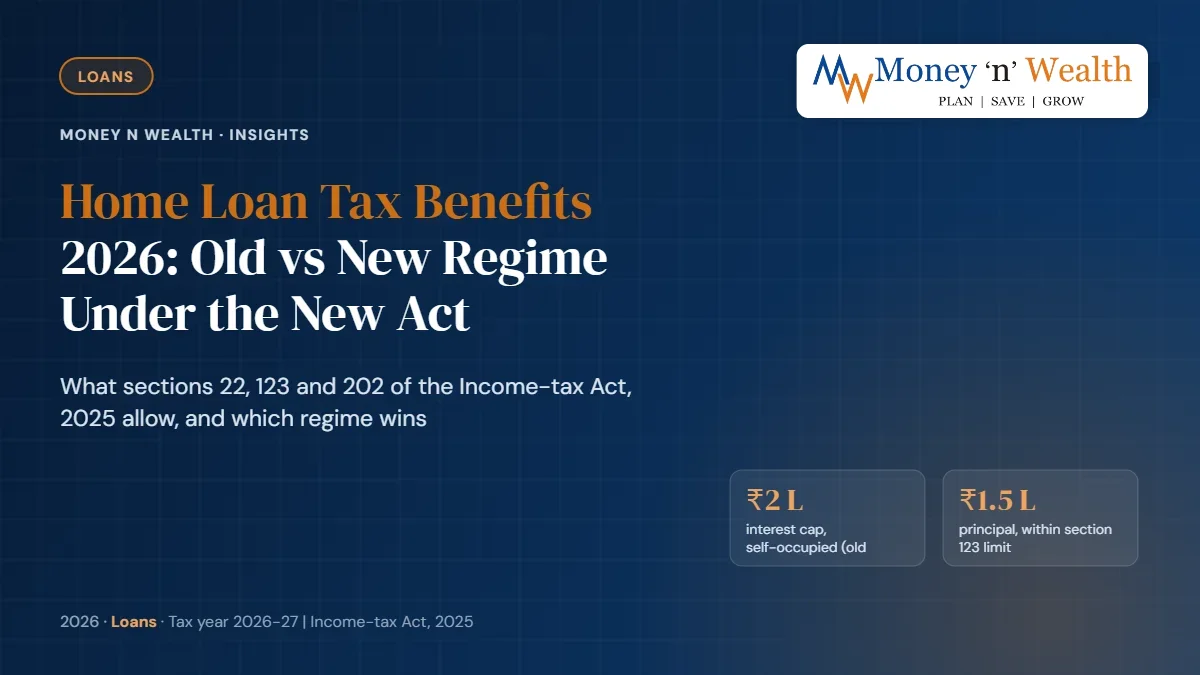
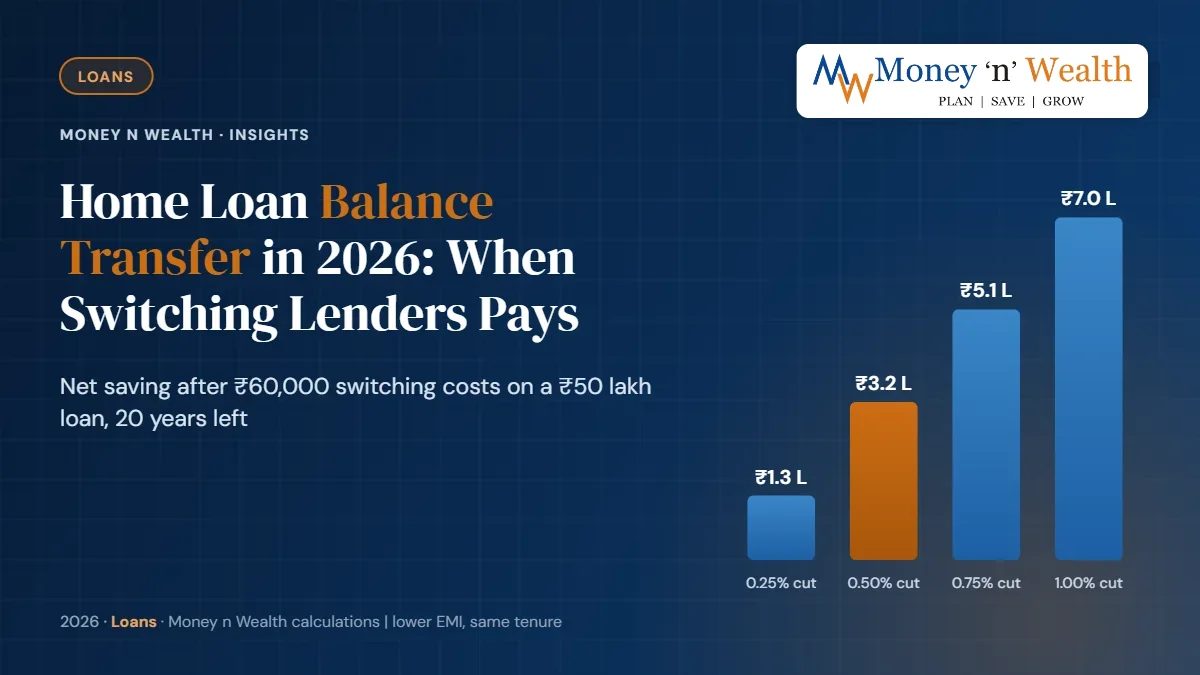
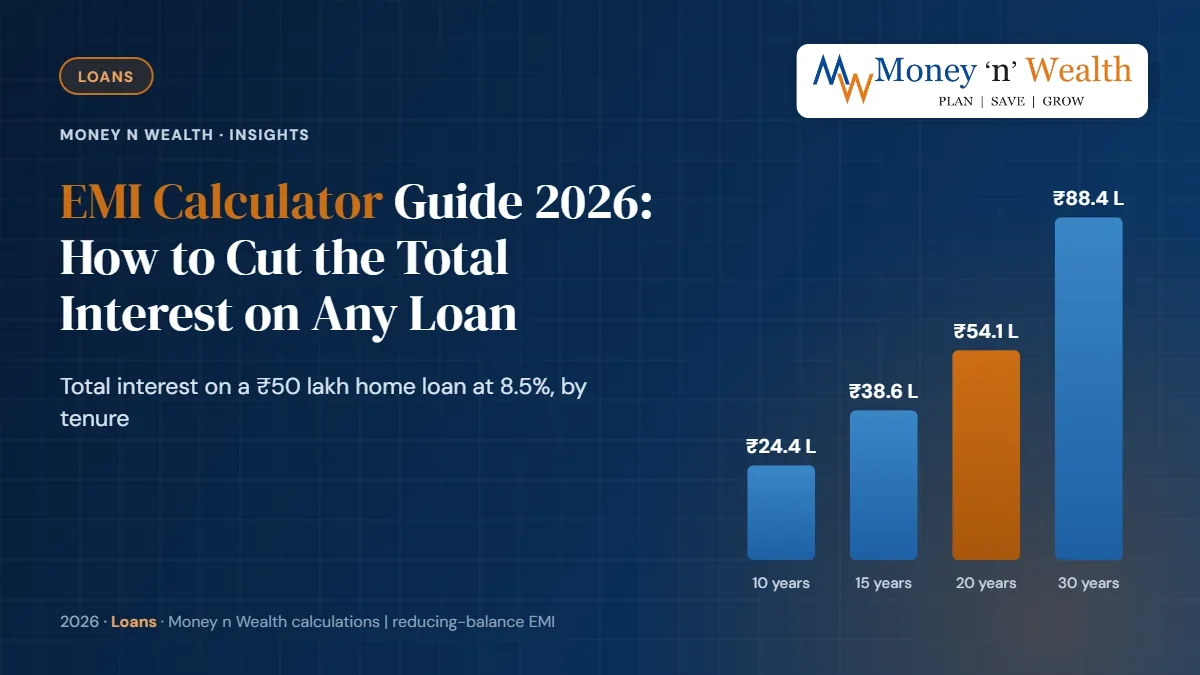
Last updated: 13 October 2026 Quick answer: Whether to prepay your home loan or invest depends on your post-tax loan rate versus your realistic post-tax investment return. On an 8% loan under the new tax regime, prepaying is a guaranteed 8% return; equity funds must earn roughly 9% a year to beat it after tax. Debt funds and FDs almost never win. Many families sensibly split the surplus. Key takeaways Big saving: ₹10 lakh prepaid on a ₹40 lakh, 8%, 15-year loan saves ₹16.2 lakh interest and ends it 68 months early. Break-even: investing wins only if equities return more than about 9% a year over 15 years. Tax regime matters: under the new regime, self-occupied home loan interest gives no deduction, so the full rate is your cost. FD loses: a 7% FD earns about 4.8% after 30% tax, far below an 8% loan. No penalty: floating-rate home loans to individuals carry no prepayment charges. Order: emergency fund, insurance and costlier debt come before any prepayment. The repo rate hike of 7 October 2026 has pushed many home loan rates back to 8% or more. For a family with a ₹5–10 lakh bonus, an inheritance or a maturing policy, the old question is suddenly sharper: should that money go to the bank to cut the loan, or into the market to build wealth? There is no universal answer, but there is a clear method. This guide works through the maths on a realistic loan, shows where the break-even return lies, explains how the old and new tax regimes change the hurdle, and lays out the non-financial factors that often decide the matter. Prepay home loan or invest: how to compare the two A home loan prepayment is a guaranteed, tax-free return equal to your loan's effective interest rate. Every rupee you prepay stops attracting interest immediately. An investment offers an expected return that is uncertain, taxable, and can be negative over short periods. So the comparison is never "8% vs 12%". It is your post-tax loan cost against the post-tax return you can realistically expect, adjusted for risk. A rupee saved on interest at 8% with certainty is not the same as a rupee that might earn 12% in equities. Step one: find your effective loan rate Under the new tax regime, which is the default under section 202 of the Income-tax Act, 2025, interest on a self-occupied house is not deductible. Your effective cost is simply the loan rate. Under the old regime, interest is deductible up to ₹2 lakh a year under section 22, which lowers the effective cost while the deduction is fully used. Comparison of effective home loan cost under old and new tax regimes for prepayment decisions Take a ₹40 lakh balance at 8% with 15 years left. Year-one interest is about ₹3.15 lakh. In the old regime at a 30% slab plus cess, only ₹2 lakh is deductible, saving ₹62,400 of tax, so the effective cost is about 6.3%. Once yearly interest falls below ₹2 lakh, the full interest qualifies and the effective cost drops to about 5.5%. How much does prepaying ₹10 lakh actually save? Here is the base case we will use throughout. The loan has ₹40 lakh outstanding at 8%, 15 years remaining, and an EMI of ₹38,226. Total remaining interest, if you change nothing, is about ₹28.8 lakh. Option for ₹10 lakh Loan ends in Remaining interest Interest saved Do nothing 180 months ₹28.81 lakh – Prepay ₹10 lakh, keep EMI 112 months ₹12.61 lakh ₹16.20 lakh Prepay ₹5 lakh, keep EMI 142 months ₹19.23 lakh ₹9.58 lakh Extra ₹10,000 every month 122 months ₹18.43 lakh ₹10.37 lakh Always ask the lender to keep the EMI and cut the tenure after a prepayment. Reducing the EMI instead saves far less interest, for the same reason that extending tenure after a rate hike costs more, as we show in raise the EMI or extend the tenure (/insights/home-loan-emi-vs-tenure-after-rate-hike) . What return must your investment beat? To compare fairly, both paths must end at the same date. In the prepay path, the loan closes after 112 months, and you then invest the freed EMI of ₹38,226 every month until month 180. In the invest path, you put ₹10 lakh into an equity fund and keep paying the loan. We assume both invest at the same return and pay 12.5% long-term capital gains tax plus cess above ₹1.25 lakh. Chart showing prepay home loan or invest break-even near a 9% annual return Assumed annual return Prepay path (post-tax) Invest path (post-tax) Winner 8% ₹32.1 lakh ₹29.1 lakh Prepay by ₹3.0 lakh 9% ₹32.9 lakh ₹33.2 lakh Roughly equal 10% ₹33.7 lakh ₹37.8 lakh Invest by ₹4.1 lakh 12% ₹35.5 lakh ₹49.1 lakh Invest by ₹13.6 lakh The break-even sits near 9% a year. Above it, investing pulls ahead because ₹10 lakh compounds for the full 15 years. Below it, prepaying wins with zero risk. Tax is simplified here as a single redemption at the end; staggered redemptions using the ₹1.25 lakh yearly exemption would slightly favour the invest path. What if you prepay monthly instead of in one go? The same logic holds for surplus cash flow. Paying an extra ₹10,000 a month closes the loan in 122 months. Compared with a ₹10,000 monthly SIP while keeping the loan, the two paths are almost level at a 9% return (about ₹34.5 lakh vs ₹34.4 lakh post-tax). At 12%, the SIP path ends about ₹6.8 lakh ahead; at 8%, prepaying is about ₹1.9 lakh ahead. Is 9% a year from equity realistic? Over long periods, diversified Indian equity has delivered more than that, but not reliably over every 10–15 year window, and the path is volatile. A 15-year horizon cuts the odds of a poor outcome but does not remove them. Our SIP corpus guide (/insights/build-1-crore-corpus-sip-calculator-guide) discusses reasonable return assumptions. The bigger risk is behavioural. The maths assumes you stay invested through crashes and never dip into the money. Research on investor behaviour, such as Morningstar's annual "Mind the Gap" studies, consistently finds that the average investor earns less than the funds they hold because of poorly timed buying and selling. Why FDs and debt funds rarely beat prepayment A 7% FD taxed at 30% plus cess returns about 4.8%. Invested for 15 years, ₹10 lakh grows to about ₹20.2 lakh, against about ₹30.0 lakh on the prepay path at the same rate. Debt fund gains are also taxed at slab rates for most investors. If the alternative is a fixed-income product, prepaying is almost always better. See FD vs debt funds after tax (/insights/fixed-deposit-vs-debt-mutual-funds-which-gives-better-post-tax-returns-now) . How does the old tax regime change the answer? If you are in the old regime and claim the interest deduction, prepaying has a hidden cost: it shrinks a deduction you would otherwise use. On our ₹40 lakh example at a 30% slab, yearly interest stays above ₹2 lakh for eight years. After a ₹10 lakh prepayment, it stays above ₹2 lakh for only two. Over the life of the loan, the lost tax saving adds up to about ₹3.6 lakh. That lowers the effective loan rate and with it the break-even return. A practical old-regime rule is to prepay only the portion that keeps yearly interest at or above ₹2 lakh, and invest the rest. Principal repayment also counts under the ₹1.5 lakh limit of section 123, though for most salaried people EPF already fills much of that. Whether you should be in the old regime at all is a separate question. With a ₹2 lakh interest deduction plus full section 123 and health insurance deductions, a person earning ₹18 lakh still pays less under the new regime. Our home loan tax benefits guide (/insights/home-loan-tax-benefits-old-new-regime) works through the break-even incomes. What do you give up when you prepay? Liquidity: money paid to the bank is locked in your house. You cannot get it back without a top-up loan, which needs fresh approval and may cost more. Diversification: prepaying concentrates more of your net worth in a single property in one city. Compounding time: money invested early compounds longer; prepaid money only stops interest. And what you gain: a guaranteed return, lower monthly risk if income is disrupted, and the peace of mind of being debt-free sooner. For someone in their late forties or in a volatile job, that last point carries real financial value. When should you prepay, and when should you invest? Lean towards prepaying if… Lean towards investing if… You are in the new regime and your loan rate is 8.5% or higher Your loan rate is low, say 7.5% or less, or you use the old-regime deduction fully Retirement is within 10–12 years and the loan runs beyond it You are under 40 with a long horizon and stable income Your job or business income is uncertain You already hold an adequate emergency fund and insurance The alternative is FDs or debt funds The alternative is a diversified equity portfolio you will hold through falls Debt causes you real stress Your retirement savings are behind target Is there a middle path? Yes, and it is what many planners recommend. Split the surplus. A common approach is to prepay part each year and invest the rest, rebalancing the ratio as rates and your circumstances change. Result of splitting a lump sum between home loan prepayment and investing The split narrows both your best and worst outcomes. At an 8% return, it trails pure prepayment by about ₹1.3 lakh; at 12%, it trails pure investing by about ₹7.4 lakh but beats prepaying by ₹6.2 lakh. You trade some upside for a shorter loan and more certainty. How the debate looks elsewhere The question is universal. In the US, many borrowers locked 30-year fixed mortgages at very low rates in 2020–21, and personal finance writers there generally favour investing over prepaying such loans. Indian borrowers face a different equation: floating rates near 8%, no deduction under the default regime, and rates that can rise, as October 2026 showed. That tilts India's answer more towards prepayment than in low fixed-rate markets. How to prepay without mistakes Checklist before you prepay a home loan Confirm your loan is floating-rate. Since 1 January 2026, RBI's Pre-payment Charges on Loans Directions, 2025 bar prepayment charges on floating-rate loans to individuals for non-business purposes; earlier RBI rules already did so for home loans. Pay through the lender's app or branch and specify "reduce tenure, keep EMI". Collect a revised repayment schedule and the provisional interest certificate for tax. Check the quarterly statement lenders must provide under RBI's 2023 rules to confirm the reduced tenure. On full closure, the lender must return original property documents within 30 days under RBI's September 2023 circular, or pay ₹5,000 for each day of delay attributable to it. Thinking about a lump sum more broadly? Our guide to using a bonus or inheritance (/insights/bonus-inheritance-windfall-what-to-do) covers the order of priorities, and the debt management guide (/insights/debt-management-guide-india) explains which loans to clear first. You can test your own numbers with our EMI calculator (/tools) . Related reading After the hike: raise the EMI or extend the tenure? (/insights/home-loan-emi-vs-tenure-after-rate-hike) Home loan tax benefits under old and new regimes (/insights/home-loan-tax-benefits-old-new-regime) EMI calculator guide: cut total interest (/insights/emi-calculator-guide-reduce-loan-interest) Home loan balance transfer: when it pays (/insights/home-loan-balance-transfer) SIP vs lumpsum vs STP for a windfall (/insights/sip-vs-lumpsum-vs-stp) Mutual funds at Money n Wealth (/products/mutual-funds) Frequently Asked Questions Is it better to prepay a home loan or invest in mutual funds? It depends on your effective loan rate and the return you can realistically earn after tax. On an 8% loan under the new tax regime, equity funds need to earn about 9% a year over 15 years to beat prepayment. If you would otherwise invest in FDs or debt funds, prepaying usually wins. Should I reduce EMI or tenure after prepaying my home loan? Reduce the tenure and keep the EMI unchanged if you can afford it. In our example, a ₹10 lakh prepayment with the same EMI ends a 15-year loan in 112 months and saves ₹16.2 lakh in interest. Lowering the EMI instead saves much less because the balance is repaid more slowly. Are there charges for prepaying a home loan in 2026? Not on floating-rate home loans taken by individuals for non-business purposes. RBI rules bar banks, NBFCs and housing finance companies from charging foreclosure or part-prepayment fees on such loans. Fixed-rate loans may still carry a charge, so check your sanction letter before paying. Do I lose tax benefits if I prepay my home loan? Only under the old tax regime, where interest on a self-occupied home is deductible up to ₹2 lakh a year. Prepaying cuts future interest and may push it below that limit. Under the new regime there is no deduction for a self-occupied home, so prepaying costs no tax benefit. What is the best time to prepay a home loan? Early in the loan, when the balance and interest share are highest. A prepayment in year two saves far more interest than the same amount in year fifteen. Many borrowers prepay each year from bonuses, after first securing an emergency fund and insurance. Should I stop my SIP to prepay my home loan? Generally no. Retirement and long-term goals need continuous investing, and stopping SIPs to prepay can leave you house-rich but cash-poor. A better approach is to keep core SIPs running and direct bonuses or windfalls to prepayment, or split them between both. Is it wise to prepay a home loan before retirement? Usually yes. Entering retirement without EMIs reduces the income you need and the risk of drawing down investments in a bad market. Aim to close the loan a few years before retiring, while keeping enough liquid savings and a separate retirement corpus. Sources: Income Tax Department, section 22, Income-tax Act 2025 (https://www.incometaxindia.gov.in/w/section-22-218) ; Income Tax Department, section 202 (new regime) (https://www.incometaxindia.gov.in/w/section-202-76) ; SCC Online on RBI Pre-payment Charges Directions 2025 (https://www.scconline.com/blog/post/2025/07/10/rbi-prepayment-charges-on-loans-directions-2025/) ; RBI circular on release of property documents (13 Sep 2023) (https://rbi.org.in/Scripts/NotificationUser.aspx?Id=12535&Mode=0) ; RBI circular on floating rate reset (18 Aug 2023) (https://rbi.org.in/Scripts/BS_CircularIndexDisplay.aspx?Id=12529) . Worked examples are Money n Wealth calculations. Bonus in hand: prepay, invest, or both? The right split depends on your loan, tax regime, goals and risk comfort. Talk to Money n Wealth (/contact) for a free portfolio review. This article is for general educational purposes only and does not constitute financial advice. Figures and examples are illustrative. Please consult a qualified financial adviser for guidance specific to your situation. Money n Wealth (Predics Fintech Services Pvt Ltd) is an AMFI-registered Mutual Fund Distributor (ARN-121995) and APMI-registered PMS Distributor (APRN07444); it is not a SEBI-registered investment adviser and may earn distribution commission on investments made through it.
Frequently Asked Questions
Is it better to prepay a home loan or invest in mutual funds?
It depends on your effective loan rate and the return you can realistically earn after tax. On an 8% loan under the new tax regime, equity funds need to earn about 9% a year over 15 years to beat prepayment. If you would otherwise invest in FDs or debt funds, prepaying usually wins.
Should I reduce EMI or tenure after prepaying my home loan?
Reduce the tenure and keep the EMI unchanged if you can afford it. In our example, a ₹10 lakh prepayment with the same EMI ends a 15-year loan in 112 months and saves ₹16.2 lakh in interest. Lowering the EMI instead saves much less because the balance is repaid more slowly.
Are there charges for prepaying a home loan in 2026?
Not on floating-rate home loans taken by individuals for non-business purposes. RBI rules bar banks, NBFCs and housing finance companies from charging foreclosure or part-prepayment fees on such loans. Fixed-rate loans may still carry a charge, so check your sanction letter before paying.
Do I lose tax benefits if I prepay my home loan?
Only under the old tax regime, where interest on a self-occupied home is deductible up to ₹2 lakh a year. Prepaying cuts future interest and may push it below that limit. Under the new regime there is no deduction for a self-occupied home, so prepaying costs no tax benefit.
What is the best time to prepay a home loan?
Early in the loan, when the balance and interest share are highest. A prepayment in year two saves far more interest than the same amount in year fifteen. Many borrowers prepay each year from bonuses, after first securing an emergency fund and insurance.
Should I stop my SIP to prepay my home loan?
Generally no. Retirement and long-term goals need continuous investing, and stopping SIPs to prepay can leave you house-rich but cash-poor. A better approach is to keep core SIPs running and direct bonuses or windfalls to prepayment, or split them between both.
Is it wise to prepay a home loan before retirement?
Usually yes. Entering retirement without EMIs reduces the income you need and the risk of drawing down investments in a bad market. Aim to close the loan a few years before retiring, while keeping enough liquid savings and a separate retirement corpus.
Bonus in hand: prepay, invest, or both?
The right split depends on your loan, tax regime, goals and risk comfort. Talk to Money n Wealth for a free portfolio review.