Retirement Planning in India: How Much Corpus You Need (2026 Guide)
Retirement planning in India carries a weight it doesn’t always carry elsewhere: outside government and a shrinking number of PSU jobs, there’s no defined-benefit pension waiting for most private-sector employees, and joint-family support that previous generations relied on is a less reliable safety net for a working generation raising smaller, often nuclear, families. What you build is, in large part, what you’ll have. This guide covers how to calculate your number and how to actually get there.
The starting framework is straightforward, even if the inputs take some thought:
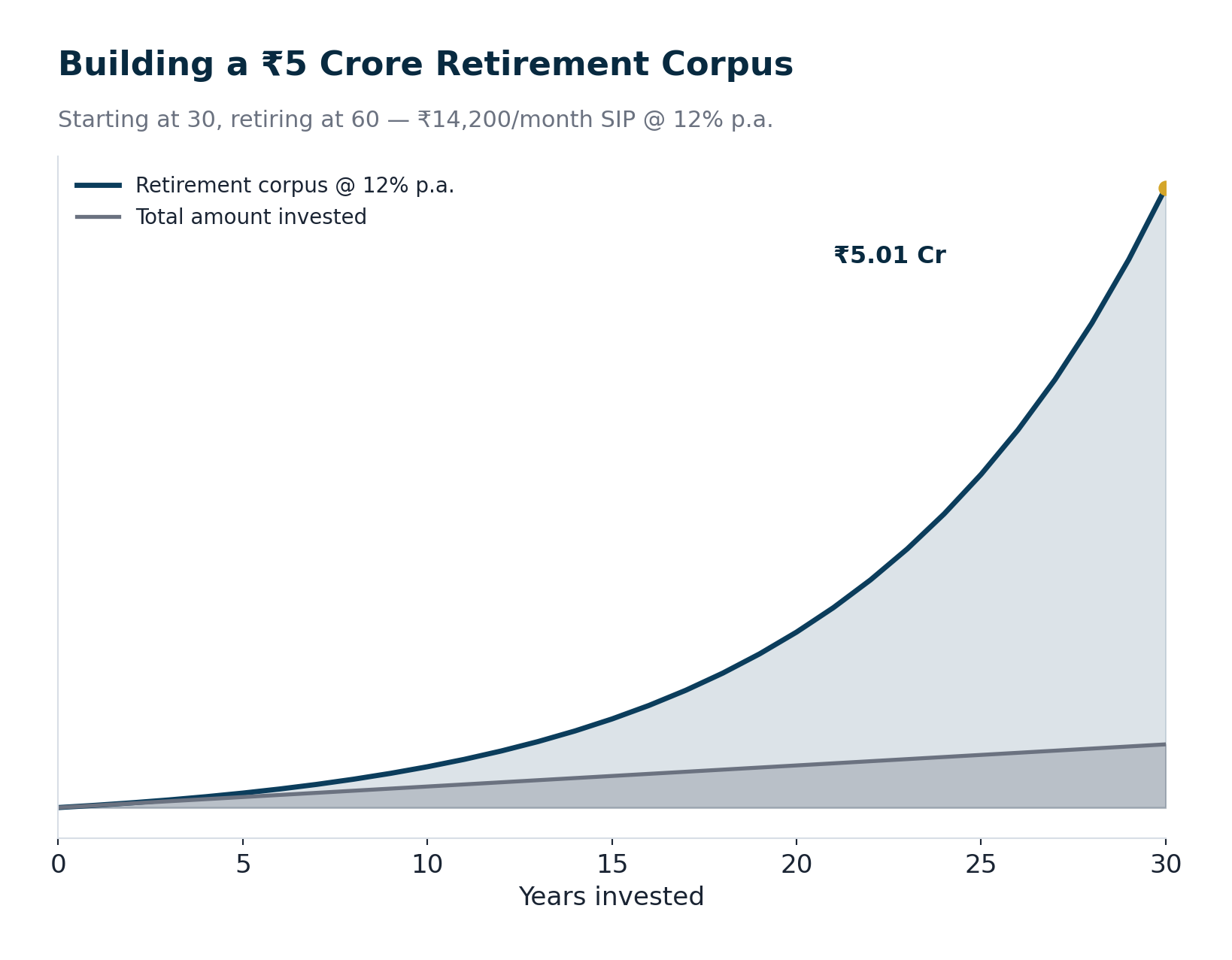
Retirement planning in India carries a weight it doesn’t always carry elsewhere: outside government and a shrinking number of PSU jobs, there’s no defined-benefit pension waiting for most private-sector employees, and joint-family support that previous generations relied on is a less reliable safety net for a working generation raising smaller, often nuclear, families. What you build is, in large part, what you’ll have. This guide covers how to calculate your number and how to actually get there. How Much Retirement Corpus Do You Actually Need? The starting framework is straightforward, even if the inputs take some thought: Step 1: Estimate your current annual expenses — not income, expenses, since that’s what retirement needs to replace (minus costs that disappear, like commuting or EMIs that will be paid off, plus costs that appear, like more healthcare spending). Step 2: Inflate that number to your retirement year. If you’re 35 now and plan to retire at 60, that’s 25 years of inflation eating into today’s rupee value — even moderate 6% inflation roughly quadruples costs over 25 years. Step 3: Apply a corpus multiple. A widely used benchmark is 25–30 times your inflated annual expenses, which corresponds to a sustainable annual withdrawal rate of roughly 3.5–4%. Given India’s historically higher inflation compared to markets where the original “4% rule” was studied, many planners lean toward the more conservative end (25–30x, or a 3–3.5% withdrawal rate) rather than assuming the higher end holds up over a 25–30 year retirement. Step 4: Remember the corpus needs to keep growing during retirement too. Retirement isn’t the day investing stops — inflation continues well into your 70s, 80s and beyond, so a retirement corpus is typically still invested (in a more conservative mix) and drawn down gradually, not converted entirely to cash on day one. Building the Corpus: What Compounding Looks Like Line chart showing a retirement corpus growing to 5 crore rupees over 30 years, from a monthly SIP of 14,200 rupees starting at age 30 ₹14,200/month, invested from age 30 to 60, at an assumed 12% annual return. A ₹14,200 monthly SIP, invested consistently from age 30 to 60 at an assumed 12% annual return, grows to roughly ₹5 crore — of which only about ₹51 lakh was actually contributed across all 30 years. The remaining ₹4.5 crore-plus is compounding. This is the same principle covered in our SIP planning guide (/insights/sip-planning-guide-india) , applied specifically to a retirement-length horizon, where it has the most time to work. The Real Cost of Starting Late Bar chart showing the monthly SIP needed to reach a 5 crore rupee corpus by age 60, starting at age 30, 40, or 50 Same ₹5 crore goal by age 60 — only the starting age changes. For the exact same ₹5 crore target corpus by age 60, at the same assumed 12% return: Start age Years to invest Monthly SIP required 30 30 years ₹14,165 40 20 years ₹50,043 50 10 years ₹2,15,203 Starting at 40 instead of 30 costs roughly 3.5 times more per month for the identical outcome. Starting at 50 costs over 15 times more than starting at 30. There’s no product or return assumption that makes up for lost decades — time is the one input in this calculation you can’t buy back later. Retirement Vehicles Available in India EPF (Employees’ Provident Fund). Mandatory for most salaried employees at eligible organisations, currently earning 8.25% for FY 2025-26 (unchanged for a third consecutive year), with both employer and employee contributions. A strong, low-risk base layer of most salaried Indians’ retirement corpus. PPF (Public Provident Fund). Available to everyone, including the self-employed, with a 15-year tenure (extendable), currently earning 7.1% (July–September 2026 quarter), fully tax-free on both interest and maturity, and qualifying for the Section 80C deduction under the old regime. NPS (National Pension System). A market-linked retirement product with equity, corporate debt and government bond options (chosen actively or via an auto-allocation glide path). Two features make it distinctive: an additional ₹50,000 tax deduction under Section 80CCD(1B), available only under the old regime, over and above the ₹1.5 lakh Section 80C limit; and, separately, if your employer contributes to your NPS , that contribution is deductible under Section 80CCD(2) up to 14% of salary (basic + DA) — and unlike the 80CCD(1B) benefit, this employer-contribution deduction remains available even under the new tax regime , which makes an employer NPS contribution worth checking for if you’ve moved to the new regime. The trade-off: NPS requires at least 40% of the corpus to be used to purchase an annuity at retirement, and annuity income is taxable. Mutual funds via SIP. The most flexible option — full liquidity, no mandatory annuitisation, and historically strong long-term equity returns, but with none of NPS’s extra tax deduction and full market risk. See our SIP (/insights/sip-planning-guide-india) and mutual fund planning (/insights/mutual-fund-planning-guide-india) guides. Senior Citizen Savings Scheme (SCSS) and other post-retirement instruments. Relevant closer to and during retirement itself — SCSS currently earns 8.2% (July–September 2026 quarter) and is specifically designed for retirees, with a maximum investment limit and quarterly payouts. Most well-built retirement plans in India combine several of these — EPF and PPF for a safe base, NPS for the additional tax benefit and forced discipline, and mutual fund SIPs for growth and flexibility — rather than relying on any single instrument. How Much Should You Invest Monthly, by Age? Rather than a single generic number, work through this for your own situation: take your target corpus (from the calculation above), your current age, your planned retirement age, and an assumed rate of return based on how the money will be invested (a higher long-term return assumption for a portfolio with more equity exposure, lower for a more conservative one). The chart above shows how dramatically the required monthly amount changes with your starting age for the same target — use it as a directional guide, and refine the actual numbers for your specific goal, ideally with professional input given how sensitive the outcome is to the assumptions. Common Retirement Planning Mistakes Underestimating post-retirement inflation. Expenses don’t stop rising just because you’ve stopped earning — a corpus calculated without inflation continuing through a 25–30 year retirement is very likely to run short in the later years. Relying solely on EPF, or solely on children. EPF alone, without PPF, NPS or market-linked investments, is unlikely to be sufficient for most people’s retirement lifestyle expectations. Relying on children’s future support is an increasingly fragile assumption in smaller, more geographically dispersed families. Starting late and trying to “catch up” with high-risk bets. As shown above, the honest fix for a late start is a higher monthly contribution and possibly a delayed retirement age — not concentrated high-risk investing in the final years before retirement, when there’s the least time to recover from a loss. Not accounting for healthcare costs specifically. Medical expenses tend to rise as a share of spending with age, and without adequate health insurance (/insights/insurance-planning-guide-india) continuing into retirement, a single major health event can disproportionately impact a retirement corpus. Ignoring estate planning (/insights/estate-planning-guide-india) alongside retirement planning. A retirement corpus without a Will or updated nominations creates unnecessary complications for a spouse or family managing it later — the two pillars are worth planning together, not sequentially. Where Retirement Planning Fits in Your Plan Retirement is usually the single largest goal in a financial plan, funded through the same SIP (/insights/sip-planning-guide-india) and mutual fund (/insights/mutual-fund-planning-guide-india) mechanisms as your other goals, shaped by tax planning (/insights/tax-planning-guide-india) choices like NPS, and completed by estate planning (/insights/estate-planning-guide-india) for what happens after. See the complete financial planning guide (/insights/financial-planning-in-india-complete-guide) for how it all connects. Corpus needed by monthly expense at retirement Monthly expense at retirement (in that year's rupees) 25× annual (US-style 4% rule) 30× annual 33× annual (closer to 3% withdrawal) ₹50,000 ₹1.5 crore ₹1.8 crore ₹2.0 crore ₹1,00,000 ₹3.0 crore ₹3.6 crore ₹4.0 crore ₹2,00,000 ₹6.0 crore ₹7.2 crore ₹7.9 crore Expenses at retirement should already include inflation from today. For Indian conditions many planners use 28–33 times annual expenses rather than 25. Interest rates on key retirement vehicles (Oct–Dec 2026) Vehicle Rate EPF 8.25% (latest declared EPFO rate; confirm the current year's rate) PPF 7.1% Senior Citizens Savings Scheme 8.2% NPS Market-linked Small-savings rates are reset quarterly; check before investing. Go deeper: retirement income strategy (/insights/retirement-income-strategy-india) , planning for couples (/insights/retirement-planning-for-couples-india) , retirement planning in Pune (/insights/retirement-planner-in-pune) and NPS vs mutual funds (/insights/nps-vs-mutual-funds-complete-comparison-guide) . Sources Business Today: small savings rates for Q3 FY27 (https://www.businesstoday.in/personal-finance/story/small-savings-scheme-interest-rates-unchanged-for-q3-fy27-check-ppf-scss-ssy-rates-558892-2026-09-30) Frequently Asked Questions How much retirement corpus do I need in India? A common starting rule is 25–30 times your expected annual expenses in the year you retire (adjusted for inflation between now and then), which supports a sustainable withdrawal rate of roughly 3.5–4% per year. The exact number depends on your retirement age, life expectancy assumption, and expected post-retirement returns and inflation. Is NPS or mutual funds better for retirement in India? They’re complementary rather than competing. NPS offers a unique additional tax deduction, low costs, and a disciplined, restricted structure, but requires at least 40% of the corpus to buy an annuity at retirement. Mutual funds offer full flexibility and liquidity but less tax benefit. Many retirement plans in India use both. What is the 4% rule in retirement planning? The 4% rule suggests you can withdraw about 4% of your retirement corpus in the first year of retirement, and adjust that amount for inflation each year after, with a reasonably low risk of running out of money over a typical retirement. In India’s higher-inflation environment, many planners use a more conservative 3–3.5% to be safer. How much should I invest monthly for retirement? It depends heavily on your current age and target corpus. As an illustration, reaching a ₹5 crore corpus by age 60 needs roughly ₹14,000/month starting at 30, versus about ₹50,000/month starting at 40, and over ₹2 lakh/month starting at 50 — all for the exact same goal, at an assumed 12% return. Not sure what your actual retirement number should be? Your real target depends on your expenses, retirement age and existing EPF/PPF/NPS balances — not a generic multiple. Talk to Money n Wealth (/contact) for a free retirement plan review. This article is for general educational purposes only and does not constitute investment advice. Mutual fund and NPS investments are subject to market risks. Figures, return and inflation assumptions shown are illustrative, not guaranteed. Please consult a qualified financial adviser before making retirement planning decisions. Money n Wealth (Predics Fintech Services Pvt Ltd) is an AMFI-registered Mutual Fund Distributor (ARN-121995) and APMI-registered PMS Distributor (APRN07444); it is not a SEBI-registered investment adviser and may earn distribution commission on investments made through it.