Section 80D, Now Section 126: Health Insurance Tax Deduction 2026
Last updated: 13 October 2026
Quick answer: Section 80D is now section 126 of the Income-tax Act, 2025, with the same limits. You can deduct health insurance premiums up to ₹25,000 for yourself, spouse and children (₹50,000 if you are 60+), plus ₹25,000 for parents (₹50,000 if a parent is 60+). The maximum is ₹1 lakh. It is available only under the old tax regime.
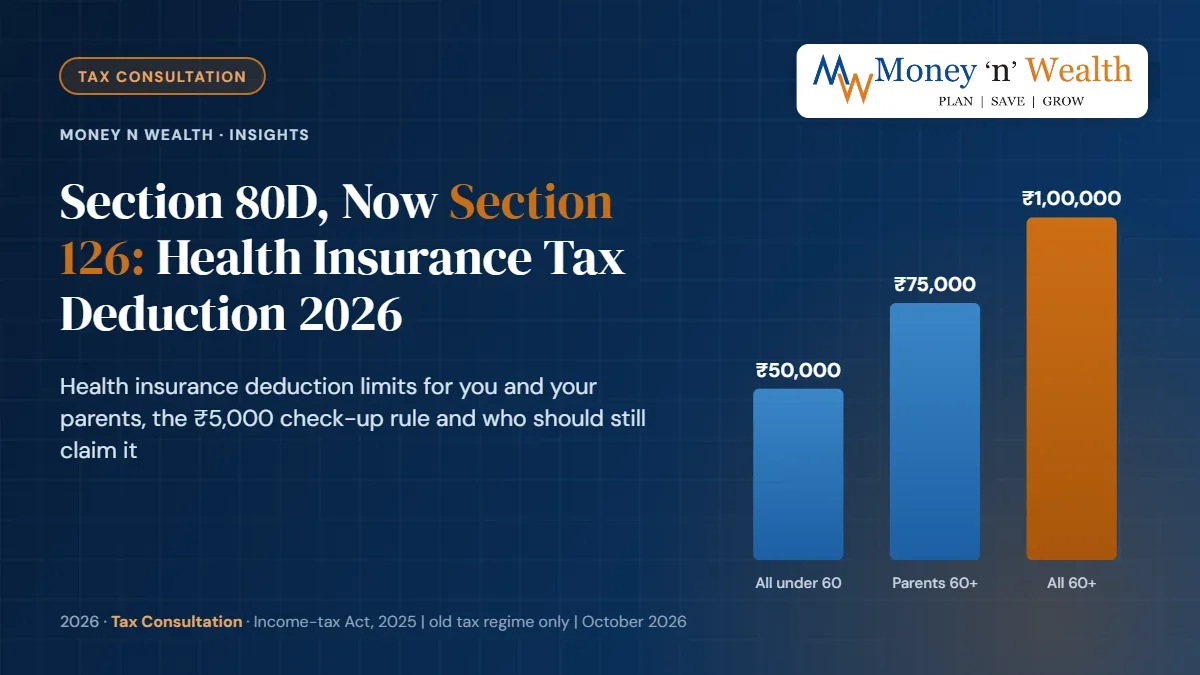
Last updated: 13 October 2026 Quick answer: Section 80D is now section 126 of the Income-tax Act, 2025, with the same limits. You can deduct health insurance premiums up to ₹25,000 for yourself, spouse and children (₹50,000 if you are 60+), plus ₹25,000 for parents (₹50,000 if a parent is 60+). The maximum is ₹1 lakh. It is available only under the old tax regime. Key takeaways New number: from tax year 2026-27, claim under section 126; for FY 2025-26 returns it is still section 80D. Limits: ₹50,000, ₹75,000 or ₹1,00,000 in total, depending on ages. Check-up: up to ₹5,000 for preventive health check-ups, inside the limits, payable in cash. Old regime only: section 202 (new regime) disallows it. Uninsured seniors: up to ₹50,000 of medical bills for a senior citizen with no health cover can be claimed. A Pune family paying ₹28,000 for their own floater and ₹62,000 for retired parents spends ₹90,000 a year on health cover. Under the old tax regime, up to ₹75,000 of that is deductible, which saves ₹23,400 for someone in the 30% slab. Under the new regime, the saving is nil. That gap is why section 80D, now section 126, still shapes regime choice for many families. This guide explains section 80D health insurance deduction limits as of October 2026: the new section number under the Income-tax Act, 2025, who can be covered, the preventive check-up rule, parents, senior citizens without insurance, multi-year premiums, and worked examples. What is section 80D and what is it called now? Section 80D was the deduction for health insurance premiums and preventive check-ups under the Income-tax Act, 1961. From 1 April 2026, the same deduction is in section 126 of the Income-tax Act, 2025, titled "Deduction in respect of health insurance premia". The limits and conditions were carried over almost word for word. Which number applies depends on the year of income: FY 2025-26 (AY 2026-27): section 80D of the 1961 Act. If you are filing a belated return before 31 December 2026, claim it here. Tax year 2026-27 onwards: section 126. Declare it to your employer in Form 124 (the old Form 12BB) and claim it in the return you file in 2027. Our Income-tax Act 2025 guide (/insights/income-tax-act-2025-changes-individuals) maps the other renumbered sections, such as 80C to 123. How much can you claim under section 80D (section 126)? The deduction has two separate buckets: one for you and your family, and one for your parents. Each bucket has its own limit, which rises from ₹25,000 to ₹50,000 if the insured person is a senior citizen (60 or older). Who is insured Self, spouse, dependent children Parents Maximum deduction Everyone under 60 ₹25,000 ₹25,000 ₹50,000 You under 60, a parent 60 or older ₹25,000 ₹50,000 ₹75,000 You 60 or older, a parent 60 or older ₹50,000 ₹50,000 ₹1,00,000 HUF (any member) ₹25,000; ₹50,000 if the insured member is 60+ ₹50,000 Section 80D now section 126 health insurance deduction limits for self and parents by age The parents' bucket is available whether or not your parents depend on you. "Family" for the first bucket means your spouse and dependent children. Parents-in-law, siblings and grandparents are not covered, but your spouse can claim for their own parents in their own return. What counts as a qualifying payment? Health insurance premium on a policy from an IRDAI-approved insurer, including family floaters, top-ups, super top-ups and senior citizen plans. Contribution to CGHS or a similar notified government health scheme, within the self-and-family bucket. Preventive health check-ups for the family or parents, within the bucket limits. Medical expenditure on a senior citizen who has no health insurance, explained below. Only premium you paid counts. If your employer pays for group cover, you get no deduction for it. If you pay extra to add parents to the group policy through salary deduction, that part generally qualifies. Our guide on gaps in corporate group cover (/insights/health-insurance-for-corporate-employees-pune) explains why many employees still need a personal policy. How does the ₹5,000 preventive check-up deduction work? Section 126(3) allows up to ₹5,000 for preventive health check-ups, but this is not an extra deduction. It sits inside the ₹25,000 or ₹50,000 limits, and the ₹5,000 cap applies to the self-and-family and parents' buckets together. It matters only when your premiums are below the limit. If your family floater already costs ₹28,000, a ₹4,000 check-up adds nothing because the ₹25,000 bucket is full. If the floater costs ₹18,000, a ₹4,000 check-up lifts your claim to ₹22,000. Check-ups are the only item you can pay in cash. Every other payment, including premiums and medical bills, must be made by a non-cash mode such as UPI, card, net banking or cheque. Can you claim medical bills for uninsured senior parents? Yes. Section 126(2)(c) and (d) allow a deduction for medical expenditure on a senior citizen, up to ₹50,000, but only if no premium was paid to insure that person. This helps families whose parents are in their late 70s or 80s and cannot buy affordable cover. The ₹50,000 is a combined ceiling for each bucket. You cannot claim ₹50,000 of premium for one senior parent and another ₹50,000 of bills for the other. Keep hospital, pharmacy and doctor bills, and pay by a traceable mode. Before relying on this, compare it with buying cover. IRDAI removed the upper age limit for buying health insurance in 2024, so many insurers now offer plans to older buyers, though with co-payments and waiting periods. Our guide to health insurance for parents and senior citizens (/insights/health-insurance-for-parents-senior-citizens) explains the options. What if you pay a multi-year premium? Many insurers offer two- or three-year policies with a discount. Section 126(8)(b) spreads the deduction: you claim an equal share of the premium in each tax year the policy covers. Example: you pay ₹1,32,000 once for a three-year policy for your senior parents. You can claim ₹44,000 in each of the three tax years, not ₹50,000 in the first year only. If the yearly share is below the limit, you can still add check-ups or other parent premiums up to the cap. Worked example: a Pune family on the old regime Rahul, 38, is a Pune-based manager in the 30% slab who uses the old regime. He pays: Family floater for himself, his wife and two children: ₹28,000 by UPI. Allowed: ₹25,000 (bucket full). Preventive check-up for himself and his wife: ₹4,000 in cash. Allowed: nil extra, because the bucket is already full. Senior citizen policy for his parents, aged 66 and 63: ₹62,000 by card. Allowed: ₹50,000. His total deduction is ₹75,000. At 30% plus 4% cess, it saves ₹23,400 a year. If Rahul's wife pays her own parents' premium, she can claim a further deduction in her return. Note that the premium is now lower than before. From 22 September 2025, individual health insurance premiums are exempt from GST after the GST Council's 56th meeting, so the full premium you pay is the insurance cost, and that is the amount you claim. Section 80D health insurance deduction limits and GST exemption at a glance Is section 80D worth claiming if you are on the new tax regime? No deduction is available. Section 202 of the 2025 Act, which sets out the new regime, disallows Chapter VIII deductions except a few such as the employer's NPS contribution. Section 126 is not among the exceptions. Whether the old regime is worth it depends on all your deductions together: section 123 (old 80C), section 126, home loan interest under section 22, HRA and NPS. A health insurance deduction alone rarely tips the balance, because the new regime's lower slabs and the ₹12 lakh rebate usually outweigh a saving of ₹15,600 to ₹31,200. Use our old vs new regime guide (/insights/tax-planning-guide-india) to compare, and our HRA guide (/insights/hra-exemption-calculation) if you rent. Tax saved under section 80D health insurance deduction at 30%, 20% and 5% slabs Either way, buy health insurance for the cover, not the tax break. A single hospitalisation can cost several lakh rupees, far more than any deduction. If your base cover is small, a super top-up (/insights/super-top-up-health-insurance) is often the cheapest way to raise it, and its premium also qualifies under section 126. How to claim the deduction, step by step Declare it to your employer. Submit premium receipts with Form 124 so TDS on salary is lower through the year. Keep the evidence. Premium receipts showing the insured names and payment mode, check-up bills, and medical bills for uninsured seniors. Claim it in your return. For FY 2025-26, under section 80D in the ITR. For tax year 2026-27, under section 126 in the new forms, choosing the old regime. Checklist for claiming section 80D section 126 health insurance deduction Global perspective Many countries subsidise health cover through tax. The US lets families contribute pre-tax to Health Savings Accounts alongside high-deductible plans, and Australia charges a Medicare levy surcharge on higher earners without private hospital cover. India's approach is a simple capped deduction that has become less relevant as more taxpayers move to the new regime. For most Indian families, the bigger lever now is adequate cover, not the deduction. Related reading Health insurance for parents and senior citizens (/insights/health-insurance-for-parents-senior-citizens) Super top-up health plans (/insights/super-top-up-health-insurance) Critical illness cover: who needs it (/insights/critical-illness-insurance-guide) Senior citizen tax planning (/insights/senior-citizen-tax-planning-interest-pension-rent) Insurance planning in India (/insights/insurance-planning-guide-india) Frequently Asked Questions What is the new section for 80D under the Income-tax Act 2025? Section 80D is now section 126 of the Income-tax Act, 2025, effective from tax year 2026-27 (income from 1 April 2026). The limits are the same: ₹25,000 or ₹50,000 for self and family, and ₹25,000 or ₹50,000 for parents, depending on age. Returns for FY 2025-26 still use section 80D. Can I claim section 80D under the new tax regime? No. Section 202, which governs the new regime, does not allow the health insurance deduction. You must opt for the old regime in your return to claim section 126. Salaried taxpayers without business income can choose the regime afresh each year when filing. Can I claim health insurance premium paid for my parents-in-law? No. The parents' bucket covers only your own father and mother. Your spouse can claim the premium for their parents if your spouse pays it, within their own ₹25,000 or ₹50,000 parent limit, and only under the old regime. Is a preventive health check-up deduction in addition to ₹25,000? No. The check-up deduction of up to ₹5,000 is part of the ₹25,000 or ₹50,000 limits, not over and above them, and the ₹5,000 cap covers your family and parents together. It helps only if your premiums are below the limit. Check-ups are the one item that can be paid in cash. Can I claim health insurance premium paid in cash? No. Premiums and medical expenditure must be paid by a mode other than cash, such as UPI, card, net banking or cheque. Only preventive health check-up costs can be paid in cash and still qualify. What is the maximum deduction under section 80D? ₹1,00,000, when both you and at least one parent are 60 or older: ₹50,000 for your own family and ₹50,000 for your parents. If you are under 60 and a parent is 60 or older, the maximum is ₹75,000. If everyone is under 60, it is ₹50,000. Do NRIs get the section 80D deduction? Yes. The deduction is available to individuals and HUFs, not only residents, so an NRI with taxable income in India can claim it under the old regime for premiums on policies from Indian insurers covering themselves, family or parents. Payment must be by a non-cash mode. Sources: Income Tax Department, section 126, Income-tax Act 2025 (https://www.incometaxindia.gov.in/w/section-126-92) ; Section 202, new tax regime (https://www.incometaxindia.gov.in/w/section-202-78) ; Income-tax Act, 2025 page (https://www.incometaxindia.gov.in/income-tax-act-202511) ; FAQs on forms under the Income-tax Rules, 2026 (Form 124) (https://www.incometaxindia.gov.in/faqs-and-guidance-notes-on-forms-as-per-income-tax-rules-2026) ; Business Standard, GST Council exempts individual health and life insurance (https://www.business-standard.com/markets/capital-market-news/insurance-policies-exempted-from-tax-life-saving-drugs-and-medical-devices-reduced-to-5-125090400146_1.html) . Worked examples are Money n Wealth calculations. Is your family's health cover enough, and are you claiming it right? The right cover for your parents matters far more than the tax deduction. Talk to Money n Wealth (/contact) for an insurance review and a free portfolio review, or see our insurance services (/products/insurance) . This article is for general educational purposes only and does not constitute financial advice. Figures and examples are illustrative. Please consult a qualified financial adviser for guidance specific to your situation. Money n Wealth (Predics Fintech Services Pvt Ltd) is an AMFI-registered Mutual Fund Distributor (ARN-121995) and APMI-registered PMS Distributor (APRN07444); it is not a SEBI-registered investment adviser and may earn distribution commission on investments made through it. Insurance is the subject matter of solicitation.
Frequently Asked Questions
What is the new section for 80D under the Income-tax Act 2025?
Section 80D is now section 126 of the Income-tax Act, 2025, effective from tax year 2026-27 (income from 1 April 2026). The limits are the same: ₹25,000 or ₹50,000 for self and family, and ₹25,000 or ₹50,000 for parents, depending on age. Returns for FY 2025-26 still use section 80D.
Can I claim section 80D under the new tax regime?
No. Section 202, which governs the new regime, does not allow the health insurance deduction. You must opt for the old regime in your return to claim section 126. Salaried taxpayers without business income can choose the regime afresh each year when filing.
Can I claim health insurance premium paid for my parents-in-law?
No. The parents' bucket covers only your own father and mother. Your spouse can claim the premium for their parents if your spouse pays it, within their own ₹25,000 or ₹50,000 parent limit, and only under the old regime.
Is a preventive health check-up deduction in addition to ₹25,000?
No. The check-up deduction of up to ₹5,000 is part of the ₹25,000 or ₹50,000 limits, not over and above them, and the ₹5,000 cap covers your family and parents together. It helps only if your premiums are below the limit. Check-ups are the one item that can be paid in cash.
Can I claim health insurance premium paid in cash?
No. Premiums and medical expenditure must be paid by a mode other than cash, such as UPI, card, net banking or cheque. Only preventive health check-up costs can be paid in cash and still qualify.
What is the maximum deduction under section 80D?
₹1,00,000, when both you and at least one parent are 60 or older: ₹50,000 for your own family and ₹50,000 for your parents. If you are under 60 and a parent is 60 or older, the maximum is ₹75,000. If everyone is under 60, it is ₹50,000.
Do NRIs get the section 80D deduction?
Yes. The deduction is available to individuals and HUFs, not only residents, so an NRI with taxable income in India can claim it under the old regime for premiums on policies from Indian insurers covering themselves, family or parents. Payment must be by a non-cash mode.
Is your family's health cover enough, and are you claiming it right?
The right cover for your parents matters far more than the tax deduction. Talk to Money n Wealth for an insurance review and a free portfolio review, or see our insurance services .