Senior Citizens Savings Scheme (SCSS) 2026: Rate, Limits, Tax and Rules
Last updated: 13 October 2026
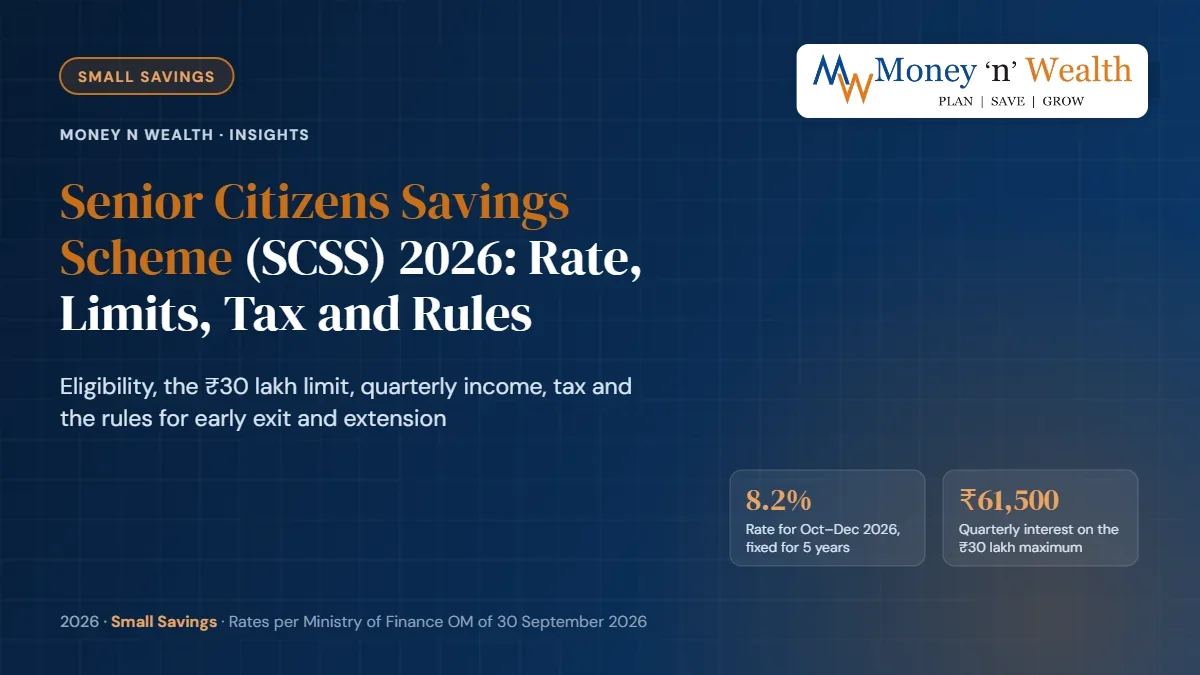
Quick answer: The Senior Citizens Savings Scheme (SCSS) pays 8.2% a year for October–December 2026, fixed for five years and paid quarterly. Anyone 60 or older can invest up to ₹30 lakh; retirees aged 55–60 and retired defence staff over 50 also qualify. Deposits get an old-regime deduction, but interest is fully taxable, with TDS above ₹1 lakh a year.
Last updated: 13 October 2026 Quick answer: The Senior Citizens Savings Scheme (SCSS) pays 8.2% a year for October–December 2026, fixed for five years and paid quarterly. Anyone 60 or older can invest up to ₹30 lakh; retirees aged 55–60 and retired defence staff over 50 also qualify. Deposits get an old-regime deduction, but interest is fully taxable, with TDS above ₹1 lakh a year. Key takeaways Rate: 8.2% for Oct–Dec 2026, unchanged since April 2023 and locked for your deposit's five-year term. Income: ₹30 lakh pays ₹61,500 a quarter (₹2.46 lakh a year); a couple can each invest ₹30 lakh. Tax: up to ₹1.5 lakh deductible under section 123 (old 80C) in the old regime only; interest taxed at slab. TDS: 10% once interest from the post office or bank crosses ₹1 lakh a year; Form 121 if your tax is nil. Exit: early closure costs 1–1.5% of the deposit after year one; extension is in three-year blocks. A retired Pune engineer recently showed us his plan: ₹30 lakh from his provident fund and gratuity, all headed to bank FDs at about 7%. Moving it into the Senior Citizens Savings Scheme instead would add roughly ₹33,000 a year of interest, with a Government of India guarantee behind every rupee. That gap explains why SCSS is the first stop for most retirees. This guide covers the current rate, who is eligible, how the ₹30 lakh limit works, the quarterly payout maths, tax and TDS under the Income-tax Act, 2025, and the rules for premature closure and extension. What is the Senior Citizens Savings Scheme? The Senior Citizens Savings Scheme (SCSS) is a five-year, government-backed deposit for people aged 60 and above, run under the Senior Citizens Savings Scheme Rules, 2019. You can open it at any post office or at authorised banks such as SBI and other large public and private sector banks. The Ministry of Finance sets small savings rates every quarter. Its office memorandum of 30 September 2026 kept every rate unchanged for 1 October to 31 December 2026, so SCSS stays at 8.2% , the level it has held since April 2023. Crucially, the rate on the day you deposit stays fixed for that deposit's full five years, even if later quarters change. Feature SCSS rule (as of October 2026) Interest rate 8.2% a year, fixed for the deposit's term Interest payment Quarterly: first working day of April, July, October and January Minimum deposit ₹1,000, in multiples of ₹1,000 Maximum deposit ₹30 lakh per individual across all SCSS accounts Tenure 5 years, extendable in blocks of 3 years Joint account Only with spouse; the whole deposit counts against the first holder's limit Tax deduction Up to ₹1.5 lakh under section 123 of the Income-tax Act, 2025 (old regime only) Tax on interest Fully taxable at slab; TDS above ₹1 lakh a year Safety Sovereign obligation of the Government of India For the full rate list across PPF, NSC, KVP and the post office deposits, see our small savings interest rates for October–December 2026 (/insights/small-savings-interest-rates-oct-dec-2026) . Who is eligible for SCSS? There are three routes in. The 2023 amendment to the rules widened the window for early retirees, which many people still do not know about. Age 60 or above: any resident individual can open an account, whether retired or still working. Age 55 to 60: only if you retired on superannuation or under a voluntary or special voluntary retirement scheme, and you invest within three months of receiving retirement benefits. Your deposit cannot exceed those benefits. Age 50 and above: retired defence personnel (excluding civilian defence employees), on the same conditions as the 55–60 group. "Retirement benefits" means money such as provident fund, gratuity, leave encashment, commuted pension and VRS ex-gratia. Keep the employer's certificate and payment proof; the post office or bank will ask for them. Non-resident Indians and HUFs cannot open SCSS. If you become an NRI after opening an account, check with your post office or bank before maturity, because the rules restrict continuation in some situations. Comparison of Senior Citizens Savings Scheme eligibility for people aged 60 plus, retirees aged 55 to 60, and retired defence personnel aged 50 plus How much can you invest in SCSS? The maximum is ₹30 lakh per individual , raised from ₹15 lakh by the Union Budget 2023-24. The limit is per person, across all SCSS accounts at all post offices and banks, not per account. You can hold more than one account, which helps if you want deposits to mature in different years. A couple who are both eligible can each hold ₹30 lakh in their own names, taking household SCSS capacity to ₹60 lakh. In a joint account with your spouse, the entire amount is attributed to the first holder. So a ₹30 lakh joint account with the husband first uses up his full limit; the wife can still open her own ₹30 lakh account as first holder. A tax caution for couples If a husband gifts money to his wife and she invests it in SCSS, the interest is clubbed back into his income under the Income-tax Act. Splitting accounts saves tax only when each spouse invests their own retirement benefits, savings or inheritance. Our guide to gifting money to family and the clubbing rules (/insights/gifting-money-family-clubbing-rules) explains the details. How much SCSS interest will you get every quarter? SCSS pays simple interest, credited quarterly. The first payment covers the period from your deposit date to the next quarter-end, so it may be smaller than later payments. SCSS deposit Yearly interest Every quarter Monthly equivalent Total over 5 years ₹5,00,000 ₹41,000 ₹10,250 ₹3,417 ₹2,05,000 ₹10,00,000 ₹82,000 ₹20,500 ₹6,833 ₹4,10,000 ₹15,00,000 ₹1,23,000 ₹30,750 ₹10,250 ₹6,15,000 ₹20,00,000 ₹1,64,000 ₹41,000 ₹13,667 ₹8,20,000 ₹30,00,000 ₹2,46,000 ₹61,500 ₹20,500 ₹12,30,000 ₹60,00,000 (couple) ₹4,92,000 ₹1,23,000 ₹41,000 ₹24,60,000 Interest is credited to your linked post office or bank savings account. If you leave it there, it does not earn the SCSS rate; it earns only the savings rate. Many retirees set a standing instruction to move the payout into a monthly recurring deposit or a liquid fund. Senior Citizens Savings Scheme quarterly interest payout chart for deposits of ₹5 lakh to ₹30 lakh at 8.2% SCSS vs bank FD: how big is the gap? Big-bank senior citizen FDs paid around 7.05–7.10% in October 2026. On ₹30 lakh, SCSS's 8.2% pays ₹2,46,000 a year against about ₹2,13,000 at 7.10% simple interest, a difference of roughly ₹33,000 a year, or ₹1.65 lakh over five years. Our comparison of senior citizen FDs, SCSS and RBI Floating Rate Bonds (/insights/senior-citizen-fd-vs-scss-vs-rbi-floating-rate-bonds) sets out where each fits. How is SCSS interest taxed in 2026? SCSS is not tax-free. The interest is added to your income as "income from other sources" and taxed at your slab rate every year. What you keep therefore depends heavily on your bracket. Bar chart of the post-tax return of the Senior Citizens Savings Scheme at different income tax slabs Deduction on the deposit Under the Income-tax Act, 2025, in force from 1 April 2026, the old section 80C deduction is now section 123 . An SCSS deposit qualifies for it, within the overall ₹1.5 lakh limit, but only if you choose the old regime. The new regime under section 202, which is the default, allows no such deduction. Under the old regime, senior citizens can also claim up to ₹50,000 of deduction on deposit interest (the old section 80TTB). Most retirees with modest income find the new regime better anyway: income up to ₹4 lakh is nil-rated, and the section 156 rebate makes taxable income up to ₹12 lakh tax-free. A retiree whose only income is ₹30 lakh of SCSS interest (₹2.46 lakh) plus a ₹4 lakh pension pays no tax in the new regime. For the full picture, see senior citizen tax planning for interest, pension and rent (/insights/senior-citizen-tax-planning-interest-pension-rent) . When is TDS deducted on SCSS interest? The post office or bank deducts TDS at 10% once interest paid to a senior citizen crosses ₹1 lakh in a tax year . Without a PAN, the rate is 20%. The threshold applies per payer, so it counts all your deposits with that post office or bank together. Example: Mrs Deshpande, 66, has ₹30 lakh in SCSS. Interest of ₹2.46 lakh crosses ₹1 lakh, so ₹24,600 is deducted over the year. If her tax is nil (say, a small pension and the new-regime rebate), she can submit Form 121 at the start of the tax year. Form 121 replaced Forms 15G and 15H under section 393(6) of the new Act; for those aged 60 and above, the only condition is that estimated tax for the year is nil. If tax is still deducted , it shows in her Form 26AS and Annual Information Statement, and she claims a refund when filing her return. Our guide to FD TDS and Form 121 (/insights/fd-calculator-cumulative-vs-payout-tds) walks through the form in detail. Can you close SCSS early, and what does it cost? Yes, you can close an SCSS account at any time, but the rules deduct a penalty depending on how long the money has stayed in. When you close Deduction On ₹10 lakh Before 1 year Interest already paid is recovered from the principal Up to ₹82,000 of interest clawed back After 1 year, before 2 years 1.5% of the deposit ₹15,000 After 2 years, before 5 years 1% of the deposit ₹10,000 Extended account, after 1 year of extension Nil ₹0 The penalty makes SCSS a poor home for your emergency money. Keep six to twelve months of expenses in a sweep FD or a liquid fund, and treat SCSS as money you will not touch for five years. Steps showing the penalty for premature closure of a Senior Citizens Savings Scheme account by holding period What happens when SCSS matures? Extension explained On maturity after five years, you can withdraw the money or extend the account for three more years . The 2023 amendment lets you extend in blocks of three years, rather than just once, which suits retirees who want to keep a portion locked in. Apply within one year of maturity (or of the end of an extended block) using the prescribed form at your post office or bank. The rate on an extended account is the one applicable on the date of maturity, not your original rate. Interest continues to be paid quarterly through the extension. New deposit instead: if rates on new deposits are higher, you could close the matured account and open a fresh one, within the ₹30 lakh limit. If the account holder dies The account is closed and the balance paid to the nominee or legal heirs, with SCSS interest up to the date of death and savings-account interest afterwards. If the spouse is joint holder or sole nominee and is eligible to open SCSS in their own right, they can choose to continue the account to maturity. Make sure every SCSS account has a nominee; see our estate planning guide (/insights/estate-planning-guide-india) . How to open an SCSS account: step by step Choose where: a post office or an authorised bank branch; several banks also allow online opening for existing customers. Fill the account opening form with nominee details. Submit KYC: PAN, Aadhaar, a photograph and age proof; early retirees add the retirement-benefit certificate. Deposit: in cash only for amounts below ₹1 lakh, otherwise by cheque or transfer for larger sums; the cheque clearance date becomes the deposit date. Link a savings account for quarterly interest credit, and submit Form 121 if eligible. Is SCSS right for you? Where it fits in a retirement plan SCSS is usually the strongest guaranteed-income option for a retiree in India. Most retirees fill it first, then use other instruments for the rest. But it has three limits worth respecting. Inflation: CPI inflation was 5.54% in September 2026. After tax at the 20% slab, SCSS yields about 6.49%, a thin real return. Over a 25-year retirement, a portfolio with no growth assets loses purchasing power. Reinvestment risk: after five years, the rate on offer may be lower. Cap: ₹30 lakh per person rarely covers a full retirement corpus. A practical structure is SCSS for steady income, a Post Office Monthly Income Scheme (/insights/post-office-monthly-income-scheme-pomis) or FD ladder for monthly cash flow and liquidity, and a portion in hybrid or equity mutual funds drawn through a systematic withdrawal plan (/insights/swp-systematic-withdrawal-plan-guide) for growth. Our retirement income strategy guide (/insights/retirement-income-strategy-india) shows how to combine them, and the retirement calculator (/tools) helps size each bucket. Related reading Senior citizen income: FD vs SCSS vs RBI Floating Rate Bonds (/insights/senior-citizen-fd-vs-scss-vs-rbi-floating-rate-bonds) Post Office Monthly Income Scheme (POMIS) explained (/insights/post-office-monthly-income-scheme-pomis) Small savings interest rates for October–December 2026 (/insights/small-savings-interest-rates-oct-dec-2026) Five years to retirement: the pre-retirement checklist (/insights/five-years-to-retirement-checklist) Retirement income for 25 years: pension, rent or SWP? (/insights/retirement-income-pension-rent-or-swp-25-years) Frequently Asked Questions What is the SCSS interest rate for October–December 2026? The Senior Citizens Savings Scheme pays 8.2% a year for deposits made between 1 October and 31 December 2026, as per the Ministry of Finance office memorandum of 30 September 2026. The rate has been unchanged since April 2023. Once you deposit, your rate stays fixed for the full five-year term, regardless of later revisions. What is the maximum amount I can invest in SCSS? ₹30 lakh per individual, across all SCSS accounts at all post offices and banks. The minimum is ₹1,000, in multiples of ₹1,000. A husband and wife who are both eligible can each invest ₹30 lakh in their own names, giving a household ₹60 lakh, though clubbing rules apply if one spouse funds the other's deposit. Can I open SCSS before 60? Yes, in two cases. If you are 55 to 60 and retired on superannuation or VRS, you can invest within three months of receiving retirement benefits, up to the amount of those benefits. Retired defence personnel, excluding civilian staff, can do the same from age 50. Otherwise, you must wait until you turn 60. Is SCSS interest tax-free? No. SCSS interest is fully taxable at your slab rate every year. The deposit itself qualifies for a deduction of up to ₹1.5 lakh under section 123 (the old 80C), but only in the old regime. Many retirees owe no tax anyway because the new regime makes taxable income up to ₹12 lakh tax-free through the rebate. How can I avoid TDS on SCSS interest? TDS applies when SCSS and other interest from the same post office or bank exceeds ₹1 lakh in a tax year. If your estimated tax for the year is nil, submit Form 121 (which replaced Form 15H from tax year 2026-27) at the start of the year. If TDS is still deducted, claim it back as a refund in your return. Can I extend my SCSS account after five years? Yes. You can extend it for blocks of three years by applying within one year of maturity. The extended account earns the rate applicable on the maturity date, paid quarterly. After one year of an extension, you can close the account without any deduction, which makes extended accounts more flexible than fresh ones. Is SCSS better than a senior citizen FD? On rate and safety, usually yes: 8.2% with a sovereign guarantee versus about 7.05–7.10% at big banks in October 2026, with bank FDs insured by DICGC only up to ₹5 lakh per bank. FDs win on flexibility, loans against the deposit and tenure choice. Most retirees use SCSS first and FDs for the rest. Sources: Ministry of Finance (DEA) office memorandum of 30 September 2026, as reproduced by StaffNews (https://www.staffnews.in/?p=168643) ; TaxGuru, Q3 2026-27 small savings rate notification (https://taxguru.in/?p=1084242) ; Business Today, small savings rates unchanged for Q3 FY27 (https://www.businesstoday.in/personal-finance/story/small-savings-scheme-interest-rates-unchanged-for-q3-fy27-check-ppf-scss-ssy-rates-558892-2026-09-30) ; Income Tax Department, Form 121 FAQs (https://www.incometaxindia.gov.in/documents/d/guest/form-121-faqs) ; Senior Citizens Savings Scheme Rules, 2019 and the November 2023 amendment (India Post / National Savings Institute). Worked examples are Money n Wealth calculations. How much of your retirement money should go into SCSS? The right split between SCSS, FDs and growth assets depends on your expenses, tax and other income. Talk to Money n Wealth (/contact) for a free portfolio review. This article is for general educational purposes only and does not constitute financial advice. Figures and examples are illustrative. Please consult a qualified financial adviser for guidance specific to your situation. Money n Wealth (Predics Fintech Services Pvt Ltd) is an AMFI-registered Mutual Fund Distributor (ARN-121995) and APMI-registered PMS Distributor (APRN07444); it is not a SEBI-registered investment adviser and may earn distribution commission on investments made through it.
Frequently Asked Questions
What is the SCSS interest rate for October–December 2026?
The Senior Citizens Savings Scheme pays 8.2% a year for deposits made between 1 October and 31 December 2026, as per the Ministry of Finance office memorandum of 30 September 2026. The rate has been unchanged since April 2023. Once you deposit, your rate stays fixed for the full five-year term, regardless of later revisions.
What is the maximum amount I can invest in SCSS?
₹30 lakh per individual, across all SCSS accounts at all post offices and banks. The minimum is ₹1,000, in multiples of ₹1,000. A husband and wife who are both eligible can each invest ₹30 lakh in their own names, giving a household ₹60 lakh, though clubbing rules apply if one spouse funds the other's deposit.
Can I open SCSS before 60?
Yes, in two cases. If you are 55 to 60 and retired on superannuation or VRS, you can invest within three months of receiving retirement benefits, up to the amount of those benefits. Retired defence personnel, excluding civilian staff, can do the same from age 50. Otherwise, you must wait until you turn 60.
Is SCSS interest tax-free?
No. SCSS interest is fully taxable at your slab rate every year. The deposit itself qualifies for a deduction of up to ₹1.5 lakh under section 123 (the old 80C), but only in the old regime. Many retirees owe no tax anyway because the new regime makes taxable income up to ₹12 lakh tax-free through the rebate.
How can I avoid TDS on SCSS interest?
TDS applies when SCSS and other interest from the same post office or bank exceeds ₹1 lakh in a tax year. If your estimated tax for the year is nil, submit Form 121 (which replaced Form 15H from tax year 2026-27) at the start of the year. If TDS is still deducted, claim it back as a refund in your return.
Can I extend my SCSS account after five years?
Yes. You can extend it for blocks of three years by applying within one year of maturity. The extended account earns the rate applicable on the maturity date, paid quarterly. After one year of an extension, you can close the account without any deduction, which makes extended accounts more flexible than fresh ones.
Is SCSS better than a senior citizen FD?
On rate and safety, usually yes: 8.2% with a sovereign guarantee versus about 7.05–7.10% at big banks in October 2026, with bank FDs insured by DICGC only up to ₹5 lakh per bank. FDs win on flexibility, loans against the deposit and tenure choice. Most retirees use SCSS first and FDs for the rest.
How much of your retirement money should go into SCSS?
The right split between SCSS, FDs and growth assets depends on your expenses, tax and other income. Talk to Money n Wealth for a free portfolio review.