SIP Planning: The Complete Guide to Systematic Investment Plans in India (2026)
A Systematic Investment Plan — better known as a SIP — is how the large majority of Indian retail investors now build long-term wealth in mutual funds. As of mid-2026, Indian investors held over 9.6 crore active SIP accounts, with SIP assets crossing ₹17 lakh crore — around a fifth of the entire mutual fund industry’s assets — and monthly SIP inflows consistently above ₹31,000 crore. This guide covers exactly how SIPs work, why they compound so effectively, and how to plan yours properly.
A SIP is simply an instruction to automatically invest a fixed amount into a mutual fund scheme on a chosen date every month (weekly and quarterly options also exist, though monthly is most common). Each instalment buys units of the fund at that day’s NAV (net asset value) — when the market is down, your fixed amount buys more units; when it’s up, it buys fewer. This mechanism, called rupee cost averaging, smooths out the average price you pay over time and removes the need to “time” your entry.
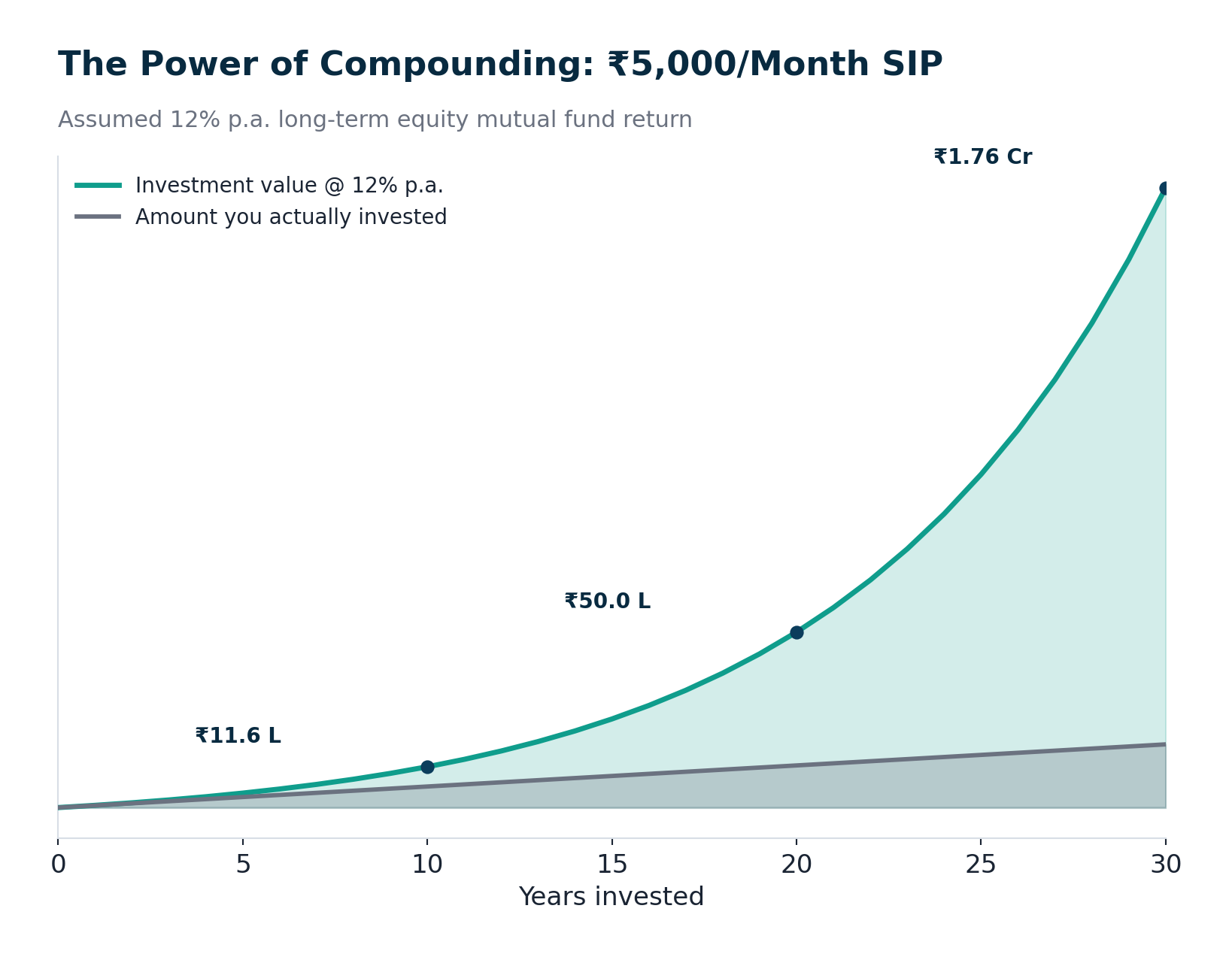
A Systematic Investment Plan — better known as a SIP — is how the large majority of Indian retail investors now build long-term wealth in mutual funds. As of mid-2026, Indian investors held over 9.6 crore active SIP accounts , with SIP assets crossing ₹17 lakh crore — around a fifth of the entire mutual fund industry’s assets — and monthly SIP inflows consistently above ₹31,000 crore . This guide covers exactly how SIPs work, why they compound so effectively, and how to plan yours properly. What Is a SIP, and How Does It Work? A SIP is simply an instruction to automatically invest a fixed amount into a mutual fund scheme on a chosen date every month (weekly and quarterly options also exist, though monthly is most common). Each instalment buys units of the fund at that day’s NAV (net asset value) — when the market is down, your fixed amount buys more units; when it’s up, it buys fewer. This mechanism, called rupee cost averaging , smooths out the average price you pay over time and removes the need to “time” your entry. SIPs are not a separate asset class — they’re simply a method of investing into mutual funds (equity, debt, hybrid, or any other category). The fund you choose determines your risk and return profile; the SIP just determines how you invest into it. See our mutual fund planning guide (/insights/mutual-fund-planning-guide-india) for how to choose the actual funds. The Power of Compounding Line chart showing a ₹5,000 monthly SIP at 12% annual return growing to ₹11.6 lakh in 10 years, ₹50 lakh in 20 years, and ₹1.76 crore in 30 years, versus the amount actually invested A ₹5,000/month SIP at an assumed 12% annual return — notice how the growth accelerates over time. This is the single most important chart in this guide. A ₹5,000 monthly SIP assumed to grow at 12% per year (a commonly used long-term assumption for diversified equity mutual funds, not a guarantee) reaches roughly: ₹11.6 lakh in 10 years — of which only ₹6 lakh was actually invested ₹50 lakh in 20 years — of which only ₹12 lakh was actually invested ₹1.76 crore in 30 years — of which only ₹18 lakh was actually invested Notice what happens between year 20 and year 30: the invested amount only grows by ₹6 lakh (from ₹12 lakh to ₹18 lakh), but the total value grows by over ₹1.25 crore. That’s compounding — returns earning returns on themselves — and it’s why the last 10 years of a long SIP typically add more wealth than the first 20 combined . Why Starting Early Matters More Than Starting Big Bar chart comparing final corpus from a ₹10,000/month SIP started at age 25, 35 and 45, all retiring at 60 Same ₹10,000/month SIP at 12% p.a. — only the starting age changes. Consider the same ₹10,000 monthly SIP at the same assumed 12% return, with only the starting age different, all retiring at 60: Start at 25 (35 years invested): roughly ₹6.5 crore Start at 35 (25 years invested): roughly ₹1.9 crore Start at 45 (15 years invested): roughly ₹50.5 lakh Ten extra years at the start — between starting at 25 versus 35 — is worth more than three times the final corpus, for the exact same monthly amount. This is the clearest argument in personal finance for starting a SIP now, even a small one, rather than waiting for a “better” time or a higher income. SIP vs Lump Sum If you receive income steadily (a monthly salary), a SIP is the natural fit — it invests as you earn. If you’re sitting on a lump sum (a bonus, an inheritance, proceeds from a sale), the choice is less obvious: investing it all immediately maximises time in the market if it goes up, but risks poor timing if a fall follows shortly after. A common middle path is to invest a portion immediately and stagger the rest into the market over 6–12 months, similar to a SIP — reducing single-point timing risk without sitting entirely in cash. Step-Up SIP: Investing More As You Earn More A step-up SIP (also called a top-up SIP) automatically increases your monthly SIP amount by a set percentage or rupee amount every year — for example, a 10% annual step-up on a ₹10,000 SIP takes it to ₹11,000 in year two, ₹12,100 in year three, and so on. Because most people’s income rises over their career, a step-up SIP captures that rising capacity automatically instead of relying on you to manually increase it (which many investors simply never get around to). Over a long horizon, a step-up SIP can meaningfully outpace a flat SIP of the same starting amount, since more money is invested earlier in years where it has the most time left to compound. How to Choose Your SIP Amount Work backward from your goal rather than picking a round number. For any goal, three inputs determine the required SIP: the target amount (in today’s or future rupees), the number of years until you need it, and an assumed rate of return based on the asset mix. Our child education planning (/insights/child-education-planning-guide-india) and retirement planning (/insights/retirement-planning-guide-india) guides show this calculation applied to specific goals. As a starting discipline, the 20% “savings and investing” bucket from the 50/30/20 budgeting rule (/insights/budgeting-guide-india) is a reasonable place to find your total SIP capacity before splitting it across goals. Staying Invested Through Market Cycles The hardest part of SIP investing isn’t the math — it’s the behaviour. Markets don’t move in a straight line, and every long SIP will pass through at least one meaningful downturn. Two behaviours separate investors who build real wealth from those who don’t: Not stopping SIPs during a fall. A falling market means your fixed SIP amount buys more units at a lower price — this is rupee cost averaging working exactly as intended. Investors who pause or stop SIPs during downturns miss both the discount and the recovery that historically follows. Not chasing last year’s top-performing fund. Switching funds based on recent performance disrupts compounding and frequently means buying in after the best returns have already happened. A fund chosen for your goal and risk profile is usually a better long-term hold than a fund chosen for its trailing one-year return. How to Start a SIP Complete your KYC (know-your-customer) — a one-time process using PAN, address proof and a video or in-person verification, valid across all mutual funds once done. Choose your fund(s) based on your goal, time horizon and risk profile (see our mutual fund planning guide (/insights/mutual-fund-planning-guide-india) ). Set up an auto-debit mandate (via net banking or UPI autopay) so the SIP runs automatically every month without manual intervention — this is what makes the habit stick. Choose a date shortly after your salary credit, so the SIP is funded before discretionary spending has a chance to compete for the same money. Common SIP Mistakes Stopping SIPs when markets fall. Covered above — this is the single most value-destroying behaviour in SIP investing. Starting too many SIPs across too many funds. Beyond a handful of well-chosen funds across categories, additional funds mostly add overlap and complexity, not diversification. Treating SIP amount as fixed forever. Without a step-up, your SIP’s real (inflation-adjusted) contribution shrinks every year your income rises and the SIP doesn’t. No clear goal attached to the SIP. A SIP without a purpose is far easier to redeem early for a discretionary expense than one earmarked for “retirement” or “child’s education.” Ignoring taxation on withdrawal. Equity mutual fund gains are taxed differently depending on holding period — see our tax planning guide (/insights/tax-planning-guide-india) for current long-term and short-term capital gains rules. Where SIP Planning Fits in Your Plan SIPs are the engine of the investment pillar in your financial plan — the mechanism, not the destination. Once your emergency fund and insurance are in place, SIPs are how you fund every medium and long-term goal: retirement (/insights/retirement-planning-guide-india) , your child’s education (/insights/child-education-planning-guide-india) , and general wealth building. See the complete financial planning guide (/insights/financial-planning-in-india-complete-guide) for how it all connects. What a monthly SIP can grow to Monthly SIP 10 years 15 years 20 years 25 years ₹5,000/month ₹11.6 lakh ₹25.2 lakh ₹50.0 lakh ₹94.9 lakh ₹10,000/month ₹23.2 lakh ₹50.5 lakh ₹99.9 lakh ₹1.90 crore ₹25,000/month ₹58.1 lakh ₹1.26 crore ₹2.50 crore ₹4.74 crore Assumes 12% a year, compounded monthly; returns are not guaranteed and equity returns vary widely year to year. Flat SIP vs 10% annual step-up Plan (20 years, 12% a year assumed) Approximate value ₹10,000 a month, flat ₹99.9 lakh ₹10,000 a month, increased 10% every year ₹1.99 crore Illustration only. Model your own numbers with our ₹1 crore SIP calculator guide (/insights/build-1-crore-corpus-sip-calculator-guide) or the planner (/planner) . Irregular income? See SIPs for freelancers (/insights/money-management-for-freelancers-and-self-employed) . Frequently Asked Questions How does a SIP work? A Systematic Investment Plan (SIP) automatically debits a fixed amount from your bank account on a chosen date each month and invests it in a mutual fund scheme of your choice, buying units at that day’s NAV (net asset value). Over time this builds a growing investment through regular, disciplined contributions rather than a single lump sum. Is SIP better than a lump sum investment? SIPs suit regular income (most salaried investors) and reduce the risk of investing a large amount right before a market fall, by spreading purchases across market ups and downs — known as rupee cost averaging. If you already have a lump sum, a mix of some immediate investment and a staggered SIP-like deployment over a few months is a commonly used middle path. What is a step-up SIP? A step-up (or top-up) SIP automatically increases your monthly investment amount by a fixed percentage or amount each year, matching your rising income. It significantly increases your final corpus compared to a flat SIP of the same starting amount, without requiring you to manually increase it each year. Should I stop my SIP when the market falls? Generally no — a market fall means your fixed SIP amount buys more units at a lower price, which is a core part of how SIPs build wealth over time. Stopping a SIP during a downturn is one of the most common ways investors lock in losses and miss the recovery that typically follows. Not sure how much to SIP, or which funds fit your goals? The right SIP amount and fund mix depend on your specific goals and timeline — a personalised plan connects the two directly. Talk to Money n Wealth (/contact) for a free portfolio and financial plan review. This article is for general educational purposes only and does not constitute investment advice. Mutual fund investments are subject to market risks; please read all scheme-related documents carefully. Returns shown (12% p.a.) are illustrative assumptions, not guaranteed or historical returns of any specific scheme. Please consult a qualified financial adviser before investing. Money n Wealth (Predics Fintech Services Pvt Ltd) is an AMFI-registered Mutual Fund Distributor (ARN-121995) and APMI-registered PMS Distributor (APRN07444); it is not a SEBI-registered investment adviser and may earn distribution commission on investments made through it.