Tax Planning in India (FY 2026-27): Old vs New Regime and How to Save Tax
Tax planning isn’t about finding loopholes — it’s about legitimately structuring your income and investments so you don’t pay more tax than the law requires. For FY 2026-27, that starts with a decision every taxpayer in India now has to make explicitly: the new tax regime or the old one. This guide walks through both, with real numbers, plus the deductions and capital gains rules that matter most.
The new tax regime is the default regime unless you actively opt for the old one. For FY 2026-27, the slabs are:
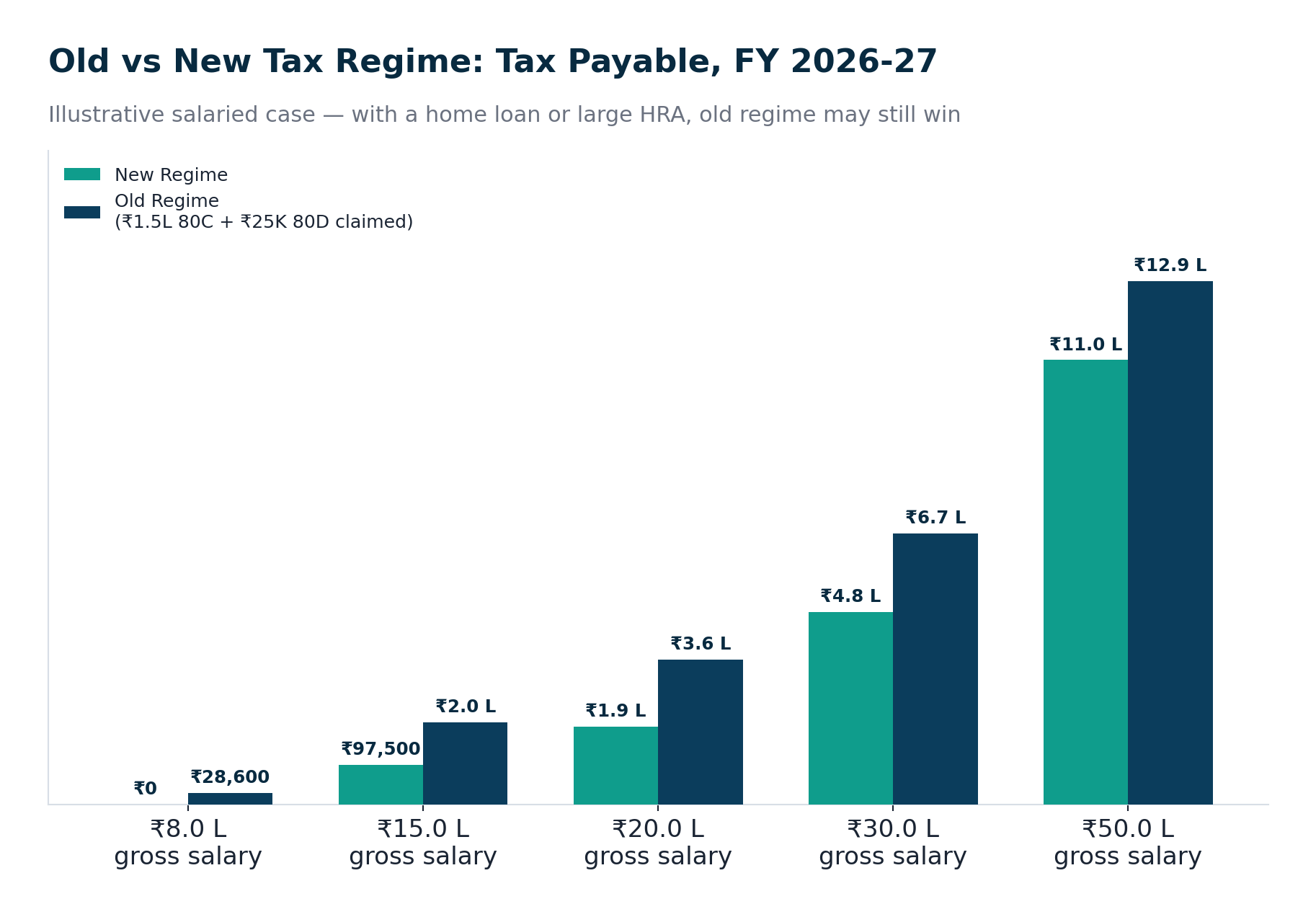
Tax planning isn’t about finding loopholes — it’s about legitimately structuring your income and investments so you don’t pay more tax than the law requires. For FY 2026-27 , that starts with a decision every taxpayer in India now has to make explicitly: the new tax regime or the old one . This guide walks through both, with real numbers, plus the deductions and capital gains rules that matter most. New Tax Regime: Income Tax Slabs for FY 2026-27 The new tax regime is the default regime unless you actively opt for the old one. For FY 2026-27, the slabs are: Taxable income Tax rate Up to ₹4,00,000 Nil ₹4,00,001 – ₹8,00,000 5% ₹8,00,001 – ₹12,00,000 10% ₹12,00,001 – ₹16,00,000 15% ₹16,00,001 – ₹20,00,000 20% ₹20,00,001 – ₹24,00,000 25% Above ₹24,00,000 30% Plus applicable health and education cess (4%) on the tax computed. Two things make this regime more generous than it first looks. First, the standard deduction for salaried individuals and pensioners is ₹75,000 under the new regime. Second, a rebate of up to ₹60,000 under Section 87A means that if your total taxable income is ₹12 lakh or below, your tax liability is reduced to zero — which works out to roughly ₹12.75 lakh of gross salary being effectively tax-free for a salaried individual once the standard deduction is applied. The trade-off: the new regime does not allow most of the deductions available under the old regime — no Section 80C, no HRA exemption, no home loan interest deduction (for a self-occupied property), and so on. It’s built to be simple, not to reward specific investments. Old Tax Regime: What’s Still Available The old regime retains the earlier slab structure — nil up to ₹2.5 lakh, 5% from ₹2.5–5 lakh, 20% from ₹5–10 lakh, and 30% above ₹10 lakh — with a ₹50,000 standard deduction for salaried individuals, and access to the full range of deductions: Section 80C (up to ₹1.5 lakh), Section 80D (health insurance premiums), HRA exemption, home loan interest under Section 24(b), and more. The old regime still carries its own Section 87A rebate, which zeroes out tax for taxable income up to ₹5 lakh. Old vs New Regime: A Real Comparison Bar chart comparing tax payable under old and new regimes at gross salaries of 8, 15, 20, 30 and 50 lakh rupees for FY 2026-27 Illustrative salaried case assuming ₹1.5 lakh (80C) + ₹25,000 (80D) claimed under the old regime. Gross annual salary New regime tax Old regime tax* Better option ₹8 lakh ₹0 ₹28,600 New regime ₹15 lakh ₹97,500 ₹2,02,800 New regime ₹20 lakh ₹1,92,400 ₹3,58,800 New regime ₹30 lakh ₹4,75,800 ₹6,70,800 New regime ₹50 lakh ₹10,99,800 ₹12,94,800 New regime *Assumes only ₹1.5 lakh under 80C and ₹25,000 under 80D are claimed, which is a realistic base case for many taxpayers. Figures include 4% cess and are illustrative, not a substitute for computing your own return. In this base-case comparison, the new regime wins at every income level shown. This is exactly why it’s the default now for most taxpayers. But the comparison flips for people with larger deductions the new regime doesn’t allow — most commonly, significant home loan interest (up to ₹2 lakh deduction under Section 24(b) for a self-occupied property), a large HRA exemption (common for renters in expensive metros), or the additional ₹50,000 NPS deduction under Section 80CCD(1B). As a rough rule of thumb, the more your total eligible deductions climb toward ₹4–4.5 lakh and beyond, the more likely the old regime becomes competitive or better — but the only reliable way to know is to compute both for your actual numbers, which we’re happy to help with. Key Deductions Under the Old Regime Bubble chart comparing lock-in period and typical long-term return for Section 80C options: ELSS, PPF, NSC, tax-saver FD and traditional life insurance ELSS has both the shortest lock-in and the highest typical long-term return among 80C options — though it also carries market risk that the others don’t. Section 80C — up to ₹1.5 lakh per year across ELSS mutual funds (3-year lock-in, market-linked), PPF (15-year tenure, 7.1% for the July–September 2026 quarter), EPF, NSC (5-year tenure, 7.7%), 5-year tax-saver fixed deposits (around 6.8%), life insurance premiums, and home loan principal repayment. See our mutual fund planning guide (/insights/mutual-fund-planning-guide-india) for more on ELSS specifically. Section 80D — up to ₹25,000 for health insurance premiums for yourself and family, and up to ₹50,000 if paying for senior citizen parents. See our insurance planning guide (/insights/insurance-planning-guide-india) for how much cover to actually buy. Section 80CCD(1B) — an additional ₹50,000 deduction (over and above the 80C limit) for your own contribution to the National Pension System (NPS), available only under the old regime. Contributions to NPS Vatsalya accounts for minor children also qualify from FY 2025-26. See our retirement planning guide (/insights/retirement-planning-guide-india) for how NPS fits into a retirement plan. Section 24(b) — up to ₹2 lakh deduction on home loan interest for a self-occupied property, one of the largest single deductions for many salaried taxpayers with a home loan. A note on numbering: the Income Tax Act, 2025 replaced the Income-tax Act, 1961, effective 1 April 2026, and renumbered many familiar sections — Section 80C is now referenced as Section 123 and Section 80D as Section 126, for example, though the deduction amounts and eligibility rules themselves are largely unchanged. Most people, and most everyday commentary, will keep using the old, familiar section numbers for a while yet — but it’s worth confirming exact citations with a tax professional when filing. Capital Gains Tax on Investments Equity mutual funds and listed shares: gains on units held for more than 12 months are long-term and taxed at 12.5% on gains above a ₹1.25 lakh per year exemption (Section 112A). Gains on units held for 12 months or less are short-term and taxed at a flat 20% . Debt mutual funds: since a rule change effective April 2023, all gains on debt fund units — regardless of how long you’ve held them — are taxed at your income slab rate , with no separate long-term rate or indexation benefit. Section 87A rebate on capital gains: eligible taxpayers below the rebate threshold can, in some cases, use the Section 87A rebate to offset tax on certain capital gains too — the exact treatment can be technical, so this is worth confirming with a tax professional if it applies to you. A Practical Framework for Choosing Your Regime List your actual eligible deductions under the old regime — 80C, 80D, HRA, home loan interest, 80CCD(1B) — using real numbers, not assumptions. Compute tax under both regimes using your actual gross income (many online calculators do this, or your CA/adviser can). Don’t decide based on last year alone — your deductions can change year to year (a home loan gets paid off, HRA changes with a move), so it’s worth re-checking annually. Remember salaried individuals can typically switch regimes every year when filing, while those with business income face more restrictions on switching — check current rules for your situation. Common Tax Planning Mistakes Buying insurance in March purely for 80C. Rushed, undersized traditional insurance policies bought in the last week of the financial year are one of the most common and costly tax-planning mistakes — see our insurance planning guide (/insights/insurance-planning-guide-india) for a better approach. Never comparing both regimes. Given the size of the gap shown above, defaulting into whichever regime you happened to pick years ago, without re-checking, can cost real money either way. Ignoring capital gains tax when planning withdrawals. Redeeming investments without considering the ₹1.25 lakh LTCG exemption or your holding period can mean paying more tax than necessary on the same withdrawal, simply due to timing. Treating tax-saving as the primary investment goal. An investment chosen only for its tax deduction, without regard to whether it fits your actual goals and risk profile, often underperforms a goal-first approach — see our mutual fund planning guide (/insights/mutual-fund-planning-guide-india) . Missing advance tax on capital gains or other income. If you have significant capital gains, rental income, or other income beyond salary, advance tax may apply during the year, not just at filing time — worth checking with a tax professional if this applies to you. Where Tax Planning Fits in Your Plan Tax planning works best when it’s integrated with your investment and retirement planning, not treated as a separate March scramble. See our SIP planning (/insights/sip-planning-guide-india) and retirement planning (/insights/retirement-planning-guide-india) guides for how tax-efficient investing fits into the bigger picture, and the complete financial planning guide (/insights/financial-planning-in-india-complete-guide) for the full framework. Advance tax due dates Due date Cumulative share of the year's tax 15 June 15% 15 September 45% 15 December 75% 15 March 100% Applies when tax due after TDS is ₹10,000 or more; senior citizens without business income are exempt. Related tax guides Tax planning for salaried families: break-even deductions by salary (/insights/tax-planning-salaried-families-india) NRI taxation: residency tests, NRE/NRO and TDS (/insights/nri-taxation-india-guide) Foreign assets, Schedule FA and foreign tax credit (/insights/foreign-assets-schedule-fa-india) Tax consultation: what a year-round relationship covers (/insights/tax-consultation-services-india) Sources Income Tax Department (https://www.incometax.gov.in/) Frequently Asked Questions What are the new tax regime income tax slabs for FY 2026-27? For FY 2026-27: nil tax up to ₹4 lakh, 5% from ₹4–8 lakh, 10% from ₹8–12 lakh, 15% from ₹12–16 lakh, 20% from ₹16–20 lakh, 25% from ₹20–24 lakh, and 30% above ₹24 lakh, plus applicable cess. A rebate of up to ₹60,000 means taxable income up to ₹12 lakh attracts no tax at all under the new regime. Is the old tax regime still available in FY 2026-27? Yes. The new tax regime is the default, but individuals can still opt for the old regime if it works out better for them, typically because they claim large deductions like home loan interest, HRA, 80C investments and 80D health insurance premiums. How much tax deduction can I claim under Section 80C? Up to ₹1.5 lakh per financial year under Section 80C (referred to as Section 123 under the new Income Tax Act, 2025), covering instruments like ELSS mutual funds, PPF, EPF, life insurance premiums, NSC, and home loan principal repayment. This deduction is only available under the old tax regime. What is the capital gains tax on mutual funds in India? For equity mutual funds, gains held over 12 months (long-term) are taxed at 12.5% above a ₹1.25 lakh annual exemption, while gains held under 12 months (short-term) are taxed at 20%. For debt mutual funds, all gains are taxed at your income slab rate regardless of holding period, following rules effective since April 2023. Not sure which regime saves you more, or how to plan around it? The right regime — and the right tax-efficient investments — depend entirely on your actual income and deductions. Talk to Money n Wealth (/contact) for a free tax and portfolio review. This article is for general educational purposes only and does not constitute tax or legal advice. Tax laws and rates are subject to change; figures reflect our understanding of rules applicable for FY 2026-27 at the time of writing. Please consult a qualified chartered accountant or tax adviser for guidance specific to your situation before filing or making tax-related decisions. Money n Wealth (Predics Fintech Services Pvt Ltd) is an AMFI-registered Mutual Fund Distributor (ARN-121995) and APMI-registered PMS Distributor (APRN07444); it is not a SEBI-registered investment adviser and may earn distribution commission on investments made through it.