Term Insurance for Housewives and Self-Employed Women: 2026 Guide
Last updated: 13 October 2026
Quick answer: Yes, a housewife can and often should buy term insurance. Size it on the cost of replacing her work, typically ₹50 lakh to ₹1 crore for a family with young children. Insurers usually link a homemaker's cover to her husband's income and cover, often capping it at 50% of his sum assured. Self-employed women qualify on their own ITR income, like any earner.
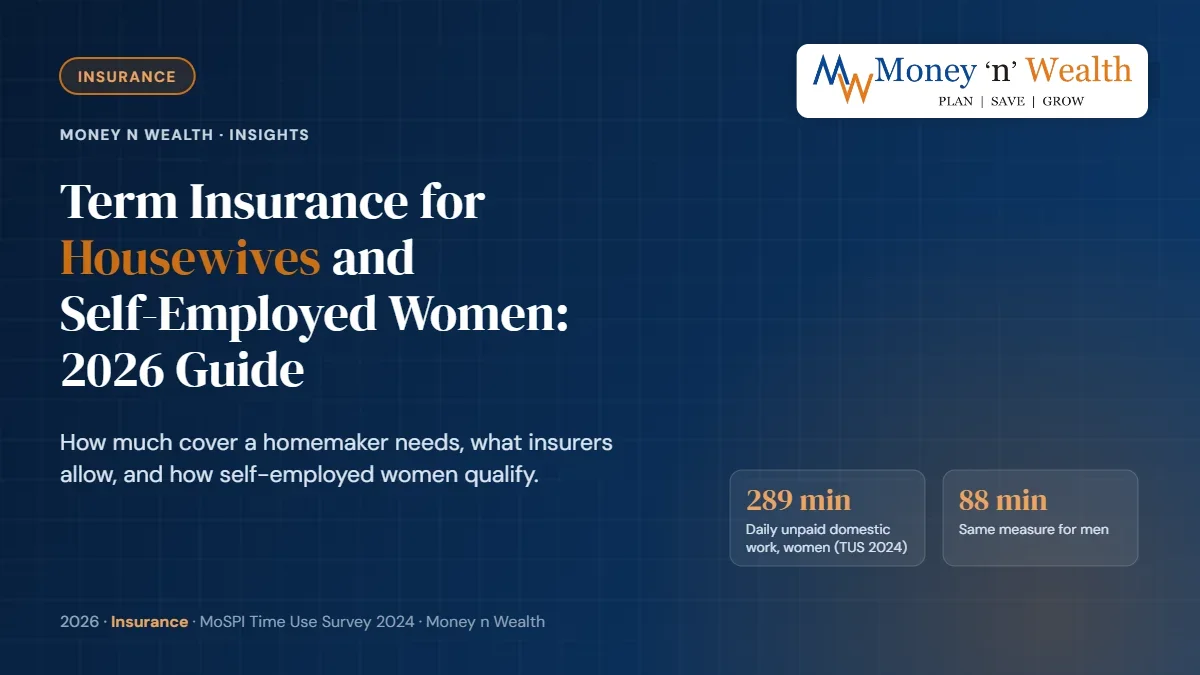
Last updated: 13 October 2026 Quick answer: Yes, a housewife can and often should buy term insurance. Size it on the cost of replacing her work, typically ₹50 lakh to ₹1 crore for a family with young children. Insurers usually link a homemaker's cover to her husband's income and cover, often capping it at 50% of his sum assured. Self-employed women qualify on their own ITR income, like any earner. Key takeaways Value: replacing a homemaker's services can cost ₹40,000+ a month in a metro. Eligibility: homemaker cover is commonly capped at 50% of the spouse's cover and often at ₹50 lakh to ₹1 crore. Self-employed: cover is a multiple of ITR income that falls with age; keep two to three years of returns ready. MWPA: the husband's policy under Section 6 of the Married Women's Property Act, 1874 protects proceeds for wife and children. Cost: individual life premiums carry no GST since 22 September 2025, and women usually pay less than men. When a homemaker dies, the family does not lose a salary. It loses a cook, a nanny, a tutor, a nurse for an ageing parent and a household manager, often all at once. The surviving spouse either pays for these services or cuts back on work. Either way, money is lost. India's Time Use Survey 2024 found that women who did unpaid domestic work spent about 289 minutes a day on it, against 88 minutes for men. Yet term insurance for housewives remains rare. This guide shows how to put a rupee value on that work, what insurers actually allow, how self-employed women should approach cover, and the legal and tax points that protect the payout. Does a housewife need term insurance? Term insurance is a pure life cover: it pays a fixed sum to nominees if the insured dies during the policy term, and nothing on survival. It is the cheapest way to replace the economic value of a life. A homemaker needs it when her death would create a cost the family cannot absorb. That is usually true when children are below 15, when there is a dependent parent at home, or when the spouse would have to reduce work hours. It is less important when children are grown and the household has substantial assets. Courts in India have recognised this value. In Kirti v Oriental Insurance Co. (2021), the Supreme Court held that a homemaker's work has real economic value and that compensation should reflect a notional income. Insurance planning should use the same logic. Time Use Survey 2024 statistics on unpaid domestic work by women and men in India How much term insurance should a homemaker have? Human life value (HLV) for an earner is usually based on income. For a homemaker, the practical method is replacement cost : what would it cost to hire the services she provides, for as long as the family needs them? Worked example: a Pune family Meera, 34, is a homemaker in Baner, Pune. Her husband Rohan, 37, earns ₹24 lakh a year and has a ₹1.5 crore term plan. Their children are 4 and 8, and Rohan's mother lives with them. Bar chart of the monthly replacement cost of a homemaker The services Meera provides would cost about ₹40,000 a month, or ₹4.8 lakh a year, to hire. The family would need most of them for 14 years, until the younger child is 18. Assume these costs rise 6% a year and the insurance payout earns 7% a year. The present value of 14 years of costs is about ₹59 lakh . Add a buffer of ₹10–15 lakh for Rohan's career disruption and one-off costs. Meera's need: roughly ₹70–75 lakh . Rohan's ₹1.5 crore cover means a 50% cap would allow up to ₹75 lakh for Meera. In this case the cap and the need line up. If Rohan had only ₹80 lakh of cover, Meera's eligible cover would be lower, and both covers would need a fresh look. A quick rule of thumb Without detailed numbers, a homemaker with children under 10 typically needs ₹50 lakh to ₹1 crore. With teenage children, ₹25–50 lakh often suffices. Recalculate when a child is born, a parent moves in or the family relocates to a costlier city. What are insurer eligibility rules for term insurance for housewives? Insurers worry about "moral hazard": large cover on a person without income. So homemaker cover is underwritten largely on the husband's profile. As of October 2026, common norms across insurers include: Factor Common norm (varies by insurer) Basis of cover Husband's income, education and existing life cover Maximum cover Often up to 50% of husband's sum assured; some allow up to 100% Absolute cap Commonly ₹50 lakh to ₹1 crore Minimum household income Often ₹5 lakh a year; higher income for higher cover Education Graduates preferred; 12th-pass may need higher household income Medical tests Usually required Existing cover in her name Deducted from her eligible limit Some insurers also offer a spouse cover option inside the husband's policy. Read it carefully. In some versions the spouse benefit is a reduced amount, or depends on who dies first. A separate individual policy for the homemaker is cleaner: her nominees receive her sum assured regardless of what happens to his policy. Do not inflate household income or hide existing policies to unlock a higher limit. Non-disclosure is the single largest cause of rejected death claims, as our guide to claim settlement ratios (/insights/claim-settlement-ratio-explained) explains. Term insurance for self-employed women: how is cover decided? A self-employed woman, whether a doctor, consultant, boutique owner, tutor or freelancer, is underwritten as an earner. Her eligibility rests on her own income, not her spouse's. Comparison of insurer eligibility rules for term insurance for homemakers vs self-employed women Income proof: insurers typically ask for two to three years of ITRs with computation of income. Irregular or falling income can lower the limit. Income multiple: maximum cover is a multiple of annual income that reduces with age. Younger applicants get higher multiples. Each insurer has its own grid. Business proof: GST registration, professional registration or a shop licence may be requested. Cash income: income not shown in ITR usually does not count. This is a strong reason to file returns properly; see our guide to money management for freelancers and the self-employed (/insights/money-management-for-freelancers-and-self-employed) . How much cover a self-employed woman needs Use the needs method. Add family living costs until dependants are independent, outstanding loans (including business loans she has guaranteed), children's education and marriage goals, and the cost of replacing her household role. Subtract existing investments and cover. The result is often well above a simple ₹1 crore. Business owners should also think about keyman insurance or partnership buy-sell cover, which are separate from personal family protection. What is MWPA and why does it matter to women? Section 6 of the Married Women's Property Act, 1874 says a policy taken by a married man on his own life, expressed to be for the benefit of his wife and/or children, is deemed a trust for them. The proceeds do not form part of his estate and are beyond the reach of his creditors while any beneficiary survives. For a homemaker, the most important MWPA policy is often her husband's . If he runs a business, has personal guarantees or large loans, a normal nomination does not stop creditors or other legal heirs from claiming the money. An MWPA endorsement does. It must be chosen at the proposal stage; an existing policy cannot be converted later. Beneficiaries can be the wife, children or both, with stated shares. A trustee can be named to receive and manage proceeds. Once endorsed, beneficiaries generally cannot be changed, including after a divorce. Section 6 is framed around a man's policy for his wife and children. Whether an insurer will issue an MWPA endorsement on a woman's own policy in favour of her husband or children varies, so ask before applying. For her own policy, a clear nomination plus a registered will usually does the job. See our estate planning guide (/insights/estate-planning-guide-india) for how nomination and wills interact. Which riders make sense for women? Riders add cost and complexity. Add one only when it fills a gap that a standalone product does not fill better. Rider What it does When it fits Accidental death benefit Extra payout if death is due to an accident Cheap; useful if commuting or driving a lot Critical illness (including women-specific) Lump sum on diagnosis of listed illnesses If no standalone critical illness plan; check the illness list and survival period Waiver of premium Future premiums waived on disability or critical illness Useful for self-employed women with no employer cover Return of premium variant Refunds premiums if you survive the term Usually poor value; a plain term plan plus investing the difference tends to work better For a deeper comparison, read who needs critical illness cover (/insights/critical-illness-insurance-guide) and personal accident and disability cover (/insights/personal-accident-disability-insurance) . How much does term insurance cost for women in 2026? Women generally pay lower term premiums than men of the same age, reflecting longer life expectancy. Non-smokers pay far less than smokers. Since 22 September 2025, premiums on individual life and health policies are exempt from GST, which removed the 18% that applied to term premiums earlier. Lock in early. A 30-year-old homemaker who buys a ₹50 lakh cover till age 60 pays the same premium every year, whereas buying at 40 costs noticeably more and risks health-based loading. Pregnancy-related conditions or recent childbirth can affect underwriting; disclose them and expect the insurer to ask for reports. Tax treatment Premium deduction: up to ₹1.5 lakh a year under section 123 of the Income-tax Act, 2025 (old section 80C), only if the payer opts for the old tax regime. A husband can claim it for a policy on his wife's life. Death benefit: the payout to nominees is tax-free. New regime: no deduction for premiums, so buy for protection, not tax. Our old vs new regime guide (/insights/tax-planning-guide-india) shows which regime suits your family. Step by step: buying a term plan for a homemaker Six steps to buy term insurance for a housewife or homemaker in India Estimate the need using replacement cost, as in Meera's example. Review the husband's cover first. If it is too low, fix it; it also sets her limit. Our guide on how much term cover you need (/insights/term-insurance-advisor-pune) helps. Choose the policy term so cover runs at least until the youngest child is 21 to 25. Compare insurers on process, not just price: medical arrangements, claim data and service. We do not rank insurers; use the checklist in our claim ratio guide. Fill the proposal yourself and disclose everything, including existing policies and any income such as rent. Record the policy with nominees and family members, and review it every three years. What if a woman is an NRI or returning to work? NRI homemakers can buy Indian term cover, but eligibility depends on residence country and the husband's profile. See insurance for NRIs from Indian insurers (/insights/insurance-for-nris-india) . If a homemaker returns to paid work, her income can support a higher cover; some plans offer life-stage increase options, but a second policy is often the simpler way to add cover. Term insurance is only one piece. Our guide to financial planning for homemakers and women (/insights/financial-planning-for-homemakers-and-women) covers emergency funds, investments in her own name and health cover. Related reading Financial planning for homemakers and women (/insights/financial-planning-for-homemakers-and-women) Claim settlement ratio: how to read it properly (/insights/claim-settlement-ratio-explained) Insurance planning in India: term, health, life (/insights/insurance-planning-guide-india) Critical illness cover: who needs it (/insights/critical-illness-insurance-guide) Retirement planning for couples (/insights/retirement-planning-for-couples-india) Frequently Asked Questions Can a housewife buy term insurance without income? Yes. Several insurers offer term plans to homemakers with no income of their own. Eligibility is based on the husband's income, education and existing life cover. Many insurers cap the homemaker's cover at 50% of the husband's sum assured and at an absolute ceiling, often between ₹50 lakh and ₹1 crore. Medical tests are usually required. How much term insurance can a housewife get? Typically up to half of her husband's existing cover, subject to a cap of ₹50 lakh to ₹1 crore depending on the insurer and household income. A few insurers allow up to the full spouse cover. Any life cover already in her name is deducted. Check the insurer's current underwriting rules, as they change periodically. How do I calculate human life value for a homemaker? Use replacement cost. List the services she provides, such as childcare, cooking, tutoring and eldercare, and price them at local rates. Multiply the annual cost by the years the family will need them, adjust for inflation and returns, and add a buffer for the spouse's career disruption. For young families, the answer is often ₹50 lakh to ₹1 crore. Is joint life term insurance good for couples? Joint life plans usually pay once, on the first death, after which cover ends or reduces. Two separate individual policies cost a little more but pay on each death independently and survive divorce or separation cleanly. For most couples with young children, separate policies give better protection. Can a wife take an MWPA policy? Section 6 of the Married Women's Property Act, 1874 is framed around a married man insuring his life for his wife and children. Some insurers may not offer MWPA endorsement on a woman's own policy, so ask the insurer. For a homemaker, the priority is usually ensuring her husband's term plan is issued under MWPA. Do women pay lower term insurance premiums? Generally yes. Because women live longer on average, insurers usually charge them lower premiums than men of the same age and health. Smoking status, health history and the policy term affect the price far more. Since 22 September 2025, individual life insurance premiums carry no GST. Can a self-employed woman get ₹1 crore term insurance? Yes, if her ITR income supports it. Insurers apply an income multiple that falls with age, so a younger applicant needs less income for the same cover. Expect to submit two to three years of ITRs and possibly business proof. Income not reflected in tax returns is usually ignored for eligibility. Sources: Business Today on MoSPI Time Use Survey 2024 (https://www.businesstoday.in/india/story/time-use-survey-women-take-on-most-of-household-and-caregiving-work-465946-2025-02-25) ; Ditto, insurer norms for housewife term plans (https://joinditto.in/articles/life-insurance/term-insurance-for-housewife/) ; Business Standard on homemaker cover (https://www.business-standard.com/article/pf/life-insurance-homemakers-must-have-a-term-cover-of-least-rs-20-50-lakh-122051800590_1.html) ; INDmoney on Section 6, MWP Act (https://www.indmoney.com/articles/insurance/married-womens-property-act-in-india) ; Bharti AXA Life on MWPA policies (https://www.bhartiaxa.com/term-insurance/mwp-act-in-insurance) ; Business Today on GST exemption (https://www.businesstoday.in/india/story/big-relief-health-and-life-insurance-exempted-from-gst-as-council-scraps-12-and-28-slabs-492405-2025-09-03) . Worked examples are Money n Wealth calculations. Is your family's cover built around both partners? A short review can size cover for each spouse, check MWPA and avoid disclosure mistakes. Talk to Money n Wealth (/contact) for an insurance review. This article is for general educational purposes only and does not constitute financial advice. Figures and examples are illustrative. Please consult a qualified financial adviser for guidance specific to your situation. Money n Wealth (Predics Fintech Services Pvt Ltd) is an AMFI-registered Mutual Fund Distributor (ARN-121995) and APMI-registered PMS Distributor (APRN07444); it is not a SEBI-registered investment adviser and may earn distribution commission on investments made through it. Insurance is the subject matter of solicitation.
Frequently Asked Questions
Can a housewife buy term insurance without income?
Yes. Several insurers offer term plans to homemakers with no income of their own. Eligibility is based on the husband's income, education and existing life cover. Many insurers cap the homemaker's cover at 50% of the husband's sum assured and at an absolute ceiling, often between ₹50 lakh and ₹1 crore. Medical tests are usually required.
How much term insurance can a housewife get?
Typically up to half of her husband's existing cover, subject to a cap of ₹50 lakh to ₹1 crore depending on the insurer and household income. A few insurers allow up to the full spouse cover. Any life cover already in her name is deducted. Check the insurer's current underwriting rules, as they change periodically.
How do I calculate human life value for a homemaker?
Use replacement cost. List the services she provides, such as childcare, cooking, tutoring and eldercare, and price them at local rates. Multiply the annual cost by the years the family will need them, adjust for inflation and returns, and add a buffer for the spouse's career disruption. For young families, the answer is often ₹50 lakh to ₹1 crore.
Is joint life term insurance good for couples?
Joint life plans usually pay once, on the first death, after which cover ends or reduces. Two separate individual policies cost a little more but pay on each death independently and survive divorce or separation cleanly. For most couples with young children, separate policies give better protection.
Can a wife take an MWPA policy?
Section 6 of the Married Women's Property Act, 1874 is framed around a married man insuring his life for his wife and children. Some insurers may not offer MWPA endorsement on a woman's own policy, so ask the insurer. For a homemaker, the priority is usually ensuring her husband's term plan is issued under MWPA.
Do women pay lower term insurance premiums?
Generally yes. Because women live longer on average, insurers usually charge them lower premiums than men of the same age and health. Smoking status, health history and the policy term affect the price far more. Since 22 September 2025, individual life insurance premiums carry no GST.
Can a self-employed woman get ₹1 crore term insurance?
Yes, if her ITR income supports it. Insurers apply an income multiple that falls with age, so a younger applicant needs less income for the same cover. Expect to submit two to three years of ITRs and possibly business proof. Income not reflected in tax returns is usually ignored for eligibility.
Is your family's cover built around both partners?
A short review can size cover for each spouse, check MWPA and avoid disclosure mistakes. Talk to Money n Wealth for an insurance review.