Unlisted and Pre-IPO Shares in 2026: The Risks Most Investors Miss
Last updated: 13 October 2026
Quick answer: Unlisted shares are shares of companies not traded on a stock exchange, bought through dealers or platforms at negotiated prices. The main risks: no reliable price discovery, IPOs priced below the unlisted market, a six-month lock-in after listing under SEBI's ICDR rules, a 24-month holding period for long-term tax, and platforms that SEBI says it does not recognise or regulate.
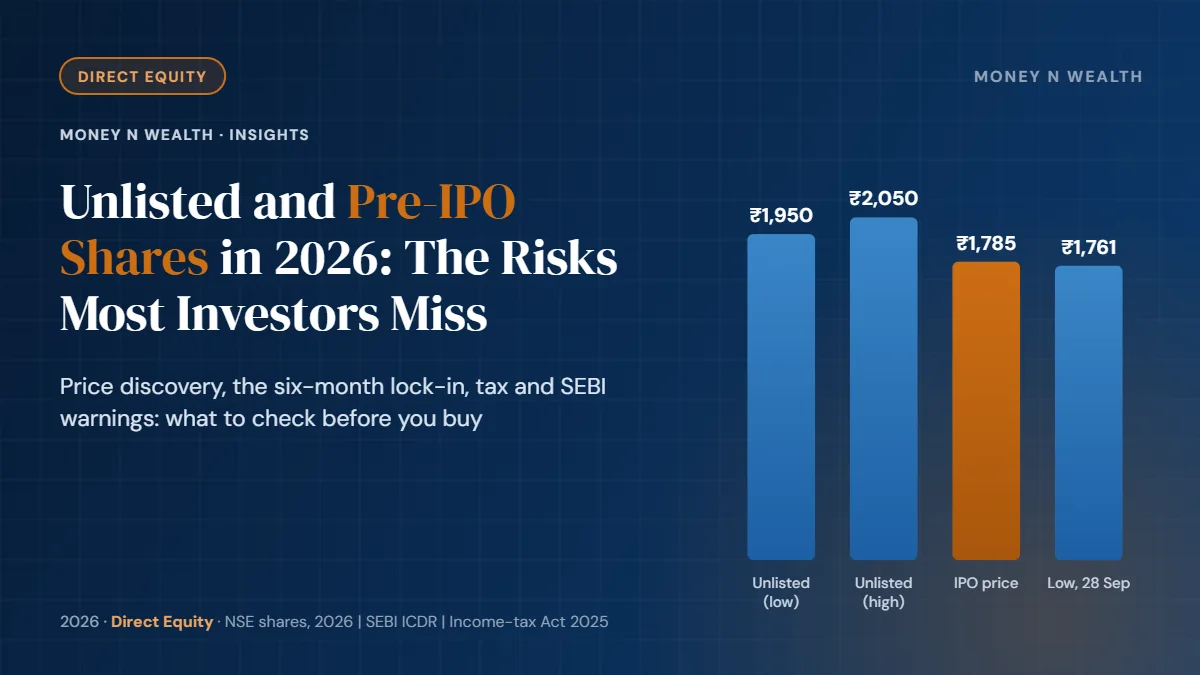
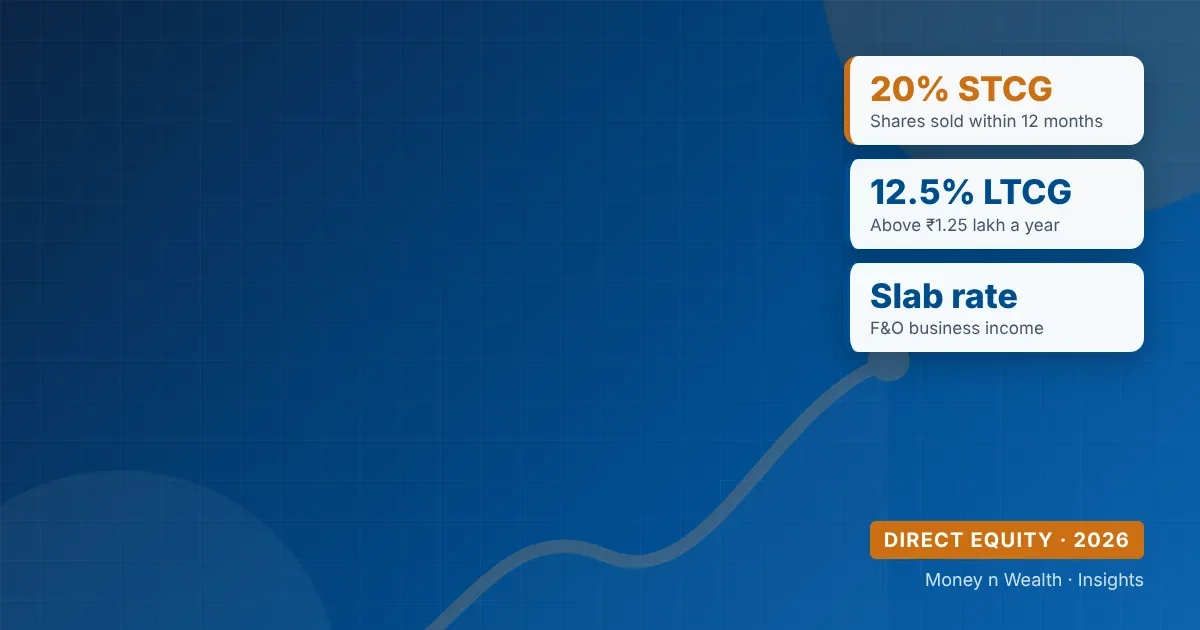
Last updated: 13 October 2026 Quick answer: Unlisted shares are shares of companies not traded on a stock exchange, bought through dealers or platforms at negotiated prices. The main risks: no reliable price discovery, IPOs priced below the unlisted market, a six-month lock-in after listing under SEBI's ICDR rules, a 24-month holding period for long-term tax, and platforms that SEBI says it does not recognise or regulate. Key takeaways Lock-in: all pre-IPO shares held by non-promoters are locked in for six months from IPO allotment (ICDR Regulation 17). NSE example: unlisted buyers paid ₹1,950–2,050; the September 2026 IPO priced at ₹1,785. HDB Financial: unlisted peak near ₹1,550 against a ₹740 IPO price in 2025. Tax: unlisted shares need 24 months for 12.5% LTCG; shorter holdings are taxed at your slab rate. SEBI warning: on 17 June 2026 SEBI again cautioned investors against unauthorised unlisted-share platforms. In September 2026, the National Stock Exchange finally listed after years of waiting. Thousands of retail and HNI investors had bought its shares in the unlisted market at ₹1,950 to ₹2,050, expecting a listing pop. The IPO was priced at ₹1,785. Within days the stock dipped to ₹1,761, and those investors could not sell: their shares were locked in until about March 2027. Pre-IPO investing is marketed as getting in "before the crowd". Sometimes it works. But the risks are structural, not accidental. This guide explains how unlisted shares are bought and priced, the lock-in and tax rules, what SEBI has said, and a checklist to use before you put money in. What are unlisted shares, and how do people buy them? Unlisted shares are equity shares of companies that are not listed on NSE or BSE. They include large public companies that have not yet gone public, private companies, and firms whose IPO is years away. Shares typically come from employees selling ESOP shares, early investors exiting, or founders' relatives. Retail buyers usually go through a dealer or an online platform. You pay the dealer, and the shares arrive in your demat account through an off-market transfer. There is no exchange, no order book and no clearing corporation guaranteeing the trade. Stamp duty of 0.015% applies on the transfer. Unlisted vs listed shares at a glance Feature Listed shares Unlisted / pre-IPO shares Where traded Recognised stock exchange Dealers and online platforms, off-market Price Continuous, public order book Negotiated; spreads undisclosed Settlement guarantee Clearing corporation None; counterparty risk Disclosure Quarterly results, SEBI LODR Annual filings with MCA, often delayed Grievance redress Exchange, SCORES, ODR Largely civil courts Long-term tax holding period More than 12 months More than 24 months Lock-in on IPO Not applicable Six months from allotment Why are unlisted share prices often higher than the IPO price? Price discovery in the unlisted market is thin. A handful of dealers set quotes based on limited trades, media buzz and their own inventory. When a well-known name heads for an IPO, demand from retail buyers rises while supply stays fixed, so quotes drift up. The IPO, by contrast, is priced through book-building with large institutions, who negotiate hard. The result is a recurring pattern. HDB Financial Services' unlisted shares were reportedly bought at around ₹1,550 at one point, according to data collated by The CapTable; the IPO in June 2025 was priced at ₹740. NSE's unlisted shares traded around ₹1,950–2,050 before its September 2026 IPO, according to Outlook Money, and the issue was priced at ₹1,785. Bar chart of unlisted shares and pre-IPO losses at IPO price for NSE and HDB Financial buyers Working the numbers: an investor who bought 100 NSE shares at ₹2,000 paid ₹2 lakh. At the ₹1,785 issue price, that holding was worth ₹1.79 lakh, a 10.8% paper loss. At the 28 September intraday low of ₹1,761, the loss was 12%, and the shares could not be sold. Not every pre-IPO buy ends this way, and early buyers who entered years earlier at much lower prices may still be in profit. The point is that the IPO price is set by a different, tougher market than the one you bought in. Grey market premiums tell a similar story; see why IPO GMP often misleads (/insights/what-is-ipo-gmp) . How does the six-month lock-in after an IPO work? Under Regulation 17 of the SEBI (Issue of Capital and Disclosure Requirements) Regulations, 2018, the entire pre-issue capital held by persons other than promoters is locked in for six months from the date of allotment in the IPO. This applies to you if you bought unlisted shares before the IPO. SEBI cut this from one year to six months in 2021. Certain holders, such as specified registered funds and some ESOP holders, are treated differently under the regulation's exemptions. Promoters face their own lock-ins: the minimum promoter contribution is generally locked for 18 months, and anchor investors are locked for 30 to 90 days. Ordinary IPO applicants have no lock-in at all. So when the stock falls after listing, IPO allottees and anchors can exit before you can. Timeline of the six-month lock-in on pre-IPO shares after the NSE IPO in September 2026 What else can block your exit? No IPO at all: many companies tipped for listing delay for years. Your money stays stuck with no market. Offer-for-sale exclusion: in an OFS, only large selling shareholders named in the offer document sell; small holders do not get to participate. Private company rules: a private limited company's articles restrict share transfers and it cannot have more than 200 members, so transfers may need board approval. Corporate actions: bonuses, splits or a merger can change your holding, and information reaches unlisted holders late. How are unlisted shares taxed? Unlisted shares are long-term only after 24 months. Long-term gains are taxed at 12.5% without indexation (since 23 July 2024), with no ₹1.25 lakh exemption. Gains on holdings of 24 months or less are added to your income and taxed at slab rates. The Income-tax Act, 2025 kept these rates. Once the company lists, the treatment generally changes. Shares sold on the exchange after listing are listed equity: more than 12 months of holding (counted from your original purchase) makes the gain long-term, taxed at 12.5% above the ₹1.25 lakh annual exemption, and short-term gains are taxed at 20%. The STT-on-purchase condition for this concessional rate is relaxed for shares acquired before listing, but confirm your case with a CA. Example: you buy shares for ₹2 lakh and later have a ₹1 lakh gain. Sold off-market within 24 months at the 30% slab, tax is ₹31,200. Sold off-market after 24 months, it is ₹13,000. Sold on the exchange after listing, with more than 12 months' holding and no other equity gains that year, it is nil. Tax on unlisted shares gains: slab-rate STCG versus 12.5% LTCG versus listed LTCG exemption Two further points. Losses on unlisted shares can be set off only against capital gains, under the usual rules. And buying unlisted shares at a price well below fair market value can trigger tax on the difference as income, a rule worth remembering for family or "friends and employees" deals. For listed-share tax planning, see capital gains tax on shares and tax harvesting (/insights/capital-gains-tax-shares-tax-harvesting) ; for employee shares, see ESOP and RSU taxation (/insights/esop-rsu-taxation-india) . What has SEBI said about unlisted share platforms? SEBI has repeatedly warned investors. In a press release dated 17 June 2026 (PR No. 32/2026), its third such advisory after August 2016 and December 2024, SEBI cautioned against dealing in securities of unlisted public companies through electronic platforms that it has not authorised or recognised. Its message, in short, was that trading in securities should happen on recognised stock exchanges. The practical consequences for you: No investor protection fund: exchange investor protection does not cover these trades. No SCORES or ODR route: SEBI's grievance and online dispute mechanisms generally do not apply, so a dispute may end up in civil court. Settlement risk: if you pay and the shares do not arrive, there is no clearing corporation to step in. In August 2025, SEBI Chairman Tuhin Kanta Pandey floated, in principle, a regulated pilot venue where shares could trade in the gap between IPO allotment and listing, to replace the grey market. That idea does not cover the wider unlisted market, and we could not confirm any notified framework as of October 2026. Until it is, treat every platform's claims of being "SEBI-approved" with suspicion; you can check any intermediary using our guide on how to verify a SEBI registration (/insights/how-to-verify-arn-sebi-irdai-registration) . Is investing in pre-IPO shares worth it? For most individual investors, only as a small, speculative slice. Global evidence on IPOs points the same way: studies of US IPOs by Jay Ritter at the University of Florida have long found that newly listed companies, on average, underperform comparable firms over the following three to five years. Buying before the IPO adds illiquidity and pricing risk on top of that. If you still want exposure to private companies, regulated routes exist. Category II AIFs (/insights/category-ii-aif-guide) invest in unlisted firms with professional due diligence (minimum ₹1 crore). Some PMS (/insights/pms-india) and mutual funds hold pre-IPO allocations within diversified portfolios. And applying in the IPO itself, through UPI and ASBA (/insights/how-to-apply-ipo-upi-asba-allotment) , carries no lock-in. Checklist of green and red flags before buying unlisted shares or pre-IPO shares in India A seven-point checklist before buying unlisted shares Limit size: keep all unlisted holdings to a small share of your equity portfolio, money you can leave untouched for five years or more. Read the financials: get the last two years' audited accounts from the MCA portal or the company website. Compare prices: get quotes from at least three dealers; ask what the last few actual trades were. Check transferability: confirm the shares are in demat form with an ISIN and the transfer is permitted. Pay against delivery: avoid paying in full before the shares are credited; use documented bank transfers only. Plan for the lock-in: assume six months from IPO allotment, plus the possibility of no IPO for years. Work out the tax: note your purchase date; the 24-month and 12-month clocks matter. Our guide to SME IPO risks (/insights/sme-ipo-risks-india) covers another corner of the market where liquidity and disclosure are weaker than they appear. Related reading What is IPO GMP, and why it misleads (/insights/what-is-ipo-gmp) SME IPOs: why the risks are different (/insights/sme-ipo-risks-india) Upcoming IPOs this week (/insights/upcoming-ipos-this-week) ESOP and RSU taxation in India (/insights/esop-rsu-taxation-india) Direct equity investing: taxation and costs (/insights/direct-equity-investing-india-taxation-guide) Investment scams in 2026 (/insights/investment-scams-india-2026) Frequently Asked Questions Is it legal to buy unlisted shares in India? Buying shares of an unlisted company in a private transaction is legal, provided the transfer complies with company law and the company's articles. The concern SEBI has raised is about electronic platforms facilitating such trades: in June 2026 it said such platforms are not authorised or recognised by it, so investors using them lack SEBI-administered protection and dispute resolution. What is the lock-in period for pre-IPO shares? Under Regulation 17 of SEBI's ICDR Regulations, shares held by non-promoter shareholders before an IPO are locked in for six months from the date of IPO allotment. If you bought unlisted shares before the IPO, you generally cannot sell them on the exchange until this period ends, even if the price falls after listing. How is tax calculated on unlisted shares? Gains on unlisted shares held more than 24 months are long-term and taxed at 12.5% without indexation, with no ₹1.25 lakh exemption. Gains on shares held 24 months or less are taxed at your slab rate. If the company lists and you sell on the exchange after more than 12 months, listed-equity rates generally apply. Why did NSE unlisted shareholders lose money after the IPO? Unlisted buyers paid about ₹1,950–2,050 per share, but the September 2026 IPO was priced at ₹1,785 through book-building with institutions. The stock listed at ₹1,800 and dipped to about ₹1,761 within days. Pre-IPO holders were in the six-month lock-in, so they could not sell, unlike IPO allottees. Are pre-IPO investment platforms regulated by SEBI? No. SEBI's advisories of August 2016, December 2024 and June 2026 cautioned that platforms facilitating trades in unlisted securities are not recognised or authorised by SEBI. Trades are off-market, with no clearing guarantee or investor protection fund. Any platform claiming SEBI approval for unlisted share trading should be treated with caution. Can I sell unlisted shares before the IPO? Yes, if you find a buyer through a dealer or privately, but liquidity is thin and you may have to accept a lower price, especially when sentiment turns. Once the IPO allotment happens, the six-month lock-in applies, and the shares cannot be sold on the exchange until it ends. Sources: Taxmann: SEBI PR 32/2026 on unlisted securities platforms (https://www.taxmann.com/post/blog/sebi-warns-investors-against-trading-unlisted-securities-on-unauthorised-platforms) ; CorpLawUpdates: SEBI's three advisories (https://www.corplawupdates.in/updates/sebi-warning-unlisted-securities-unauthorised-platforms-2026) ; Outlook Money: NSE trades below issue price (https://www.outlookmoney.com/invest/nse-share-price-falls-below-ipo-issue-price-why-the-stock-is-tumbling-and-what-it-means-for-investors) ; Business Standard: NSE IPO coverage (https://www.business-standard.com/amp/topic/nse-ipo) ; The CapTable: retail investors in unlisted stocks (https://the-captable.com/2025/07/retail-investors-in-unlisted-stocks/) ; Business Standard: SEBI may consider regulated pre-IPO platform (https://www.business-standard.com/amp/markets/news/sebi-may-introduce-regulated-platform-for-pre-ipo-firms-tuhin-kanta-pandey-125082100581_1.html) ; IPO lock-in rules under SEBI ICDR (https://www.ipomarket.in/news/ipo-lock-in-period-promoters-anchor-investors-1xji2s) . Worked examples are Money n Wealth calculations. Holding unlisted shares or tempted by a pre-IPO deal? A second opinion on price, lock-in and tax can prevent an expensive mistake. Talk to Money n Wealth (/contact) for a free portfolio review, or explore our direct equity services (/products/equity) . This article is for general educational purposes only and does not constitute financial advice. Figures and examples are illustrative. Please consult a qualified financial adviser for guidance specific to your situation. Money n Wealth (Predics Fintech Services Pvt Ltd) is an AMFI-registered Mutual Fund Distributor (ARN-121995) and APMI-registered PMS Distributor (APRN07444); it is not a SEBI-registered investment adviser and may earn distribution commission on investments made through it.