What to Do With a Windfall: Bonus, Inheritance or Sudden Money (2026)
Last updated: 13 October 2026
Quick answer: With a windfall, first park it in a liquid fund and wait 30–90 days. Then settle any tax, pay off high-interest debt, top up your emergency fund and insurance, and set aside money for goals within three years. Invest the rest per your asset allocation, as a lump sum or short STP, and keep 5–10% to enjoy.
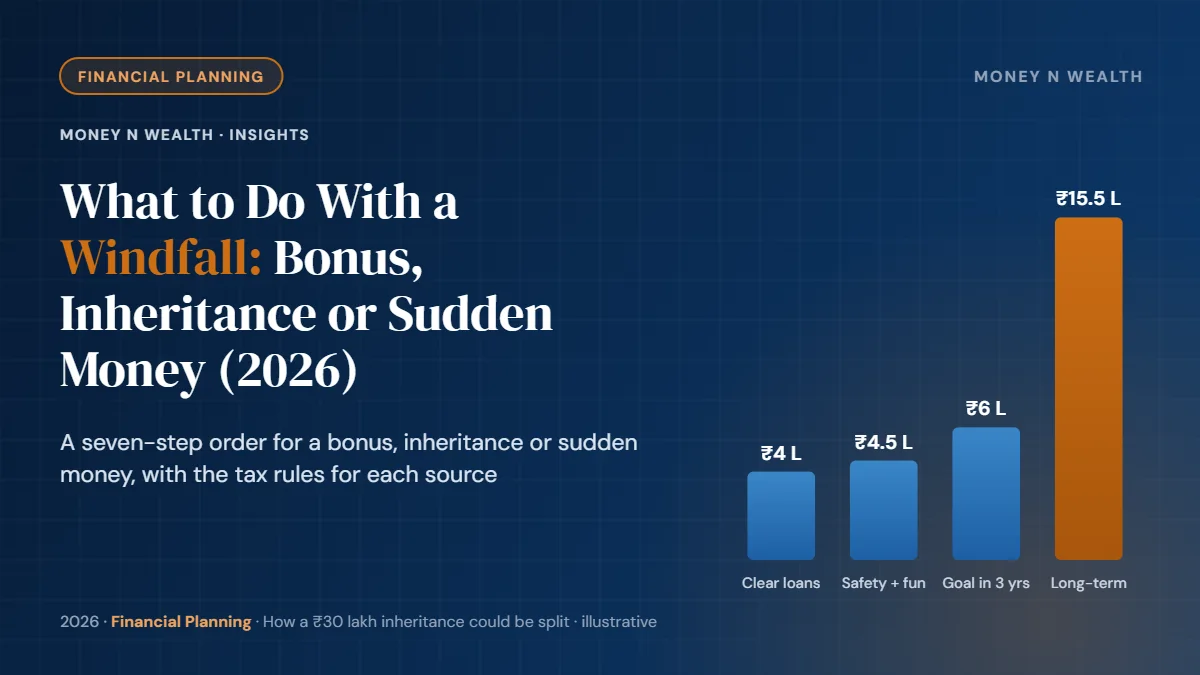
Last updated: 13 October 2026 Quick answer: With a windfall, first park it in a liquid fund and wait 30–90 days. Then settle any tax, pay off high-interest debt, top up your emergency fund and insurance, and set aside money for goals within three years. Invest the rest per your asset allocation, as a lump sum or short STP, and keep 5–10% to enjoy. Key takeaways Inheritance: not taxed on receipt under section 92(3) of the Income-tax Act, 2025; India has no estate duty. Bonus: taxed as salary; a ₹5 lakh bonus at the 30% slab leaves about ₹3.44 lakh. Lottery: taxed at a flat 30% plus surcharge and cess, with no basic exemption. Debt first: clearing a 13.5% personal loan is a guaranteed 13.5% return. Lump sum vs STP: Vanguard found lump sums beat three-month averaging about two-thirds of the time. Ananya, a 38-year-old product manager in Baner, received ₹30 lakh from her late father's FDs and mutual funds. Within a week, she had three suggestions: a relative wanted her to buy a plot, her bank pitched a "guaranteed" insurance plan, and a colleague recommended a small-cap fund that had doubled. Sudden money, whether a bonus, an inheritance, ESOP proceeds or a property sale, tends to attract advice and pressure in equal measure. This guide sets out what to do with a windfall in India: how each type is taxed, the order in which to use it, and a worked example of how ₹30 lakh can be split. What should you do first when you receive a windfall? Do nothing dramatic. A windfall is any large, one-off sum that is not part of your regular income. The first job is to protect it from rushed decisions, including your own. Park the money in a liquid fund, an overnight fund or a sweep-in FD for 30 to 90 days. Liquid funds have a small exit load only in the first seven days. Use the time to understand the tax, list your debts and goals, and, in the case of an inheritance, let the grief settle before committing to anything irreversible. Research suggests this matters. A study of Florida lottery winners by Hankins, Hoekstra and Skiba, published in 2011 in The Review of Economics and Statistics , found that prizes of $50,000 to $150,000 appeared to delay bankruptcy rather than prevent it among people already in financial difficulty. Money without a plan tends to leak away. Seven-step plan for what to do with a windfall, bonus or inheritance in India Is a bonus, inheritance or gift taxable in India? It depends entirely on the source. Here is the position under the Income-tax Act, 2025, as of October 2026. Windfall Tax on receipt What to watch Annual, joining or retention bonus Salary, taxed at your slab; employer deducts TDS Clawback clauses on joining bonuses Inheritance or bequest under a will Not taxed (section 92(3)(c)) Later income and capital gains are taxed; you inherit the original cost and holding period Gift from a relative Not taxed, any amount (section 92(3)(a)) Clubbing applies to gifts from a spouse Gift from a non-relative Fully taxable if gifts total more than ₹50,000 in the year The whole amount is taxed, not just the excess Gifts on your marriage Not taxed, from anyone Birthdays and anniversaries do not qualify Lottery, game show, betting winnings Flat 30% plus surcharge and cess; TDS of 30% above ₹10,000 under section 393(3) No basic exemption or deductions ESOP or RSU proceeds Perquisite at exercise or vesting at slab; capital gains on sale Foreign shares need Schedule FA reporting Property sale Long-term gains at 12.5% (held over 24 months) Reinvestment exemptions under the old sections 54/54F/54EC Table showing tax on bonus, inheritance, gifts and lottery windfall in India in 2026 Inheritance: tax-free now, taxable later India abolished estate duty in 1985 and has no inheritance tax. Money or property received under a will or by inheritance is explicitly excluded from tax on receipt. But once you hold it, interest, rent and dividends are taxed as your income. When you sell an inherited asset, the previous owner's cost and holding period carry over, which usually makes the gain long-term. Our guide on claiming a parent's investments (/insights/claim-deceased-parent-investments-checklist) covers the transmission process, and gifting money to family (/insights/gifting-money-family-clubbing-rules) explains section 92 in detail. Bonus: plan for the tax before you plan the spending A bonus is salary. At the 30% slab plus 4% cess, a ₹5 lakh bonus leaves about ₹3.44 lakh in hand. If your employer under-deducts TDS, the shortfall shows up in March or at filing. For one-off capital gains, such as selling inherited property or shares, check whether you need to pay advance tax; our advance tax guide (/insights/advance-tax-for-investors) explains the dates. Should you pay off debt or invest a windfall? Clear expensive debt first. Paying off a loan earns you its interest rate, risk-free and after tax. No investment reliably beats a 36–42% credit card rate or a 13–16% personal loan. Credit card balances: always first. See the minimum-due trap (/insights/credit-card-debt-minimum-due-trap) . Personal loans: Ananya's ₹4 lakh at 13.5% with three years left would cost about ₹88,700 more in interest. Check foreclosure charges on fixed-rate loans before paying. Car loans around 9–10%: a judgement call; prepaying is reasonable if you are cautious. Home loans: often worth keeping if the rate is modest and you have a long horizon, especially with a tax benefit. Our prepay or invest guide (/insights/prepay-home-loan-or-invest) runs the numbers. RBI rules bar foreclosure charges on floating-rate loans to individuals. How should you invest a windfall? A worked example Once debt is handled, the order is safety, near-term goals, then long-term investing. Here is how Ananya, who spends ₹75,000 a month and had ₹1.5 lakh in her emergency fund, split her ₹30 lakh. Bar chart of how to invest inheritance money: debt repayment, emergency fund, near-term goal and long-term investments Personal loan (₹4 lakh): paid off, saving about ₹88,700 of interest and freeing ₹13,574 a month for her SIP. Emergency fund (₹3 lakh): topped up to ₹4.5 lakh, six months of expenses, in a liquid fund and sweep FD. See our emergency fund guide (/insights/emergency-fund-guide-india) . Fun and family (₹1.5 lakh): 5% for a family trip and a gift for her mother. A small, planned slice reduces the urge to raid the rest. Home down payment in three years (₹6 lakh): in short-duration debt funds and FDs. At 7% it could be about ₹7.35 lakh when needed. Long-term portfolio (₹15.5 lakh): invested in line with her 65:35 equity-debt allocation, with the equity portion entered through a six-month STP. She also checked insurance. Her term cover was adequate, but her only health cover was through work, so she added a personal floater. Our insurance planning guide (/insights/insurance-planning-guide-india) explains how to size both. Line chart comparing a windfall invested in a balanced mutual fund portfolio with an FD after tax over 20 years The long-term slice is where the windfall compounds. At an assumed 10% a year, ₹15.5 lakh could grow to about ₹1.04 crore in 20 years. In an FD at 7%, taxed at 31.2%, it would reach about ₹40 lakh. Neither figure is guaranteed, and the portfolio will have bad years, but the gap shows the cost of leaving long-term money in deposits. Lump sum or STP: how should the equity part go in? Vanguard's study of cost averaging found that investing a lump sum immediately beat splitting it over three months about 68% of the time in global equities from 1976 to 2022. Markets rise more often than they fall, so cash waiting on the side usually costs you. But the study also found that averaging suits investors who would regret a bad entry. A practical rule: Where the money is going Approach Debt funds, FDs, arbitrage funds Lump sum Balanced advantage or multi-asset funds Lump sum; the fund manages equity exposure Diversified equity, comfortable with volatility Lump sum or 3-month STP Diversified equity, first large investment 3–6 month STP from a liquid fund Small-cap or sectoral funds Only as a small satellite, staggered Our detailed comparison, SIP vs lumpsum vs STP (/insights/sip-vs-lumpsum-vs-stp) , covers exit loads and tax on STP transfers. What should you avoid doing with a windfall? Buying a product because a salesperson called. Bundled insurance-investment plans often have low real returns. See how to check the real IRR (/insights/guaranteed-return-endowment-plan-real-irr) . Chasing last year's best fund. Recent returns are a poor guide to future returns. Choose by fit and process, as in our portfolio-first framework (/insights/how-to-choose-mutual-funds-portfolio-framework) . Putting it all into property. A plot ties up money, earns no income and is hard to sell in parts. Lending to friends and relatives without a plan. Decide in advance what you can afford to treat as a gift. Ignoring retirement. A windfall in your 40s can close a large part of a retirement gap; see retirement planning at 40 (/insights/starting-retirement-planning-at-40) . Handling an inheritance: the emotional side An inheritance usually arrives with loss. Many people feel guilty spending it, or rush to "honour" it with a big purchase. Both are normal. Waiting a few months, involving your spouse, and writing down what you want the money to achieve make better decisions more likely. If siblings share the estate, agree the division and paperwork in writing before anyone invests their share. Related reading SIP vs lumpsum vs STP: investing a bonus or windfall (/insights/sip-vs-lumpsum-vs-stp) FIRE in India: retiring early without running out (/insights/fire-movement-retire-early-india) SWP: drawing a monthly income from mutual funds (/insights/swp-systematic-withdrawal-plan-guide) Tax on property sale and reinvestment exemptions (/insights/tax-on-property-sale-section-54-54f-54ec) ESOP and RSU taxation for IT employees (/insights/esop-rsu-taxation-india) Mutual funds with Money n Wealth (/products/mutual-funds) Frequently Asked Questions Is inheritance taxable in India? No. Under section 92(3)(c) of the Income-tax Act, 2025, money or property received under a will or by inheritance is not taxed on receipt, and India has had no estate duty since 1985. However, income from inherited assets, such as interest or rent, is taxable in your hands, and capital gains apply when you sell, using the previous owner's cost and holding period. How much tax will I pay on my annual bonus? A bonus is part of salary and is taxed at your slab rate. If your income already falls in the 30% slab, a ₹5 lakh bonus attracts about ₹1.56 lakh of tax including 4% cess, leaving about ₹3.44 lakh. Surcharge applies at higher incomes. Your employer deducts TDS, but check your annual tax position for any shortfall. Should I use my bonus to prepay my home loan? Partly, perhaps. Prepaying gives a risk-free return equal to the loan rate. If your home loan costs around 8–9% and you have 15 or more years left, investing for long-term goals may build more wealth, but with risk. Many people split the bonus: some to prepay, some to investments. Always clear credit cards and personal loans first. How is lottery or game-show prize money taxed? Winnings from lotteries, game shows, card games and betting are taxed at a flat 30%, plus surcharge and 4% cess, with no basic exemption or deductions. The payer deducts 30% TDS on winnings above ₹10,000 in a single transaction under section 393(3) of the Income-tax Act, 2025, which replaced the old section 194B. Should I invest a large windfall all at once or through an STP? Historically, investing at once has done better about two-thirds of the time, according to Vanguard's global study. But a 3–6 month STP reduces regret if markets fall soon after you invest. Put debt and hybrid money in at once; for equity, choose based on how you would cope with a 20% fall in the first year. Where should I keep a windfall while I decide? A liquid fund, overnight fund or sweep-in FD is suitable for one to three months. They keep the money safe and accessible while earning something. Liquid funds have a small graded exit load only in the first seven days. Avoid locking it into long-term products until you have a plan. Do I need to pay tax on money my parents give me? No. Parents are "relatives" under section 92, so gifts from them are tax-free in any amount. Keep a bank trail and a simple gift letter. Income you later earn on the money is taxed in your hands, not theirs, if you are an adult. Sources: Income Tax Department, section 92, Income-tax Act 2025 (https://www.incometaxindia.gov.in/w/section-92-113) ; TDSMAN on TDS on winnings under section 393(3) (https://blog.tdsman.com/2026/05/tds-on-winnings-from-lottery-games-etc-section-3933-section-194b/) ; Vanguard, Cost averaging: invest now or temporarily hold your cash? (https://corporate.vanguard.com/content/dam/corp/research/pdf/cost_averaging_invest_now_or_temporarily_hold_your_cash.pdf) ; Hankins, Hoekstra and Skiba (2011), Review of Economics and Statistics (https://ideas.repec.org/a/tpr/restat/v93y2011i3p961-969.html) ; Income Tax Department, section 198 (https://www.incometaxindia.gov.in/w/section-198-76) . Worked examples are Money n Wealth calculations. Just received a bonus or inheritance? The right split depends on your debts, goals, tax position and family situation, and a few weeks of planning can be worth lakhs. Talk to Money n Wealth (/contact) for a free portfolio review. This article is for general educational purposes only and does not constitute financial advice. Figures and examples are illustrative. Please consult a qualified financial adviser for guidance specific to your situation. Money n Wealth (Predics Fintech Services Pvt Ltd) is an AMFI-registered Mutual Fund Distributor (ARN-121995) and APMI-registered PMS Distributor (APRN07444); it is not a SEBI-registered investment adviser and may earn distribution commission on investments made through it.