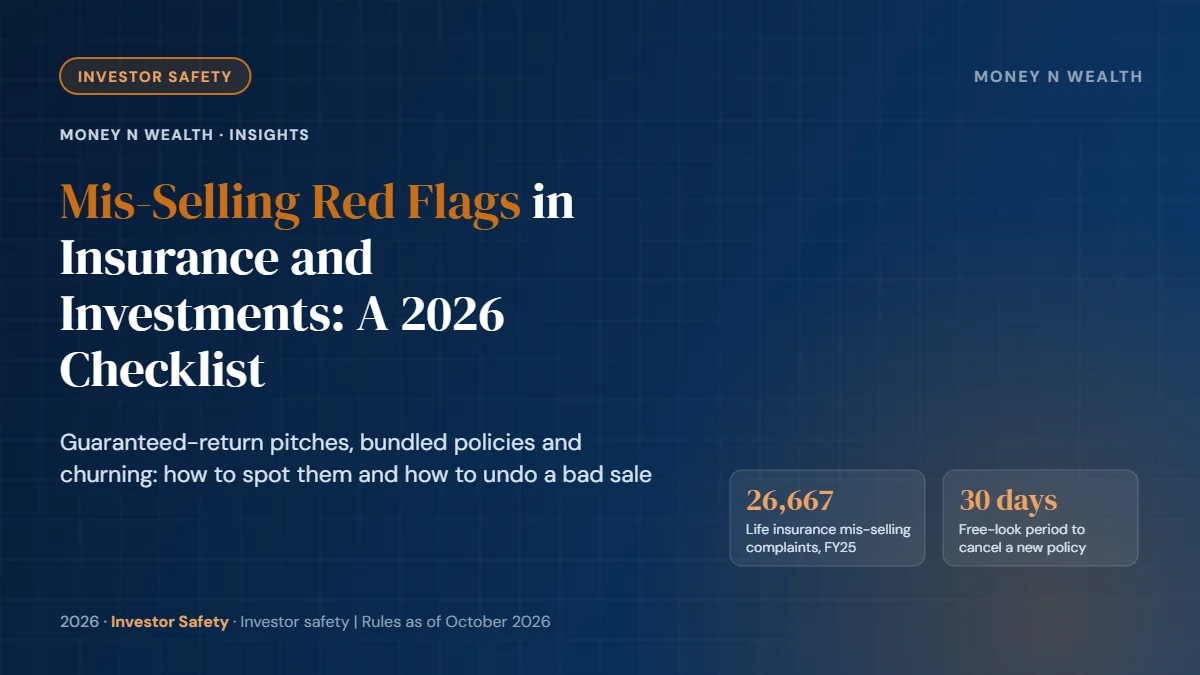
Mis-Selling Red Flags in Insurance and Investments: A 2026 Checklist
Last updated: 13 October 2026
Quick answer: The biggest mis-selling red flags are a savings plan pitched as "guaranteed" or "like an FD", insurance pushed as a condition of a loan, and frequent switching of funds or policies. Ask for the IRR and lock-in in writing. If you have just bought an unsuitable policy, cancel it within IRDAI's 30-day free-look period for a near-full refund.
Last updated: 13 October 2026 Quick answer: The biggest mis-selling red flags are a savings plan pitched as "guaranteed" or "like an FD", insurance pushed as a condition of a loan, and frequent switching of funds or policies. Ask for the IRR and lock-in in writing. If you have just bought an unsuitable policy, cancel it within IRDAI's 30-day free-look period for a near-full refund. Key takeaways Rising complaints: Life insurance mis-selling grievances rose from 23,335 in FY24 to 26,667 in FY25 (IRDAI). Free-look: IRDAI extended the life insurance free-look period from 15 to 30 days in its June 2024 master circular. Maturity vs IRR: A "guaranteed ₹17 lakh" for ₹10 lakh paid over 10 years works out to only about 5.1% a year. Bank sales: RBI's amended rules, effective 1 January 2027, ban compulsory bundling and require refunds when mis-selling is established. Churning: Switching funds or policies often costs exit loads, tax and fresh charges for the seller's benefit. Consider a familiar story: a retired schoolteacher in Kothrud walks into her bank to renew a ₹5 lakh FD. She walks out having signed for a "special senior scheme" with five annual premiums of ₹5 lakh each. It is a traditional life insurance plan, and the illustration she was shown quoted the maturity amount, not the return. Stories like this are why mis-selling complaints keep rising. Mis-selling is the sale of a financial product that does not suit the buyer, or the sale of one on the basis of incomplete or misleading information. This guide lists the red flags in insurance, mutual funds and bank-sold products, explains the free-look and complaint routes, and shows what changes under the new RBI rules. How common is mis-selling in India? IRDAI's Annual Report 2024-25 recorded 2,57,790 insurance grievances on the Bima Bharosa portal, of which 1,20,429 were against life insurers. Complaints classed as unfair business practices, the regulator's term for mis-selling, rose 14.3% to 26,667. They now make up about 22% of all life insurance grievances, up from about 19% a year earlier. Incentives explain a lot. Life insurers paid about ₹60,800 crore in commissions in FY25, up 18% year on year, while premiums grew in single digits. Front-loaded commissions reward the first sale more than the right sale. That is why IRDAI is reviewing commission structures and RBI has rewritten the rules on how banks sell third-party products. Mis-selling red flags data: life insurance unfair business practice complaints rose from 23,335 in FY24 to 26,667 in FY25 What are the red flags of insurance mis-selling? Most complaints involve traditional endowment, money-back and "guaranteed income" plans, and ULIPs sold as short-term investments. Watch for these signals. 1. "Guaranteed returns" quoted as a big maturity amount The pitch quotes a large rupee figure ("you get ₹17 lakh") instead of a yearly return. A big number spread over 15 to 20 years can hide a low internal rate of return (IRR), the true annual yield on your premiums. Traditional plans typically deliver around 4% to 6% pre-tax, as our guide to working out the real IRR of endowment plans (/insights/guaranteed-return-endowment-plan-real-irr) shows. Bar chart showing a guaranteed ₹17 lakh endowment plan earns an IRR of only 5.1%, while the same deposits at 7.1% grow to ₹20.95 lakh In this illustrative case you pay ₹1 lakh a year for 10 years and receive ₹17 lakh at the end of year 15. The ₹7 lakh "profit" sounds attractive, but it equals an IRR of about 5.1%. The same deposits compounding at 7.1% would reach about ₹20.95 lakh. 2. "It is like an FD, but better" An FD can be broken with a small penalty. A traditional policy surrendered in the early years can return much less than premiums paid, and a ULIP has a 5-year lock-in. If the word "FD" is used to sell an insurance policy, ask for the surrender value table for years 1 to 5 in writing. See whether to surrender an old traditional policy (/insights/surrender-old-traditional-life-policy) if you are already holding one. 3. Confusion between premium paying term and policy term "Pay only five times" may mean five annual premiums of ₹5 lakh, not one payment. Many seniors believe they made a single deposit. Check the premium paying term, the policy term and the annual premium on the proposal form before signing. 4. Insurance as a condition of a loan or a locker Being told a home loan or locker needs a particular policy from the bank's partner insurer is classic bundling. Lenders may insist that a loan be insured as a risk mitigant, but you can usually buy suitable cover from any provider. RBI's new rules make this explicit for banks from January 2027. 5. Too little life cover, too much "investment" A 35-year-old with dependants and a home loan needs term cover of many times annual income. A savings plan with ₹10 lakh of cover is not protection. Compare a ULIP with a term plan plus mutual fund (/insights/ulip-vs-term-plus-mutual-fund) before you commit. 6. Tax claims that skip the fine print Maturity proceeds are no longer always tax-free. For policies issued from 1 April 2023, maturity proceeds of non-ULIP policies with aggregate annual premiums above ₹5 lakh are taxable. For ULIPs issued from 1 February 2021, the threshold is ₹2.5 lakh of annual premium. Death benefits remain exempt. If a seller says "fully tax-free" without asking about your other policies, be wary. Mis-selling red flags: common sales pitches for insurance and investments alongside the question that exposes each one What does mis-selling look like in mutual funds and other investments? Mutual funds are regulated by SEBI, and distributors earn trail commissions, not upfront ones. Mis-selling here is subtler. Churning: frequent switches between schemes or into every NFO. Each switch is a redemption, which can trigger exit loads and capital gains tax. Read how to evaluate an NFO (/insights/how-to-evaluate-nfo) . Return promises: no distributor may guarantee a mutual fund return. "This fund will give 18%" is a red flag. Risk mismatch: small cap or sectoral funds for a retiree's income needs, or credit risk funds sold as FD substitutes. Hidden costs: not explaining the difference between regular and direct plans. See direct vs regular mutual funds (/insights/direct-vs-regular-mutual-funds-what-the-higher-return-claim-leaves-out) . Complex products to the wrong buyer: PMS, AIFs or SIFs pitched to someone whose total investable money barely meets the minimum. Outright frauds, such as fake apps and WhatsApp "tip" groups, are a separate problem; see investment scams in 2026 (/insights/investment-scams-india-2026) . Product Typical mis-sell Check before signing Endowment / money-back Sold as guaranteed high-return savings IRR, surrender table, premium paying term ULIP Sold to someone who needs money in 2-3 years 5-year lock-in, all charges, fund options Health policy Waiting periods and sub-limits not explained PED waiting period, room rent cap, co-pay Mutual fund Churning, risk mismatch, return promises Riskometer, exit load, tax on switch Bank-sold bundle Policy tied to a loan or locker Is it optional? Written consent only What is the free-look period, and how do you use it? The free-look period is a window after you receive a policy during which you can return it for a refund if you disagree with its terms. IRDAI's Master Circular on Life Insurance Products, dated 12 June 2024, extended the free-look period for life policies from 15 days to 30 days. IRDAI's 2024 health insurance master circular also provides a 30-day free-look period for new individual health policies (not renewals). On cancellation, the insurer may deduct only the proportionate risk premium for the days you were covered, the cost of any medical examination and stamp duty. For a ULIP, the refund is based on unit value on the date of cancellation, plus charges deducted. A ₹5 lakh premium cancelled on day 20 usually comes back almost in full. Four steps to cancel an insurance policy within the 30-day IRDAI free-look period Two practical points. First, the clock starts on receipt of the document, so keep the courier slip or the email date. Second, the insurer's welcome call is a chance to object. If what you hear differs from what you were told, say so on the call and follow up in writing. What changes with RBI's new mis-selling rules for banks? RBI amended its framework on the advertising, marketing and sale of financial products by banks in June 2026, after a draft in February 2026. The rules apply from 1 January 2027 to banks and to their direct selling and marketing agents. Mis-selling defined: selling an unsuitable product, selling without accurate information, without explicit consent, or through compulsory bundling. Consent alone does not cure an unsuitable sale. No forced bundling: a bank cannot make one product conditional on another. Where insurance is needed as a risk mitigant, you may buy it from any provider. Explicit consent: the default digital option must be "No", and terms must be shown before you agree. Suitability check: the bank must consider your age, income, literacy and risk tolerance. No dark patterns in apps, and sales calls broadly limited to 9 am to 7 pm. Refunds: where mis-selling is established, the bank must refund the full amount and compensate for losses. How does India compare globally? The UK paid out more than £38 billion in redress after the payment protection insurance (PPI) mis-selling scandal, which forced banks to rethink bundled sales. Its Consumer Duty rules, in force since July 2023, now require firms to show products deliver fair value. India's direction is similar: suitability first, explicit consent, and refunds when the seller gets it wrong. You have been mis-sold. What now? If you are within the free-look window, cancel. If not, gather evidence and complain in writing. Our guide on how to complain via SCORES, ODR, RBI Ombudsman and Bima Bharosa (/insights/how-to-complain-sebi-scores-odr-ombudsman) covers timelines in detail. Collect evidence: proposal form, benefit illustration, brochures, WhatsApp messages, emails and the agent's name. Complain to the seller's grievance officer and keep the reference number. Escalate after 30 days to Bima Bharosa for insurance, SEBI SCORES for funds and brokers, or the RBI complaint portal for banks. Approach the ombudsman or ODR: the Insurance Ombudsman, RBI Ombudsman or SEBI's SMART ODR platform. Decide on the policy itself: if no refund comes, compare surrender, making the policy paid-up, or continuing. Escalation ladder for mis-selling complaints in India: company grievance officer, regulator portal, then ombudsman or ODR Before buying from anyone, verify their registration. Our guide on how to verify an ARN, SEBI registration or IRDAI licence (/insights/how-to-verify-arn-sebi-irdai-registration) takes two minutes. A 10-question checklist before you sign anything What exactly is this product: insurance, mutual fund, bond or deposit? What is the expected or guaranteed IRR, not the maturity amount? How long is my money locked, and what do I get if I exit in year 2? What is the premium paying term, and the policy term? What are all the charges, and what does the seller earn? How much life cover does it provide relative to my needs? How is the payout taxed in my case? Is this optional, or tied to another product? Is the seller registered, and with whom? Can I take 48 hours and a second opinion? Any seller who discourages the last question has answered the rest. Related reading How to Verify an ARN, SEBI Registration or IRDAI Licence (/insights/how-to-verify-arn-sebi-irdai-registration) How to Complain: SEBI SCORES, ODR, RBI Ombudsman and Bima Bharosa (/insights/how-to-complain-sebi-scores-odr-ombudsman) Investment Scams in 2026: Fake Apps, WhatsApp Groups and Digital Arrest (/insights/investment-scams-india-2026) Guaranteed-Return Plans: Working Out the Real IRR (/insights/guaranteed-return-endowment-plan-real-irr) Term Insurance: How Much Cover You Need (/insights/term-insurance-advisor-pune) Insurance Planning in India: Term, Health, Life (/insights/insurance-planning-guide-india) Frequently Asked Questions What is the free-look period for life insurance in 2026? It is 30 days from the date you receive the policy document. IRDAI extended it from 15 days through its Master Circular on Life Insurance Products in June 2024. You can cancel for any reason during this time. The insurer may deduct only proportionate risk premium, medical examination costs and stamp duty; for ULIPs, the refund reflects unit values on the cancellation date. Does the free-look period apply to health insurance? Yes, for new individual health policies. IRDAI's 2024 health insurance master circular provides a 30-day free-look period from receipt of the policy document. It does not apply on renewal. If you cancel, the insurer can retain a proportionate premium for the days covered and any pre-policy medical check-up cost. Porting to another insurer is the route if your issue arises later. What counts as mis-selling of insurance? Mis-selling covers selling a policy that does not suit your needs, misrepresenting returns, lock-ins or charges, hiding the premium paying term, or forcing a policy as a condition of a loan or other service. IRDAI records these as unfair business practice complaints. Common examples are endowment plans sold as FDs and ULIPs sold to people who need money within five years. Can I get my money back if a bank mis-sold me a policy? If you are within the 30-day free-look window, cancel directly with the insurer. After that, complain in writing to the bank and insurer, then escalate to Bima Bharosa and the Insurance Ombudsman. From 1 January 2027, RBI rules require banks to refund the full amount and compensate losses where mis-selling is established, which strengthens your case against the bank. What is churning in mutual funds? Churning means switching your money between schemes, or into new fund offers, more often than your goals need, usually so the seller can show fresh business. Each switch is a sale for tax purposes and may attract exit loads. A sound portfolio review changes funds only for clear reasons such as persistent underperformance, a strategy change or a change in your goals. Are guaranteed-return insurance plans always bad? Not always. A guaranteed plan can suit a very conservative buyer who values certainty and has already bought adequate term cover. The problem is how they are sold: as high-return or FD-like products. Compare the IRR with PPF, FDs and debt funds after tax, check liquidity, and buy only if the trade-off is clear to you in writing. How long do I have to complain to the Insurance Ombudsman? Complain to the insurer first. If it rejects your complaint, does not reply within 30 days, or you are unhappy with the reply, you can approach the Insurance Ombudsman, generally within one year of the insurer's reply. Ombudsman complaints are free and do not need a lawyer. Keep your policy, proposal form and all sales communication ready. Sources: IRDAI Master Circular on Life Insurance Products, June 2024 (King Stubb & Kasiva summary) (https://ksandk.com/newsletter/irdai-master-circular-life-insurance-product/) ; IRDAI Annual Report 2024-25 complaints data (Outlook Money) (https://www.outlookmoney.com/insurance/insurance-claims-mis-selling-account-for-most-insurance-complaints-in-fy25-reveals-irdai-annual-report) ; Business Standard on life insurance mis-selling (https://www.business-standard.com/amp/finance/personal-finance/life-insurance-mis-selling-review-benefit-illustration-premium-table-126010800557_1.html) ; RBI amended mis-selling framework, effective 1 Jan 2027 (KNN India) (https://knnindia.co.in/news/newsdetails/sectors/financefintech/rbi-overhauls-framework-to-curb-mis-selling-boost-customer-protection) ; Insurance commission data and reform proposals (Drishti) (https://www.drishtiias.com/daily-updates/daily-news-analysis/regulatory-push-to-curb-insurance-mis-selling/print_manually) . Worked examples are Money n Wealth calculations. Worried a policy or fund was mis-sold to you? An independent look at the IRR, surrender value and alternatives can turn a bad product into a sensible decision. Talk to Money n Wealth (/contact) for a free portfolio review. This article is for general educational purposes only and does not constitute financial advice. Figures and examples are illustrative. Please consult a qualified financial adviser for guidance specific to your situation. Money n Wealth (Predics Fintech Services Pvt Ltd) is an AMFI-registered Mutual Fund Distributor (ARN-121995) and APMI-registered PMS Distributor (APRN07444); it is not a SEBI-registered investment adviser and may earn distribution commission on investments made through it. Insurance is the subject matter of solicitation.