How to Budget Your Money in India: The 50/30/20 Rule and Practical Budgeting Guide (2026)
If you’ve ever reached the 25th of the month wondering where your salary went, you don’t have a spending problem — you have a budgeting gap. Budgeting your money in India isn’t about restriction; it’s about deciding in advance where every rupee goes, so your money works for goals you actually chose.
This guide covers the 50/30/20 rule, how to adapt it to Indian cities and incomes, a step-by-step process to build your first real budget, and the mistakes that quietly sink most budgets within a month of starting. For how budgeting fits into your larger plan, see our complete financial planning guide.
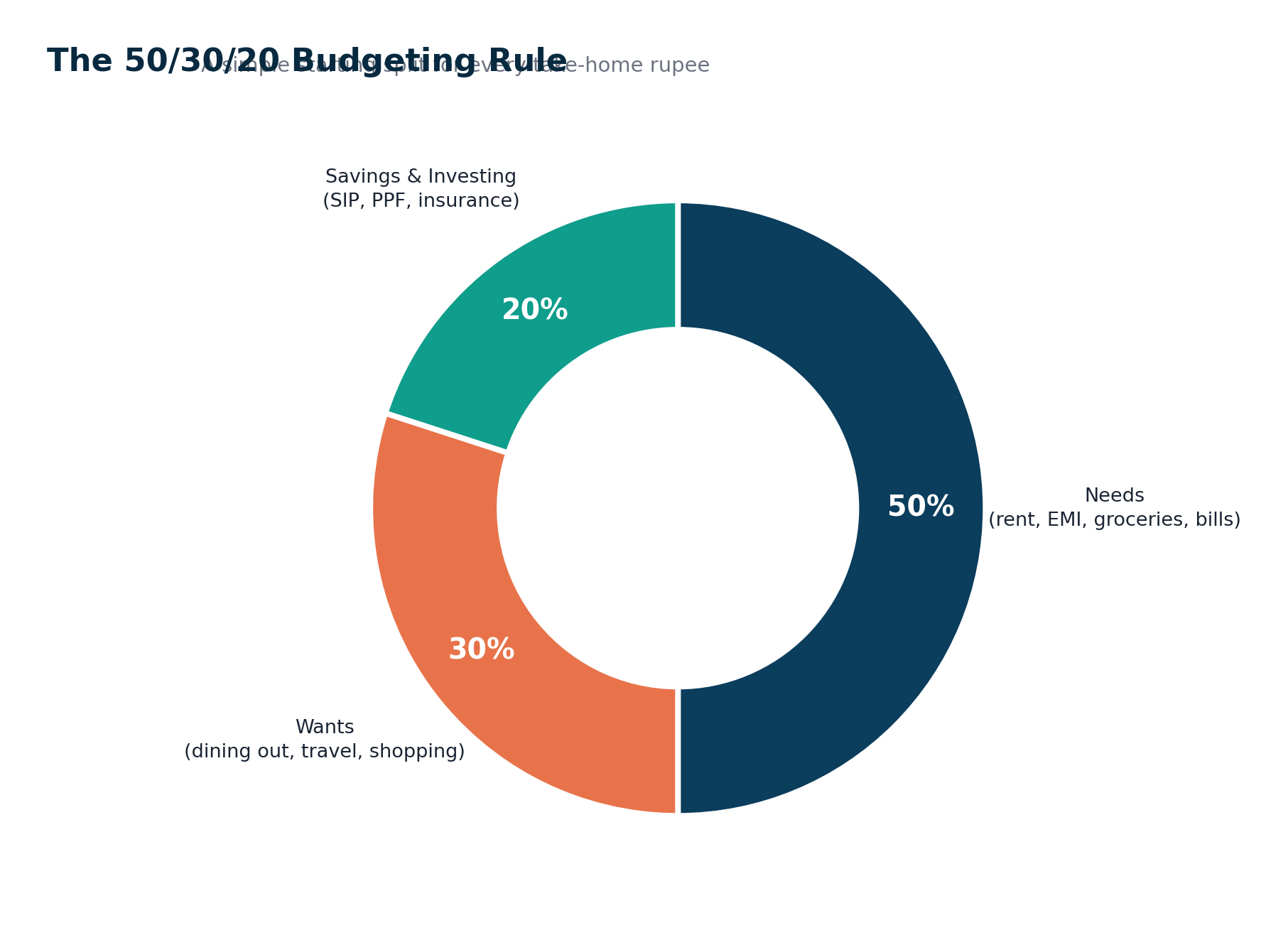
If you’ve ever reached the 25th of the month wondering where your salary went, you don’t have a spending problem — you have a budgeting gap. Budgeting your money in India isn’t about restriction; it’s about deciding in advance where every rupee goes, so your money works for goals you actually chose. This guide covers the 50/30/20 rule, how to adapt it to Indian cities and incomes, a step-by-step process to build your first real budget, and the mistakes that quietly sink most budgets within a month of starting. For how budgeting fits into your larger plan, see our complete financial planning guide (/insights/financial-planning-in-india-complete-guide) . Why Budgeting Matters More in India Than the Numbers Suggest Three things make budgeting particularly important here. First, most private-sector employees have no defined-benefit pension — what you save is what you’ll have. Second, EMI culture (credit cards, personal loans, consumer durable loans, “buy now pay later”) makes it easy to commit future income before you’ve budgeted for it. Third, one uninsured medical event or job gap can undo years of saving if there’s no buffer — which is exactly what a budget, followed by an emergency fund (/insights/emergency-fund-guide-india) , is designed to prevent. The 50/30/20 Rule, Explained Pie chart showing the 50/30/20 budgeting rule: 50% needs, 30% wants, 20% savings and investing A simple starting split for every rupee of take-home pay. The 50/30/20 rule divides your take-home (post-tax) income into three categories: 50% — Needs. Rent or home loan EMI, groceries, utilities, transport to work, insurance premiums, minimum loan payments, and children’s school fees. If you couldn’t reasonably avoid the expense without a real change in lifestyle, it belongs here. 30% — Wants. Dining out, streaming subscriptions, travel, shopping beyond basics, upgrading gadgets. Nothing wrong with this bucket — it exists precisely so you’re not white-knuckling your way through every month. 20% — Savings & investing. Emergency fund contributions, SIPs, PPF, extra debt repayment beyond the minimum. This is the bucket that builds your future, and it’s the one that gets skipped first when there’s no plan. Should you actually use exactly 50/30/20? Treat it as a starting point, not a rulebook. A few common adjustments: High-EMI households (large home loan) often run closer to 60/20/20 or even 65/15/20 for a few years — that’s fine, as long as the savings bucket doesn’t drop to zero. Metro renters (Mumbai, Bangalore, Delhi NCR) frequently find “needs” alone exceeds 50% once rent is factored in; the fix is usually trimming “wants,” not abandoning the savings bucket. Dual-income households with lower fixed costs can often push savings to 30% or more — and should, since your prime saving years are also your prime earning years. Early-career earners with few obligations have the easiest path to a 30–40% savings rate — the earlier this habit forms, the more it compounds. See our SIP planning guide (/insights/sip-planning-guide-india) for what starting early is actually worth. Sample Monthly Budget Bar chart showing a sample monthly budget on ₹80,000 take-home income split into needs, wants, and savings Illustrative split on a ₹80,000/month take-home income — scale to your own number. On a ₹80,000 monthly take-home income, a 50/30/20 split looks like ₹40,000 for needs, ₹24,000 for wants, and ₹16,000 for savings and investing. The exercise isn’t about hitting these exact numbers — it’s about deliberately deciding the split instead of finding out by accident at month-end. How to Build Your First Budget: 5 Steps Step 1: Track actual spending for one month Before you can budget, you need real data, not a guess. Use your bank and card statements, or a simple expense-tracking app, to record every rupee spent for 30 days. Most people underestimate discretionary spending — especially small, frequent purchases — by a wide margin until they actually track it. Step 2: Categorise everything into needs, wants, and savings Go through the month’s spending and bucket each item. Be honest about the grey areas: a daily cab to work is a need; a weekend cab because you didn’t feel like driving is a want. This isn’t about judgment — it’s about accuracy, because an inaccurate budget just fails quietly a few weeks in. Step 3: Set your target split and fix the gaps Compare your actual split to a target like 50/30/20 (adjusted for your situation). If “wants” is consuming 45% instead of 30%, identify the two or three biggest contributors — subscriptions, food delivery, and impulse shopping are the usual suspects — and trim there first, rather than cutting evenly across everything. Step 4: Automate savings on salary day, not month-end The single highest-leverage change you can make is to move your savings and SIP amount out of your account on the day your salary arrives , not whatever’s left at month-end. What’s automated gets saved; what’s “left over” rarely survives the month. Set up auto-debits for SIPs and recurring investments the same week your salary is credited. Step 5: Review monthly, adjust quarterly A budget isn’t a one-time spreadsheet — it’s a habit. Spend 15 minutes once a month comparing actual spending to your plan, and revisit the overall split every quarter or after any income change. Budgets that are set once and never revisited tend to quietly stop being followed. Budgeting Methods Beyond 50/30/20 Zero-based budgeting assigns every rupee of income a specific job — a bill, a goal, a category — before the month starts, so income minus all allocations equals zero. It gives the tightest control but takes more monthly effort to maintain. The envelope method (physical or digital) allocates a fixed amount to each spending category and stops spending in that category once the “envelope” is empty. It works particularly well for people who overspend on variable categories like eating out. Pay-yourself-first budgeting simply automates the savings percentage first and budgets loosely with whatever remains. It’s the lowest-effort method and pairs well with the automation in Step 4 above — many people find a hybrid of pay-yourself-first plus a rough 50/30/20 check is sustainable for years, where a detailed zero-based budget isn’t. Common Budgeting Mistakes Budgeting from gross income, not take-home. Your salary slip’s top-line number includes tax and deductions you’ll never see in your account. Always budget from what actually lands in your bank. Forgetting irregular expenses. Annual insurance premiums, festival spending, and family events don’t show up in a “typical month,” so they blow up otherwise-good budgets. Divide known annual/irregular costs by 12 and set that amount aside monthly. Cutting the savings bucket first when money is tight. It’s tempting to skip this month’s SIP “just this once.” In practice, the needs and wants buckets should absorb a temporary squeeze first — savings should be the last thing cut, not the first. No emergency fund, so every surprise becomes debt. A budget without a buffer for the unexpected isn’t really a complete budget. See our emergency fund guide (/insights/emergency-fund-guide-india) for how much to hold and where to keep it. Treating debt EMIs as fixed forever. High-interest debt (credit cards especially) deserves an aggressive, above-minimum repayment plan inside your budget, not just a permanent line item. Our debt management guide (/insights/debt-management-guide-india) covers how to pay it down faster. Where Budgeting Fits in Your Larger Plan Budgeting is Step 3 of the financial planning process — it’s what makes every later step possible, from your emergency fund to your SIPs. Once your budget is running and your emergency fund is funded, the natural next steps are insurance planning (/insights/insurance-planning-guide-india) to protect what you’ve built, and SIP planning (/insights/sip-planning-guide-india) to start growing it. See the complete financial planning guide (/insights/financial-planning-in-india-complete-guide) for how all the pieces connect. Sample budget on ₹80,000 take-home Bucket Share Amount Examples Needs 50% ₹40,000 Rent/EMI, groceries, utilities, insurance premiums, commute, school fees Wants 30% ₹24,000 Eating out, shopping, travel, subscriptions Savings and investments 20% ₹16,000 Emergency fund top-up, SIPs, PPF/NPS If rent alone exceeds 30–35% of take-home, as it often does in Pune or Mumbai, a 55/25/20 or 60/20/20 split is a realistic starting point; keep the 20% savings line intact. Use the planner (/planner) to map your own numbers, and read first salary, first investment (/insights/first-salary-first-investment-pune) . Frequently Asked Questions What is the 50/30/20 rule in budgeting? The 50/30/20 rule splits your take-home income into three buckets: 50% for needs (rent, EMIs, groceries, utilities), 30% for wants (dining out, entertainment, shopping), and 20% for savings and investing. It’s a starting template, not a strict law — adjust it to your city and life stage. How do I budget my salary in India every month? Track your actual spending for one month, categorise it into needs, wants and savings, apply a split like 50/30/20 adjusted to your situation, automate your savings and SIPs on salary day, and review the budget once a month against what you actually spent. What percentage of salary should I save in India? 20% is a common starting benchmark, but if you’re carrying high EMIs or live in an expensive metro, even 10–15% consistently is a solid start. The more useful goal is to raise your savings rate a little every time your income increases. What is zero-based budgeting? Zero-based budgeting means every rupee of income is assigned a job — expenses, debt repayment, savings or investing — before the month begins, so income minus all allocations equals zero. It’s stricter than the 50/30/20 rule and works well for people who want full control over every rupee. Want help turning your budget into a full financial plan? A working budget is the foundation — the next step is matching your savings to real goals with the right mix of insurance and investments. Talk to Money n Wealth (/contact) for a free portfolio and financial plan review. This article is for general educational purposes only and does not constitute financial advice. Figures and examples are illustrative. Please consult a qualified financial adviser for guidance specific to your situation. Money n Wealth (Predics Fintech Services Pvt Ltd) is an AMFI-registered Mutual Fund Distributor (ARN-121995) and APMI-registered PMS Distributor (APRN07444); it is not a SEBI-registered investment adviser and may earn distribution commission on investments made through it.