ETF vs Index Fund in India: Which Suits a Long-Term Investor in 2026?
Last updated: 21 October 2026
Quick answer: ETFs and index funds track the same indices and are taxed the same. ETFs usually have lower expense ratios but need a demat account and carry brokerage, bid-ask spreads and liquidity risk. Index funds cost slightly more but allow easy SIPs at NAV with no trading costs. For most monthly SIP investors an index fund is simpler; for lump sums in liquid ETFs, an ETF can be cheaper.
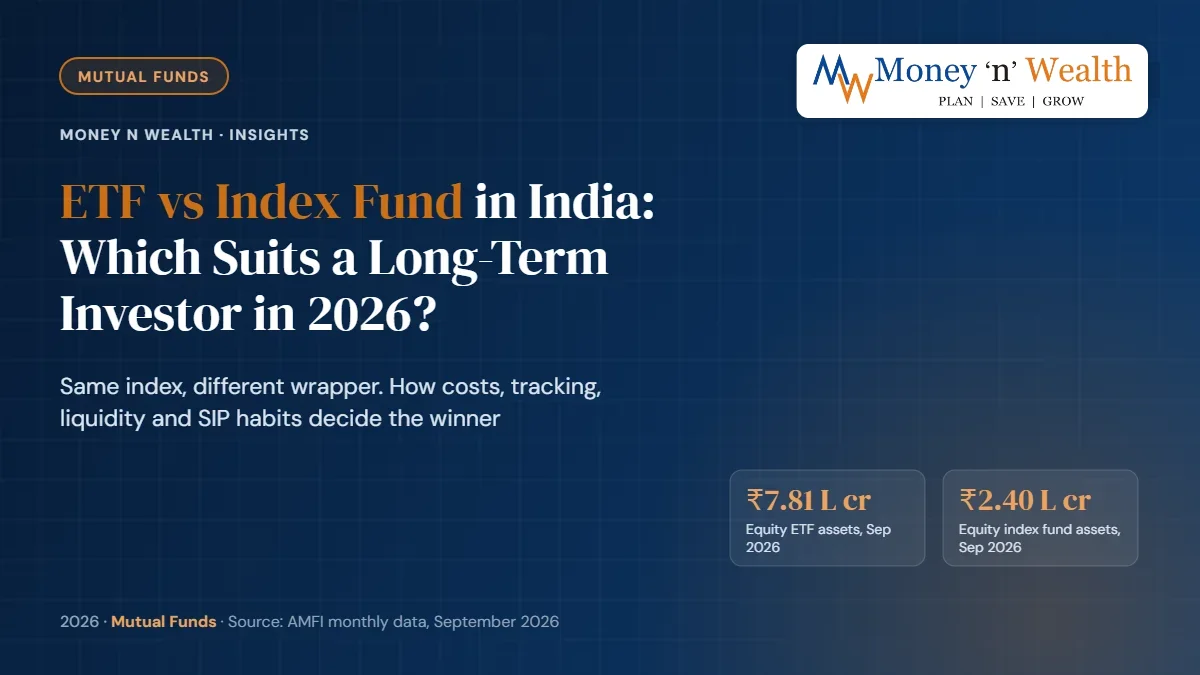
Last updated: 21 October 2026 Quick answer: ETFs and index funds track the same indices and are taxed the same. ETFs usually have lower expense ratios but need a demat account and carry brokerage, bid-ask spreads and liquidity risk. Index funds cost slightly more but allow easy SIPs at NAV with no trading costs. For most monthly SIP investors an index fund is simpler; for lump sums in liquid ETFs, an ETF can be cheaper. Key takeaways Market size: equity ETFs held ₹7.81 lakh crore and equity index funds ₹2.40 lakh crore in September 2026 (AMFI). Same rules: both must invest at least 95% in the index's securities. Tracking error cap: 2% a year for equity ETFs and index funds under SEBI's 2022 passive funds circular. Real cost: compare tracking difference, not just expense ratio. ETF liquidity: AMCs must appoint at least two market makers; poor liquidity can open a direct redemption window. Two colleagues in Hinjewadi both decide to "just buy the Nifty". One opens his broking app and buys a Nifty 50 ETF. The other sets up a ₹15,000 monthly SIP in a Nifty 50 index fund. Same index, same tax. Yet after ten years their outcomes can differ, because the wrapper decides costs, convenience and how often each of them actually invests. Passive investing is now mainstream in India. AMFI data for September 2026 shows 269 equity ETFs and 277 equity index funds. This guide explains how an ETF differs from an index fund, which costs really matter, how to read tracking difference and liquidity, and a simple decision framework. It does not recommend specific schemes. What is the difference between an ETF and an index fund? An index fund is a mutual fund scheme that buys the stocks of an index in the same weights. You buy and redeem units directly with the fund house at the day's closing NAV. An exchange-traded fund (ETF) holds the same kind of portfolio, but its units are listed on NSE or BSE. You buy them from other investors through a broker, at whatever price the market quotes during the day. SEBI's categorisation puts both in the same bucket: an index fund or ETF must invest at least 95% of its assets in the securities of the index it tracks, as confirmed again in SEBI's circular of 26 February 2026 on rationalisation of mutual fund schemes. The difference is the plumbing, not the portfolio. Bar chart comparing ETF vs index fund assets in India in September 2026 ETF assets look bigger, but much of that money is institutional. Large holders such as the EPFO have invested through ETFs for years, which swells the totals. Retail folio counts are closer: 1.97 crore ETF folios against 1.57 crore index fund folios. For background on how index funds work, see our page on index funds (/insights/index-funds) . ETF vs index fund: costs compared Costs come in three layers. Look at all three before deciding which is cheaper. Cost item ETF Index fund Expense ratio (TER) Usually the lowest in the market for large index ETFs Typically somewhat higher than the same AMC's ETF; direct plans cheaper than regular Brokerage Nil to a few rupees per order, depending on broker Nil Bid-ask spread / premium to NAV Yes; can be large in thinly traded ETFs None; you transact at NAV Demat (AMC and DP) charges Annual maintenance plus a DP charge on each sell day None if held in statement form Stamp duty on purchase Yes Yes (0.005%) STT Small STT on exchange trades 0.001% on redemption of equity-oriented units Exit load None on exchange Usually nil or very short; check the SID Expense ratios vary by AMC and index, and they change, so check the current TER on the AMC's website or factsheet rather than relying on any article. Our guide to expense ratios, exit loads and other costs (/insights/mutual-fund-expense-ratio-exit-load-costs) explains how TER is charged daily through NAV. Why small cost differences matter over decades Assume an index earns 11% a year. ₹10 lakh grows to ₹80.62 lakh in 20 years with zero cost. At a total annual drag of 0.05% it becomes ₹79.90 lakh; at 0.20%, ₹77.77 lakh; at 0.50%, ₹73.66 lakh; at 1%, ₹67.27 lakh. The gap between a 0.05% and a 0.50% product is over ₹6 lakh. Chart showing how a higher expense ratio and tracking difference reduce a 20-year index fund or ETF corpus For a ₹10,000 monthly SIP over 20 years at the same 11% index return, the corpus is about ₹81.07 lakh at 0.05% drag, ₹79.63 lakh at 0.20% and ₹76.83 lakh at 0.50%. These are illustrative Money n Wealth calculations, not projections. Tracking error vs tracking difference: which matters more? Two numbers tell you how faithfully a passive fund follows its index. They are often confused. Tracking difference is the gap between the fund's return and the index's total return over a period, for example −0.25% over one year. It captures expense ratio, cash drag, transaction costs and dividend timing. This is the number that hits your wallet. Tracking error is the volatility of that gap: the annualised standard deviation of daily return differences. A low tracking error means the fund moves closely with the index day to day. SEBI's circular on development of passive funds (https://www.sebi.gov.in/sebi_data/attachdocs/may-2022/1653307308174.pdf) (23 May 2022, effective 1 July 2022) caps tracking error at 2% a year for equity ETFs and index funds. It requires daily disclosure of tracking error and monthly disclosure of tracking difference over 1, 3, 5 and 10 years and since launch, on the AMC and AMFI websites. For debt ETFs and index funds, the one-year average tracking difference must not exceed 1.25%. How to use these numbers Pick the index first (Nifty 50, Nifty Next 50, Sensex, a midcap index). List all ETFs and index funds on that index. Compare the 1-year and 3-year tracking difference of the direct plan or ETF. Smaller negative numbers are better. Use tracking error as a tie-breaker; consistently low is good. Then compare liquidity (ETFs) or plan type (index funds). A fund with a slightly higher TER but a better tracking difference is usually the better choice, because tracking difference is the all-in result. ETF liquidity, iNAV and market makers explained An ETF's market price can drift from the value of its holdings. Two mechanisms keep it close. Market makers. SEBI requires every AMC to appoint at least two market makers for each ETF. They must quote buy and sell prices for at least 75% of market hours. They also create and redeem ETF units with the AMC in large blocks, which pulls the price back towards NAV. iNAV. The indicative NAV is the real-time value of the ETF's basket. Exchanges must show it continuously, updated at least every 15 seconds for equity ETFs. Comparing the last traded price with iNAV tells you whether you are paying a premium. Ordinary investors cannot normally redeem ETF units with the AMC; direct transactions must exceed ₹25 crore. But the 2022 circular gives a safety valve. If an ETF trades at a discount of more than 1% to NAV for 7 straight trading days, has no quotes for 3 trading days, or has thin bids for 7 days, investors can redeem directly with the AMC without exit load. Checklist for ETF liquidity: traded value, bid-ask spread, iNAV premium and limit orders Premiums can be large in thematic or international ETFs when demand surges. Gold and silver ETFs have also seen sharp premiums during rallies; see our guides to gold ETFs (/insights/gold-etf) and silver ETFs (/insights/silver-etf) . In plain-vanilla Nifty 50 ETFs from large AMCs, spreads are usually narrow, but always check. Can you do a SIP in an ETF? Index funds win on convenience. A SIP in an index fund is a standard mutual fund mandate: the amount is debited, units are allotted at NAV, and fractional units mean every rupee is invested. STPs and SWPs work the same way, which matters when you later draw income in retirement. ETFs trade in whole units. Many brokers now offer "ETF SIPs" that place a buy order on a fixed date, but you pay brokerage each time, buy at the market price, and leftover cash sits idle. You also need the discipline to keep the instructions running. Behaviour matters more than a few basis points: Morningstar's long-running "Mind the Gap" research shows investors' own returns lag their funds' returns because of timing decisions. Side-by-side comparison of ETF and index fund features in India What is coming next: MF Lite. SEBI created a lighter "MF Lite" licence in December 2024 for fund houses that offer only passive schemes such as index funds and ETFs. In October 2026, 1 Finance became the first firm to receive in-principle approval under this framework, with a launch targeted for January to March 2027. More passive-only fund houses could mean more competition on costs, but judge any new fund on the same tests: expense ratio, tracking difference and liquidity. How are ETFs and index funds taxed in 2026? Tax is the same for both when they track equity indices, because both are equity-oriented schemes with 90%+ in domestic equity. Gains on units held over 12 months are long-term and taxed at 12.5% above ₹1.25 lakh a year. Gains on units held 12 months or less are taxed at 20%. Under the Income-tax Act, 2025, these are in Sections 198 and 196. Debt index funds and debt ETFs bought after 1 April 2023 are taxed at slab rates. Gold and silver ETFs have their own rules, covered in our article on tax on gold (/insights/tax-on-gold-india) . For full detail see capital gains tax on mutual funds in 2026 (/insights/capital-gains-tax-mutual-funds-2026) . Which is better for a long-term investor: ETF or index fund? There is no universal winner. Match the wrapper to how you invest. Decision guide for choosing between an ETF and an index fund Investor profile Likely better fit Why Salaried, ₹5,000–₹50,000 monthly SIP, no demat Index fund (direct or via distributor) Automatic SIP at NAV, no trading or demat costs Lump sum of ₹10 lakh+, active demat Liquid large-index ETF Lower TER; one-time brokerage negligible Retiree drawing monthly income Index fund Built-in SWP; no need to sell on exchange Niche index (factor, sector, international) Check liquidity first; index fund often safer Thin ETFs can trade at premiums or discounts Already holds stocks in demat, rebalances yourself ETF All holdings in one place; intraday control If you go the index fund route, prefer funds with a long record of small tracking difference. If you go the ETF route, check traded value and spread before every purchase, not just the first one. Either way, the bigger decisions are your asset allocation and how long you stay invested. Our portfolio-first framework (/insights/how-to-choose-mutual-funds-portfolio-framework) and SIP planning guide (/insights/sip-planning-guide-india) cover those. The global picture: why ETFs dominate in the US but not always for retail In the US, ETFs gained an edge partly because of tax. Their in-kind creation and redemption lets funds pass out low-cost shares without triggering gains, so ETFs distribute far fewer capital gains than traditional mutual funds, as State Street's research notes. India taxes investors only when they sell units, not when the fund trades inside the portfolio, so that structural tax edge does not apply here. That is why the Indian choice comes down to costs, liquidity and convenience. For a further look at passive and factor strategies, read our guide to smart beta and factor funds (/insights/smart-beta-factor-funds-india) . Related reading Index funds: how they work (/insights/index-funds) Smart beta and factor funds: momentum, quality, low volatility (/insights/smart-beta-factor-funds-india) Direct vs regular mutual funds (/insights/direct-vs-regular-mutual-funds-what-the-higher-return-claim-leaves-out) XIRR vs CAGR vs absolute return (/insights/xirr-vs-cagr-vs-absolute-return) How to read a mutual fund factsheet (/insights/how-to-read-mutual-fund-factsheet) Frequently Asked Questions Is an ETF cheaper than an index fund? Usually the expense ratio is lower, but the all-in cost may not be. ETF investors also pay brokerage, demat charges and the bid-ask spread, and may buy at a premium to NAV. For large lump sums in liquid ETFs these extras are tiny. For small monthly purchases, an index fund's slightly higher expense ratio can work out cheaper and simpler. Do I need a demat account to invest in an ETF? Yes. ETF units are listed on the stock exchange and are bought and held through a broker and demat account. Index funds do not need a demat account; you can invest directly with the fund house, through a distributor or through platforms such as MF Central, and hold units in statement form. What is tracking difference in an index fund? Tracking difference is the gap between the fund's return and its index's total return over a period. It includes expense ratio, cash holdings and trading costs. SEBI requires AMCs to disclose it monthly for 1, 3, 5 and 10 years and since launch. A smaller gap means the fund delivers more of the index return to you. What is the SEBI limit on tracking error? Under SEBI's May 2022 passive funds circular, the tracking error of equity ETFs and index funds must not exceed 2% a year, measured as the annualised standard deviation of daily return differences over a rolling one year. Tracking error must be disclosed daily on AMC and AMFI websites. What happens if my ETF has no buyers? SEBI requires at least two market makers per ETF. If the ETF trades more than 1% below NAV for seven consecutive trading days, has no quotes for three days, or has very thin bids for seven days, investors may redeem directly with the AMC up to ₹25 crore without exit load. The AMC must disclose when this window opens. Are ETFs and index funds taxed differently? No, not when both track equity indices. Both are equity-oriented schemes: long-term gains after 12 months are taxed at 12.5% above ₹1.25 lakh a year, and short-term gains at 20%. Debt index funds and debt ETFs follow slab-rate taxation for investments made after 1 April 2023. Can I start a SIP in an ETF? Not as a mutual fund SIP. Some brokers let you schedule recurring ETF buy orders, but you pay brokerage each time and buy only whole units at market price. A regular index fund SIP invests the exact amount at NAV, including fractional units, with no trading cost. Sources: AMFI monthly data, September 2026 (https://portal.amfiindia.com/spages/amsep2026repo.pdf) ; SEBI circular on development of passive funds, 23 May 2022 (https://www.sebi.gov.in/sebi_data/attachdocs/may-2022/1653307308174.pdf) ; SEBI circular on categorisation, 26 Feb 2026 (https://www.sebi.gov.in/sebi_data/attachdocs/feb-2026/1772079826878.pdf) ; AMFI: SEBI categorisation of schemes (https://amfiindia.com/investor-corner/knowledge-center/SEBI-categorization-of-mutual-fund-schemes.html) ; Sundaram MF Tax Reckoner 2026-27 (https://www.sundarammutual.com/pdf2/TaxReckoner/Tax_Reckoner_2026_27.pdf) ; State Street Global Advisors on ETF tax efficiency (https://www.ssga.com/us/en/individual/insights/tax-efficiency-is-structural-etfs-continue-to-issue-fewer-capital-gains-than-mutual-funds) ; Morningstar, Mind the Gap (https://www.morningstar.com/lp/mind-the-gap) . Worked examples are Money n Wealth calculations. Building a low-cost passive portfolio? The right mix of index funds and ETFs depends on how you invest, your goals and what you already own. Talk to Money n Wealth (/contact) for a free portfolio review. This article is for general educational purposes only and does not constitute financial advice. Figures and examples are illustrative. Please consult a qualified financial adviser for guidance specific to your situation. Money n Wealth (Predics Fintech Services Pvt Ltd) is an AMFI-registered Mutual Fund Distributor (ARN-121995) and APMI-registered PMS Distributor (APRN07444); it is not a SEBI-registered investment adviser and may earn distribution commission on investments made through it.
Frequently Asked Questions
Is an ETF cheaper than an index fund?
Usually the expense ratio is lower, but the all-in cost may not be. ETF investors also pay brokerage, demat charges and the bid-ask spread, and may buy at a premium to NAV. For large lump sums in liquid ETFs these extras are tiny. For small monthly purchases, an index fund's slightly higher expense ratio can work out cheaper and simpler.
Do I need a demat account to invest in an ETF?
Yes. ETF units are listed on the stock exchange and are bought and held through a broker and demat account. Index funds do not need a demat account; you can invest directly with the fund house, through a distributor or through platforms such as MF Central, and hold units in statement form.
What is tracking difference in an index fund?
Tracking difference is the gap between the fund's return and its index's total return over a period. It includes expense ratio, cash holdings and trading costs. SEBI requires AMCs to disclose it monthly for 1, 3, 5 and 10 years and since launch. A smaller gap means the fund delivers more of the index return to you.
What is the SEBI limit on tracking error?
Under SEBI's May 2022 passive funds circular, the tracking error of equity ETFs and index funds must not exceed 2% a year, measured as the annualised standard deviation of daily return differences over a rolling one year. Tracking error must be disclosed daily on AMC and AMFI websites.
What happens if my ETF has no buyers?
SEBI requires at least two market makers per ETF. If the ETF trades more than 1% below NAV for seven consecutive trading days, has no quotes for three days, or has very thin bids for seven days, investors may redeem directly with the AMC up to ₹25 crore without exit load. The AMC must disclose when this window opens.
Are ETFs and index funds taxed differently?
No, not when both track equity indices. Both are equity-oriented schemes: long-term gains after 12 months are taxed at 12.5% above ₹1.25 lakh a year, and short-term gains at 20%. Debt index funds and debt ETFs follow slab-rate taxation for investments made after 1 April 2023.
Can I start a SIP in an ETF?
Not as a mutual fund SIP. Some brokers let you schedule recurring ETF buy orders, but you pay brokerage each time and buy only whole units at market price. A regular index fund SIP invests the exact amount at NAV, including fractional units, with no trading cost.
Building a low-cost passive portfolio?
The right mix of index funds and ETFs depends on how you invest, your goals and what you already own. Talk to Money n Wealth for a free portfolio review.