Step-Up SIP Calculator 2026: What a 10% Yearly Increase Does to Your Corpus
Last updated: 13 October 2026
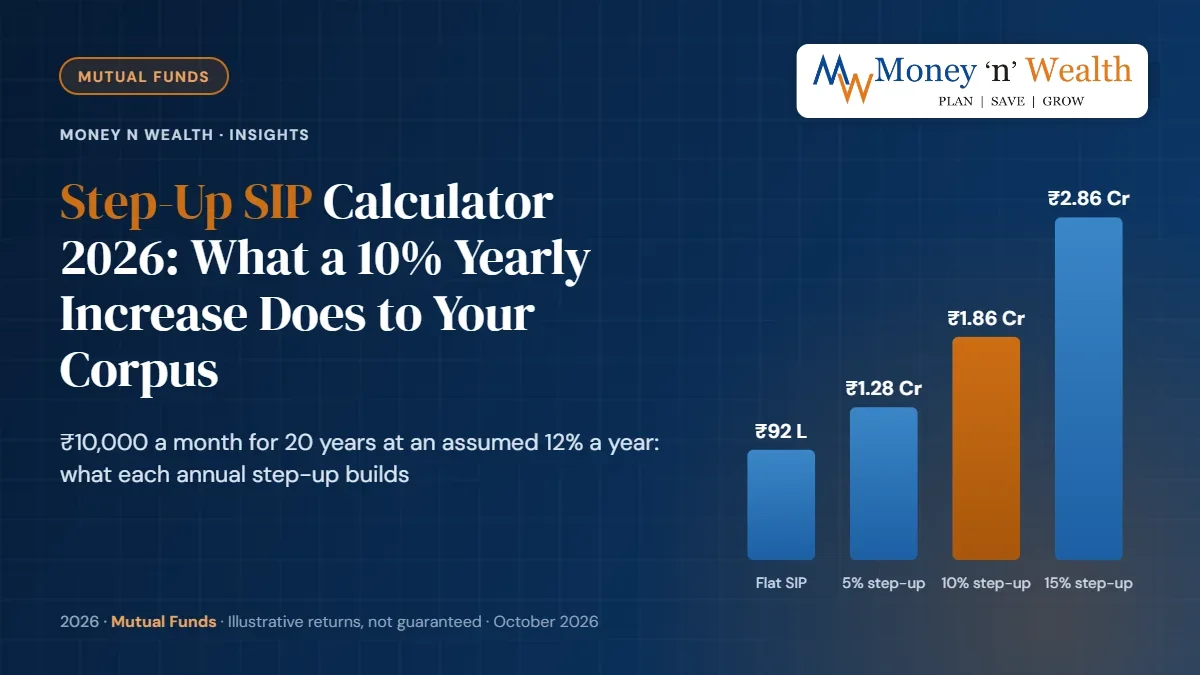
Quick answer: A step-up SIP raises your monthly instalment by a set percentage or amount every year. At an assumed 12% annual return, a ₹10,000 SIP held flat for 20 years grows to about ₹92 lakh. Raise it by 10% each year and the same SIP grows to about ₹1.86 crore, because you invest ₹68.7 lakh instead of ₹24 lakh. The step-up adds money, not magic, so set it at what your income can sustain.
Last updated: 13 October 2026 Quick answer: A step-up SIP raises your monthly instalment by a set percentage or amount every year. At an assumed 12% annual return, a ₹10,000 SIP held flat for 20 years grows to about ₹92 lakh. Raise it by 10% each year and the same SIP grows to about ₹1.86 crore, because you invest ₹68.7 lakh instead of ₹24 lakh. The step-up adds money, not magic, so set it at what your income can sustain. Key takeaways 10% step-up, 20 years: ₹10,000 start becomes ₹1.86 crore vs ₹92 lakh flat (assumed 12%). Faster goals: ₹1 crore arrives in about 16 years with a 10% step-up vs about 21 years flat. Smaller start: For ₹1 crore in 15 years you can start at about ₹12,100 with a 10% step-up instead of ₹21,000 flat. Typical rules: Yearly or half-yearly increases; fixed top-ups usually start at ₹500; a cap stops the increases. Match your pay: Indian salaries were projected to rise about 9% in 2026 (Aon), so a 5–10% step-up is realistic for many. Most people start a SIP with whatever they can spare in their first job and leave it untouched for a decade. Their salary doubles, but the ₹10,000 SIP stays where it was, shrinking in real terms every year. A step-up SIP (also called a top-up SIP) fixes this by building the increase into the instruction itself. This guide works like a step-up SIP calculator in print: it shows what 5%, 10% and 15% annual step-ups do to your corpus, gives the formula, separates genuine benefit from illusion, and explains how to set one up with your fund house as of October 2026. What is a step-up SIP? A step-up SIP is a systematic investment plan in which the instalment increases automatically at fixed intervals, by either a percentage of the previous instalment or a fixed rupee amount. For example, a ₹10,000 monthly SIP with a 10% yearly step-up becomes ₹11,000 in year two, ₹12,100 in year three, and so on. It is not a separate product but a facility that asset management companies (AMCs) attach to an ordinary SIP. The fund, NAV, costs and taxation are the same as a regular SIP. SIPs remain the backbone of Indian mutual fund investing. According to AMFI data, monthly SIP contributions reached a record ₹32,297 crore in August 2026, and contributing SIP accounts crossed 10 crore. The question is not whether people use SIPs but whether those SIPs keep pace with their incomes. How much does a 10% step-up SIP grow in 20 years? Here is the core step-up SIP calculation. We assume a ₹10,000 starting SIP, the instalment raised once a year, money invested at the start of each month, and a steady 12% annual return (about 0.95% a month). Real equity returns are never this smooth, so treat the numbers as illustrations of the mechanism, not forecasts. Annual step-up SIP in year 20 Total invested Corpus after 20 years Gain None (flat SIP) ₹10,000 ₹24.0 lakh ₹92.0 lakh ₹68.0 lakh 5% a year ₹25,270 ₹39.7 lakh ₹1.28 crore ₹87.9 lakh 10% a year ₹61,159 ₹68.7 lakh ₹1.86 crore ₹1.18 crore 15% a year ₹1,42,318 ₹1.23 crore ₹2.86 crore ₹1.63 crore A 10% step-up roughly doubles the 20-year corpus compared with a flat SIP. A 15% step-up roughly triples it. But look at the second column too: a 15% step-up means writing a ₹1.42 lakh cheque every month in year 20. That is only realistic if your income grows at a similar pace. Step-up SIP calculator comparison of amount invested and 20-year corpus for 0%, 5%, 10% and 15% annual step-ups Step-up SIP returns over 10, 15, 20 and 25 years The longer the horizon, the more the step-up matters, because the larger later instalments still get years to compound. The table below shows the corpus (₹ lakh) for a ₹10,000 starting SIP at an assumed 12% return. Horizon Flat SIP 5% step-up 10% step-up 15% step-up 10 years ₹22.4 L ₹26.9 L ₹32.7 L ₹40.0 L 15 years ₹47.6 L ₹61.9 L ₹82.8 L ₹113.4 L 20 years ₹92.0 L ₹127.5 L ₹186.3 L ₹286.0 L 25 years ₹170.2 L ₹248.3 L ₹393.6 L ₹677.4 L Over 10 years, a 10% step-up adds about 46% to the corpus. Over 25 years it adds about 131%. This is why step-ups suit long goals such as retirement far better than a five-year car fund. What if returns are lower than 12%? Equity returns over any 20-year stretch could be well below 12%. At an assumed 10% return, the 20-year corpus is ₹72.4 lakh flat, ₹1.03 crore with a 5% step-up, ₹1.55 crore with 10% and ₹2.44 crore with 15%. At 8% the figures fall to ₹57.3 lakh, ₹83.8 lakh, ₹1.29 crore and ₹2.09 crore. The step-up's advantage holds at every return level, because it works mainly by increasing how much you invest. Line chart of a 10% step-up SIP versus a flat SIP growing over 20 years Is a step-up SIP better than a regular SIP? The honest answer A step-up SIP does not earn a higher return than a flat SIP. Both earn whatever the fund earns. The step-up wins only because you put in more money. In fact, rupee for rupee, a flat SIP is more efficient. Suppose you could afford ₹28,637 every month from day one. Over 20 years you would invest the same ₹68.7 lakh as the 10% step-up SIP, but your corpus would be about ₹2.63 crore, not ₹1.86 crore. Money invested earlier simply has longer to compound. So the real case for a step-up is behavioural and practical: Affordability: most people cannot invest ₹28,000 a month at 25, but can invest ₹10,000 and grow it with their pay. Automation: the increase happens without a fresh decision every April, which is when good intentions usually fail. Inflation protection: a flat SIP loses real value every year. At 6% inflation, ₹10,000 in 20 years buys what about ₹3,100 buys today. Goal discipline: retirement and education targets are inflation-linked, so contributions should be too. The practical rule: invest as much as you comfortably can today, and add a step-up so that the SIP keeps rising with your income. How a step-up SIP helps you reach ₹1 crore sooner Step-ups shine when you work backwards from a goal. Two common questions are how long a ₹10,000 SIP takes to reach ₹1 crore, and how small a starting SIP can be if you want ₹1 crore in 15 years. Both are answered below at an assumed 12% return. Annual step-up Years to ₹1 crore (₹10,000 start) Starting SIP for ₹1 crore in 15 years None 20.7 years ₹21,011 5% 18.3 years ₹16,152 10% 16.2 years ₹12,085 15% 14.4 years ₹8,823 Years to reach 1 crore with a step-up SIP at different step-up rates A 10% step-up brings ₹1 crore about four and a half years closer, or cuts the required starting SIP by over 40%. For a 30-year-old IT professional in Hinjewadi or Kharadi, that is the difference between a stretched budget and a comfortable one. Our ₹1 crore SIP calculator guide (/insights/build-1-crore-corpus-sip-calculator-guide) covers the flat-SIP version of this goal in detail. Remember that ₹1 crore in 15 years will not buy what it buys today. Our guide on what ₹1 crore will be worth in 20 years (/insights/inflation-value-of-1-crore-future) shows the inflation adjustment. At 6% inflation, the ₹1.86 crore step-up corpus above is worth about ₹58 lakh in today's money, versus about ₹29 lakh for the flat SIP. The step-up SIP formula If you want to check any step-up SIP calculator yourself, the maths is a growing annuity. With a yearly step-up, first compute A, the value at the end of year one of one year of monthly instalments: A = P × [((1 + r) 12 − 1) ÷ r] × (1 + r) Here P is the starting monthly SIP and r is the monthly return. Then the corpus after n years, with annual return i and annual step-up g, is: Corpus = A × [(1 + i) n − (1 + g) n ] ÷ (i − g) Worked check: P = ₹10,000, i = 12%, monthly r = 1.12 1/12 − 1 ≈ 0.949%. Then A ≈ ₹1,27,665. With g = 10% and n = 20, the corpus is ₹1,27,665 × (9.6463 − 6.7275) ÷ 0.02 ≈ ₹1.86 crore, matching the table. If i equals g, the formula becomes A × n × (1 + i) n−1 . In Excel or Google Sheets, build it year by year with =FV(r, 12, −SIP, −previous value, 1), raising the SIP cell by 10% each row. Our SIP and goal calculators (/tools) do the same in your browser. Percentage step-up or fixed top-up: which should you choose? AMCs usually offer two ways to step up. The choice changes your outcome more than most people expect. Percentage step-up raises the SIP by, say, 10% of the previous instalment. Increases grow over time (₹1,000, then ₹1,100, then ₹1,210), which mirrors how salaries compound. Fixed top-up raises the SIP by a fixed amount, say ₹1,000 each year. Increases stay flat, so the step-up becomes smaller in percentage terms each year. Compare them on our ₹10,000, 20-year, 12% example. A fixed ₹1,000 yearly top-up ends at ₹29,000 a month, invests ₹46.8 lakh and builds about ₹1.47 crore. A ₹2,000 top-up ends at ₹48,000, invests ₹69.6 lakh and builds about ₹2.03 crore. A 10% percentage step-up invests almost the same ₹68.7 lakh but builds less, ₹1.86 crore, because its biggest instalments come late. A fixed top-up front-loads the increase; a percentage step-up tracks income better over long careers. Should you cap the step-up? A cap stops increases once the SIP reaches a chosen amount, after which the SIP continues at that level. If you cap a 10% step-up after year 10 (at about ₹23,580 a month), you invest ₹47.4 lakh over 20 years and build about ₹1.54 crore. That is still far ahead of the flat SIP's ₹92 lakh, with a much gentler peak instalment. How do you set up a step-up SIP? Rules differ by AMC, so read the SIP top-up terms in the scheme's Statement of Additional Information or enrolment form. Based on the published terms of several AMCs, including DSP Mutual Fund (https://dspim.com/media/pages/mandatory-disclosures/45ea2f5512-1715849288/terms-condition-special-facilities.pdf) and Canara Robeco Mutual Fund (https://canararobeco.com/wp-content/uploads/2025/02/notice-cum-addendum-no-7-and-8.pdf) , the typical process looks like this: Choose the type: percentage or fixed amount. Fixed top-ups commonly require a minimum of ₹500. Choose the frequency: monthly SIPs usually allow half-yearly or yearly top-ups; quarterly SIPs only yearly. Defaults differ: DSP defaults to yearly, while SBI Mutual Fund's top-up page (https://www.sbimf.com/en-us/financial-planning-calculators/top-up-sip-calculator) says half-yearly. Set a cap or end date: a maximum instalment after which the top-up stops. Check your mandate: the bank mandate (NACH or OTM) must be high enough to cover the largest future instalment, or debits will fail. Register it as a new SIP: many AMCs offer top-up only on fresh registrations. Converting an existing SIP often means cancelling it and starting a new one, which restarts exit-load clocks on new units. Five steps to set up a step-up SIP or top-up SIP with a mutual fund Not every scheme or platform supports top-ups (SBI Mutual Fund lists its small-cap fund as an exception). The simple workaround: start a second SIP each April for the increase amount. How much should you step up each year? Link the step-up to your income, not to a calculator's most exciting output. Aon's salary survey, released in October 2025, projected an average increase of about 9% for Indian companies in 2026, after 8.9% in 2025 ( Aon (https://www.aon.com.au/apac/in-the-press/asia-newsroom/2025/salaries-in-india-projected-to-increase-by-nine-percent-in-2026-aon-study) ). Averages hide wide differences between sectors and career stages. Your situation Sensible step-up range Why Early career, fast-rising pay 10–15% Income growth is steepest in the first 10–15 years Mid-career salaried 7–10% Roughly tracks typical increments Close to peak earnings or 50+ 5% or a fixed top-up with cap Pay growth slows; avoid unaffordable instalments Business owner, irregular income 5% plus lump sums in good years Keeps the SIP affordable in weak years Minimum to beat inflation 5–6% Keeps the SIP's real value roughly constant One useful habit: commit a fixed share of every increment, such as one-third, to investments. If your take-home rises by ₹9,000 a month, a ₹3,000 SIP increase is painless and powerful. Step-up SIP mistakes to avoid Over-ambitious step-ups: a 15% step-up that you abandon in year six does worse than a 7% step-up you keep for 20 years. Ignoring the mandate limit: a failed debit can cancel the SIP after repeated bounces and may attract bank charges. See what happens when you pause, skip or stop a SIP (/insights/sip-pause-skip-stop-what-happens) . Stepping up into the wrong fund: the step-up multiplies the impact of fund choice. Start with a sound fund shortlisting framework (/insights/how-to-shortlist-sip-funds-2026) . Stopping in a crash: step-up years during a market fall buy more units cheaply. Read should you stop your SIP when markets fall (/insights/should-you-stop-sip-when-markets-fall) . Judging returns wrongly: SIP returns must be measured with XIRR, not simple growth. Our guide to XIRR vs CAGR vs absolute return (/insights/xirr-vs-cagr-vs-absolute-return) explains why. How is a step-up SIP taxed? Exactly like any SIP. Each monthly instalment buys units with its own purchase date. When you redeem, units are treated on a first-in, first-out basis. For equity-oriented funds, units held over 12 months attract long-term capital gains tax at 12.5% on gains above ₹1.25 lakh a year, and shorter holdings 20%, as of October 2026. Debt-oriented funds have different rules; see our guide to capital gains tax on mutual funds in 2026 (/insights/capital-gains-tax-mutual-funds-2026) . Related reading SIP Planning: The Complete Guide (/insights/sip-planning-guide-india) How to Build a ₹1 Crore Corpus With a SIP (/insights/build-1-crore-corpus-sip-calculator-guide) SIP vs Lumpsum vs STP: Investing a Bonus or Windfall (/insights/sip-vs-lumpsum-vs-stp) Starting Late at 40: Catching Up on Retirement (/insights/starting-retirement-planning-at-40) XIRR vs CAGR vs Absolute Return (/insights/xirr-vs-cagr-vs-absolute-return) Frequently Asked Questions What is the difference between a step-up SIP and a top-up SIP? None in substance. Both describe a SIP whose instalment increases automatically at set intervals, by a percentage or a fixed amount. AMCs use "top-up" in their forms, while calculators and platforms often say "step-up". The fund, NAV, costs and tax are the same as a normal SIP; only the instalment schedule changes. How much will a ₹5,000 SIP with a 10% step-up give in 20 years? At an assumed 12% annual return, about ₹93 lakh, which is half the ₹1.86 crore produced by a ₹10,000 start. You would invest about ₹34.4 lakh in total, and the SIP would reach about ₹30,600 a month in year 20. A flat ₹5,000 SIP over the same period builds about ₹46 lakh. Returns are illustrative, not guaranteed. Can I add a step-up to my existing SIP? Often not directly. Many AMCs, including DSP and Canara Robeco per their published terms, offer top-up only on fresh SIP registrations. You may need to cancel the existing SIP and register a new one with top-up, or simply start a second SIP for the increase amount each year. Check with your AMC or distributor. Is a step-up SIP better than investing a lump sum? They solve different problems. A step-up SIP invests future income as it arrives. A lump sum invests money you already have. If you have a bonus or windfall today, the question becomes lump sum versus staggered entry, covered in our guide to SIP vs lumpsum vs STP (/insights/sip-vs-lumpsum-vs-stp) . Many investors do both. What step-up percentage should I choose? Choose a rate below your expected income growth. Indian salary increments were projected at about 9% for 2026 in Aon's survey, so 5–10% suits most salaried investors. Younger professionals with fast-rising pay can consider 10–15%. A cap protects you if income growth slows later in your career. Can I stop or reduce the step-up later? Yes. You can cancel the SIP and register a new one at a different amount, and many AMCs let you set a cap at the start so increases stop automatically. Stopping the step-up does not affect units already bought. Cancelling a SIP has no penalty, though exit loads apply to units redeemed early. Does a step-up SIP give higher returns than a regular SIP? No. The return rate is identical because both invest in the same fund. A step-up SIP builds a bigger corpus only because you invest more money over time. Rupee for rupee, money invested earlier compounds longer, so a larger flat SIP from day one would do even better if you could afford it. Sources: AMFI Monthly data (https://www.amfiindia.com/research-information/amfi-monthly) ; DSP Mutual Fund SIP top-up terms (https://dspim.com/media/pages/mandatory-disclosures/45ea2f5512-1715849288/terms-condition-special-facilities.pdf) ; Canara Robeco SIP top-up addendum (https://canararobeco.com/wp-content/uploads/2025/02/notice-cum-addendum-no-7-and-8.pdf) ; SBI Mutual Fund top-up SIP calculator (https://www.sbimf.com/en-us/financial-planning-calculators/top-up-sip-calculator) ; Aon salary increase survey 2025-26 (https://www.aon.com.au/apac/in-the-press/asia-newsroom/2025/salaries-in-india-projected-to-increase-by-nine-percent-in-2026-aon-study) . Worked examples are Money n Wealth calculations assuming a constant 12% annual return (also 10% and 8%), monthly investment at the start of each month and yearly step-ups. Not sure what step-up your income can sustain? The right step-up depends on your goals, cash flow and existing SIPs, and a quick review can set it for the next 20 years. Talk to Money n Wealth (/contact) for a free portfolio review. This article is for general educational purposes only and does not constitute financial advice. Figures and examples are illustrative. Please consult a qualified financial adviser for guidance specific to your situation. Money n Wealth (Predics Fintech Services Pvt Ltd) is an AMFI-registered Mutual Fund Distributor (ARN-121995) and APMI-registered PMS Distributor (APRN07444); it is not a SEBI-registered investment adviser and may earn distribution commission on investments made through it.
Frequently Asked Questions
What is the difference between a step-up SIP and a top-up SIP?
None in substance. Both describe a SIP whose instalment increases automatically at set intervals, by a percentage or a fixed amount. AMCs use "top-up" in their forms, while calculators and platforms often say "step-up". The fund, NAV, costs and tax are the same as a normal SIP; only the instalment schedule changes.
How much will a ₹5,000 SIP with a 10% step-up give in 20 years?
At an assumed 12% annual return, about ₹93 lakh, which is half the ₹1.86 crore produced by a ₹10,000 start. You would invest about ₹34.4 lakh in total, and the SIP would reach about ₹30,600 a month in year 20. A flat ₹5,000 SIP over the same period builds about ₹46 lakh. Returns are illustrative, not guaranteed.
Can I add a step-up to my existing SIP?
Often not directly. Many AMCs, including DSP and Canara Robeco per their published terms, offer top-up only on fresh SIP registrations. You may need to cancel the existing SIP and register a new one with top-up, or simply start a second SIP for the increase amount each year. Check with your AMC or distributor.
Is a step-up SIP better than investing a lump sum?
They solve different problems. A step-up SIP invests future income as it arrives. A lump sum invests money you already have. If you have a bonus or windfall today, the question becomes lump sum versus staggered entry, covered in our guide to SIP vs lumpsum vs STP . Many investors do both.
What step-up percentage should I choose?
Choose a rate below your expected income growth. Indian salary increments were projected at about 9% for 2026 in Aon's survey, so 5–10% suits most salaried investors. Younger professionals with fast-rising pay can consider 10–15%. A cap protects you if income growth slows later in your career.
Can I stop or reduce the step-up later?
Yes. You can cancel the SIP and register a new one at a different amount, and many AMCs let you set a cap at the start so increases stop automatically. Stopping the step-up does not affect units already bought. Cancelling a SIP has no penalty, though exit loads apply to units redeemed early.
Does a step-up SIP give higher returns than a regular SIP?
No. The return rate is identical because both invest in the same fund. A step-up SIP builds a bigger corpus only because you invest more money over time. Rupee for rupee, money invested earlier compounds longer, so a larger flat SIP from day one would do even better if you could afford it.
Not sure what step-up your income can sustain?
The right step-up depends on your goals, cash flow and existing SIPs, and a quick review can set it for the next 20 years. Talk to Money n Wealth for a free portfolio review.