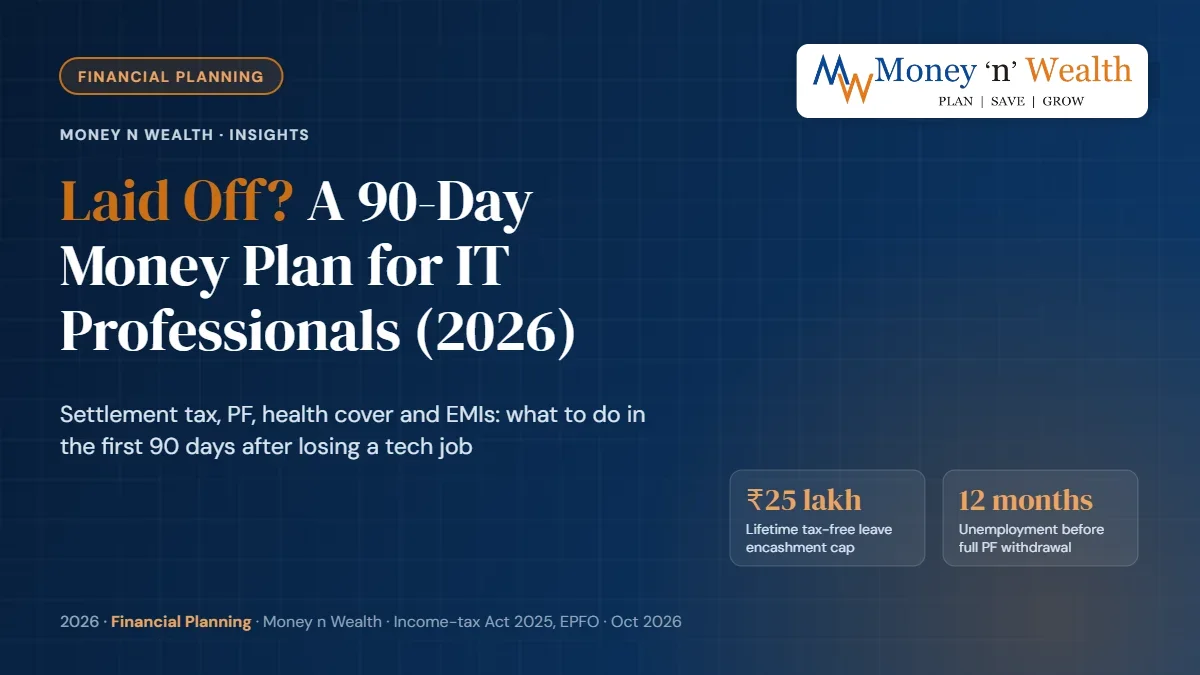
Laid Off? A 90-Day Money Plan for IT Professionals (2026)
Last updated: 13 October 2026
Quick answer: If you are laid off, first buy your own health cover before group insurance ends, then work out your runway: emergency fund plus the post-tax settlement, divided by an essentials budget. Severance and notice pay are taxed as salary; gratuity (up to ₹20 lakh) and leave encashment (up to ₹25 lakh) are tax-free. Keep PF invested, never miss an EMI, and review the plan every month.
Last updated: 13 October 2026 Quick answer: If you are laid off, first buy your own health cover before group insurance ends, then work out your runway: emergency fund plus the post-tax settlement, divided by an essentials budget. Severance and notice pay are taxed as salary; gratuity (up to ₹20 lakh) and leave encashment (up to ₹25 lakh) are tax-free. Keep PF invested, never miss an EMI, and review the plan every month. Key takeaways Tax: severance and notice pay are fully taxable; in our ₹30 lakh example, tax on them is about ₹3.4 lakh. Tax-free: gratuity after five years and leave encashment are exempt within limits, in both tax regimes. Health: group cover usually stops on your last day; buy an individual floater while still employed. PF: full withdrawal now needs 12 months of unemployment; leave it to compound at 8.25%. Runway: a ₹6 lakh emergency fund lasts 5.5 months; adding the settlement stretches it to about 19. The calendar invite arrives at 9:30 on a Tuesday. By lunchtime, a Hinjewadi engineer with six years at the company, a home loan and a toddler has a separation letter, an F&F date and a dozen questions. How much of the payout will be taxed? Is the family still insured tonight? Should the PF come out? A layoff is a cash-flow problem first and a career problem second. Getting the money decisions right in the first 90 days buys you time to find the right next role instead of the first one. This laid off money plan walks through the tax on severance, notice pay and leave encashment under the Income-tax Act, 2025, the new EPF rules, health cover gaps, EMIs and a month-by-month runway, with a worked rupee example. Laid Off: What should you do in the first week after a layoff? A layoff money plan is a short, ordered list of decisions that protect cash, credit and health cover while you look for work. The first week is about protecting what you cannot easily rebuild later: health insurance, your credit score and documentary proof of what you are owed. Read the separation letter carefully. Note the last working day, whether it is called retrenchment, termination or "mutual separation", and every amount promised. Buy health cover before the last day. Group mediclaim usually ends with employment. A gap of even a week can leave the family exposed. Ask HR for the F&F breakup. Severance, notice pay, gratuity, leave encashment, bonus, variable pay and any recovery should each appear as a line. List every EMI, card due date and SIP. You need this to build a budget and to avoid a missed payment. Download documents. Payslips, Form 16 for previous years, appointment letter, ESOP/RSU grant statements and the PF passbook, while you still have portal access. Laid off money plan: six steps for the first 90 days after an IT layoff How are severance pay, notice pay and leave encashment taxed? From 1 April 2026, the exemptions for amounts received on leaving a job sit in the table under section 19 of the Income-tax Act, 2025 (https://www.incometaxindia.gov.in/w/section-19-199) , which replaced section 10(10), 10(10AA) and 10(10B) of the old Act. These exemptions apply in both the old and the new tax regime. Everything not covered by an exemption is taxed as salary at your slab rate. Payment Tax treatment (as of October 2026) Limit Notice pay (salary in lieu of notice) Fully taxable as salary None Severance / ex gratia / "separation bonus" Taxable as salary (profits in lieu of salary) None, unless it qualifies as retrenchment compensation below Statutory retrenchment compensation to a "worker" Exempt up to the lowest of actual amount, statutory formula and the notified limit ₹5 lakh notified limit Gratuity (private sector) Exempt up to formula amount ₹20 lakh lifetime Leave encashment (non-government) Exempt up to lowest of four limits ₹25 lakh lifetime Bonus, variable pay, pro-rata salary Fully taxable None The "worker" test decides retrenchment compensation Under the Industrial Relations Code, 2020, in force since 21 November 2025, a retrenched worker gets one month's notice (or pay in lieu) and compensation of 15 days' average pay for every completed year of service. The employer must also put 15 days' last-drawn wages into a worker re-skilling fund for each retrenched worker, as EY's alert on the labour codes (https://www.ey.com/content/dam/ey-unified-site/ey-com/en-in/alerts-hub/2025/11/new-labour-codes-implemented-across-the-country-effective-21-november-2025.pdf) summarises. The catch: "worker" excludes people employed mainly in managerial or administrative roles and supervisors above the wage threshold. An individual contributor engineer may qualify; a delivery manager who approves leave and runs appraisals may not. If you are outside the definition, your package is whatever the contract and company policy say, and the whole severance is taxed as salary. Leave encashment: the ₹25 lakh cap For non-government employees, leave encashment on leaving a job is exempt up to the lowest of: actual amount received, 10 months' average salary, cash value of leave (counting at most 30 days per year of service), and ₹25 lakh. The ₹25 lakh limit applies from 1 April 2023 under notification 31/2023, as the PIB-sourced announcement (https://en.vikaspedia.in/news/increased-limit-for-tax-exemption-on-leave-encashment-for-non-government-salaried-employees-notified) confirms. It is a lifetime cap, so track what earlier employers paid you tax-free. Gratuity follows the 15/26 formula once you have five years of continuous service (one year for fixed-term employees under the labour codes). Our gratuity guide (/insights/gratuity-calculation-tax-free-limit) covers eligibility and the ₹20 lakh cap in detail. Worked example: tax on a ₹30 lakh-a-year engineer's layoff settlement Arjun, 36, earns ₹30 lakh a year (₹2.5 lakh a month gross, ₹1.25 lakh basic) at a Pune IT firm. He is laid off with a last day of 31 October 2026, after six years of service. He is in the new regime. Item Amount Taxable? Salary April–October (7 months) ₹17,50,000 Yes Severance: three months' gross ₹7,50,000 Yes (not a "worker") Notice pay: two months' gross ₹5,00,000 Yes Gratuity: ₹1,25,000 × 15/26 × 6 ₹4,32,692 No Leave encashment: 30 days of basic ₹1,25,000 No Taxable income after ₹75,000 standard deduction ₹29,25,000 Tax for FY 2026-27 incl. 4% cess ₹4,75,800 Two things stand out. First, severance and notice pay add about ₹3.35 lakh of tax, because they sit at his 30% marginal slab. His net from those two items is roughly ₹9.15 lakh, not ₹12.5 lakh. Second, his total tax for the year is the same as if he had worked all twelve months, because the payouts simply replace five months of salary. His total post-tax settlement is about ₹14.7 lakh. If the employer's TDS on the F&F does not match his actual liability, he settles the difference with advance tax (/insights/advance-tax-for-investors) or claims a refund in his return. Large lump sums can sometimes qualify for relief under the provision that replaced section 89 of the old Act; ask a tax consultant before filing. Tax on severance pay, notice pay, gratuity and leave encashment after a layoff in India If you find a new job in the same year Declare your previous employer's salary and TDS to the new employer so it deducts tax correctly. Otherwise both employers apply the lower slabs and the standard deduction separately, and you face a large bill in July. You will receive two Form 16s; our guide on which ITR form to file (/insights/which-itr-form-to-file) helps when you also have capital gains from RSUs or funds. What happens to your PF after a layoff? Your EPF account keeps earning interest after you leave. The rate for FY 2025-26 is 8.25%. Under the EPF Scheme, 2026, notified on 29 June 2026, full withdrawal after leaving a job before 55 requires 12 continuous months of unemployment, up from two months earlier. The EPS withdrawal benefit for those with under ten years of service is payable only after 36 months. If you need money sooner, the "special circumstances" partial withdrawal allows up to 75% of your balance after 12 months of membership, without giving a reason. But treat PF as the last line of defence, not the first: Tax: withdrawals before five years of continuous service (including transferred service) are taxable, with 10% TDS above ₹50,000. Cost: ₹5 lakh withdrawn at 35 would have grown to about ₹31 lakh by 58 at 8.25%. Continuity: when you join a new employer, transfer the balance to keep service unbroken. Our sibling guide on EPF withdrawal rules, VPF and tax in 2026 (/insights/epf-vpf-rules-withdrawal-tax-2026) has the full rules and the claim process. How do you avoid a health insurance gap after losing a job? Group health insurance is tied to employment and usually ends on your last working day, or on the date HR removes you from the policy. Many group plans cover pre-existing illness and maternity from day one, which makes the loss bigger than it looks. An individual policy bought after you leave starts its own waiting periods, up to 36 months for pre-existing diseases. Ask about conversion. Some insurers let a departing group member move to an individual policy with continuity credit. Availability varies, so ask HR and the insurer in writing before your last day; see our health insurance portability guide (/insights/health-insurance-portability-rules) . Buy a family floater now. ₹10 lakh is a sensible minimum for a Pune family. Individual health premiums carry no GST since 22 September 2025. Add a super top-up for cheap high cover. Our super top-up guide (/insights/super-top-up-health-insurance) explains how deductibles work. Replace the group term life cover as well. A personal term plan stays with you; size it with our term insurance guide (/insights/term-insurance-advisor-pune) . If you bought a personal policy years ago, this is where it pays off: waiting periods are already served. Our article on group cover gaps for corporate employees (/insights/health-insurance-for-corporate-employees-pune) explains why we recommend one even when your employer is generous. Health insurance after job loss: group cover versus an individual policy compared Can you get an EMI moratorium after losing your job? There is no RBI-mandated moratorium for job loss in 2026; the blanket moratorium of 2020 was a one-time COVID measure. Lenders can offer restructuring, a temporary EMI reduction or a tenure extension case by case, but this may be reported to credit bureaus and can affect future borrowing. Pay on time while you have runway. A missed EMI hurts your credit score far more than a restructuring request. Our credit score guide (/insights/credit-score-cibil-check-improve) explains why. Talk to the lender early if runway is under six months. Lenders are more flexible before an account is overdue. Watch floating rates. After the RBI's October 2026 hike to 5.50%, floating home loan EMIs or tenures may rise at the next reset. See EMI vs tenure after the hike (/insights/home-loan-emi-vs-tenure-after-rate-hike) . Never revolve credit card debt to fund living costs; interest of 36–48% a year compounds fast. If you need a bridge, a loan against mutual funds is usually cheaper than a personal loan and avoids selling at a bad time. Compare options in our guide to personal loans, loans against MF and gold loans (/insights/personal-loan-vs-lamf-vs-gold-loan) . How long will your money last? Building a job-search runway Runway is the number of months your liquid money can cover essential spending. The formula is simple: (emergency fund + post-tax settlement) ÷ monthly essentials. Exclude PF, retirement funds and equity you would not want to sell in a falling market. Arjun's family spends ₹1.1 lakh a month, including a ₹45,000 home loan EMI. His ₹6 lakh emergency fund (/insights/emergency-fund-guide-india) alone lasts 5.5 months. Adding his ₹14.7 lakh net settlement stretches that to about 19 months. Trimming discretionary spending to reach ₹85,000 a month takes it past 24 months. Job loss financial runway chart showing months of expenses covered by emergency fund and settlement Where to park the settlement Money you may need within two years should not be in equity. Use a mix of savings account, sweep-in FD and liquid or money market funds, and keep three months of expenses instantly accessible. Our guide to overnight and liquid funds (/insights/overnight-liquid-funds) explains the options, and our FD timing piece (/insights/lock-in-fd-now-or-wait-rate-hike-2026) covers rates after the hike. What to do with SIPs and investments Pause or reduce discretionary SIPs rather than cancelling them; most AMCs allow a pause, as our SIP pause guide (/insights/sip-pause-skip-stop-what-happens) explains. Do not redeem long-term equity in a panic. If you hold vested RSUs, factor in tax before selling; our ESOP and RSU tax guide (/insights/esop-rsu-taxation-india) covers foreign shares. Days 31 to 90: paperwork, budget reviews and upskilling Collect the F&F statement and Form 16 and check the TDS shows in your Form 26AS/annual information statement. Keep your UAN and update KYC so a future transfer or claim is smooth. Review nominations on bank accounts, mutual funds and policies; it is a good moment to tidy up. Budget for upskilling deliberately. A certification costing ₹50,000 is worth it if it shortens the search; set a cap in advance. Recalculate runway every 30 days. If it drops below six months, lower spending further before touching PF. Talk as a family. Share the numbers with your spouse; a joint plan reduces stress and impulsive decisions. Once you are back in work, rebuild the emergency fund first, restart SIPs, and consider a step-up to make up lost months. Our step-up SIP guide (/insights/step-up-sip-calculator-guide) shows how quickly that closes the gap. Related reading EPF and VPF: rules, withdrawals and tax in 2026 (/insights/epf-vpf-rules-withdrawal-tax-2026) Gratuity: formula, eligibility and tax-free limit (/insights/gratuity-calculation-tax-free-limit) Emergency fund: how much and where (/insights/emergency-fund-guide-india) Health insurance for corporate employees (/insights/health-insurance-for-corporate-employees-pune) Debt management: get out of debt faster (/insights/debt-management-guide-india) What to do with a bonus or windfall (/insights/bonus-inheritance-windfall-what-to-do) Frequently Asked Questions Is severance pay taxable in India? Yes. Severance, ex gratia and separation bonuses are taxed as salary at your slab rate in the year you receive them. The only exemption is for statutory retrenchment compensation paid to a "worker", up to ₹5 lakh, under section 19 of the Income-tax Act, 2025. Most managers and many senior IT staff fall outside that definition, so assume the whole amount is taxable. Is notice pay taxable when an employer pays it on layoff? Yes. Salary paid in lieu of the notice period is fully taxable as salary, and the employer deducts TDS on it with your final settlement. It also counts towards your total income for the year, so it may push you into a higher slab. There is no separate exemption for notice pay. Is leave encashment tax-free after a layoff? For private-sector employees, leave encashment on leaving a job is exempt up to the lowest of the actual amount, 10 months' average salary, the cash value of leave capped at 30 days per year of service, and ₹25 lakh over your lifetime. The exemption is available in both the old and new regimes. Leave encashed while still employed is fully taxable. Can I withdraw my full PF after being laid off? Under the EPF Scheme, 2026, full settlement requires 12 continuous months of unemployment if you leave before 55. Before that, you can make a "special circumstances" partial withdrawal of up to 75% of your balance after 12 months of membership. Withdrawals before five years of continuous service are taxable, so leaving PF invested is usually better. Does my company health insurance continue after I am laid off? Usually not. Group health cover generally ends on your last working day or when HR removes you from the policy. Ask HR whether the insurer offers conversion to an individual policy with continuity. The safest course is to buy an individual family floater before your last day so you are never uninsured. Is there an EMI moratorium for people who lose their jobs? No general moratorium exists in 2026. Lenders may agree to restructuring, a lower EMI for a few months or a longer tenure, case by case, but this can show up in your credit report. Keep paying on time while you have runway and approach the lender before you miss a payment. How much emergency fund should IT professionals keep? Given hiring cycles in tech, six to nine months of essential expenses, including EMIs, is a sensible target for a single-income family, and at least six months for a double-income one. Keep it in a savings account, sweep FD and liquid funds, not in equity. Sources: Income Tax Department: section 19, Income-tax Act 2025 (https://www.incometaxindia.gov.in/w/section-19-199) ; Vikaspedia (PIB): ₹25 lakh leave encashment limit (https://en.vikaspedia.in/news/increased-limit-for-tax-exemption-on-leave-encashment-for-non-government-salaried-employees-notified) ; EY: labour codes effective 21 Nov 2025 (https://www.ey.com/content/dam/ey-unified-site/ey-com/en-in/alerts-hub/2025/11/new-labour-codes-implemented-across-the-country-effective-21-november-2025.pdf) ; EPFO: 238th CBT press brief (https://www.epfindia.gov.in/site_docs/PDFs/EPFO_PRESS_RELEASES/PressBrief_MOL&EChairs238thMeetingCBT_EPF_13102025.pdf) ; Income Tax Department: section 202 (new regime) (https://www.incometaxindia.gov.in/w/section-202-78) . Worked examples are Money n Wealth calculations. Just lost your job and unsure what to do with the settlement? The right order of moves depends on your loans, cover and investments. Talk to Money n Wealth (/contact) for a free portfolio review. This article is for general educational purposes only and does not constitute financial advice. Figures and examples are illustrative. Please consult a qualified financial adviser for guidance specific to your situation. Money n Wealth (Predics Fintech Services Pvt Ltd) is an AMFI-registered Mutual Fund Distributor (ARN-121995) and APMI-registered PMS Distributor (APRN07444); it is not a SEBI-registered investment adviser and may earn distribution commission on investments made through it.
Frequently Asked Questions
Is severance pay taxable in India?
Yes. Severance, ex gratia and separation bonuses are taxed as salary at your slab rate in the year you receive them. The only exemption is for statutory retrenchment compensation paid to a "worker", up to ₹5 lakh, under section 19 of the Income-tax Act, 2025. Most managers and many senior IT staff fall outside that definition, so assume the whole amount is taxable.
Is notice pay taxable when an employer pays it on layoff?
Yes. Salary paid in lieu of the notice period is fully taxable as salary, and the employer deducts TDS on it with your final settlement. It also counts towards your total income for the year, so it may push you into a higher slab. There is no separate exemption for notice pay.
Is leave encashment tax-free after a layoff?
For private-sector employees, leave encashment on leaving a job is exempt up to the lowest of the actual amount, 10 months' average salary, the cash value of leave capped at 30 days per year of service, and ₹25 lakh over your lifetime. The exemption is available in both the old and new regimes. Leave encashed while still employed is fully taxable.
Can I withdraw my full PF after being laid off?
Under the EPF Scheme, 2026, full settlement requires 12 continuous months of unemployment if you leave before 55. Before that, you can make a "special circumstances" partial withdrawal of up to 75% of your balance after 12 months of membership. Withdrawals before five years of continuous service are taxable, so leaving PF invested is usually better.
Does my company health insurance continue after I am laid off?
Usually not. Group health cover generally ends on your last working day or when HR removes you from the policy. Ask HR whether the insurer offers conversion to an individual policy with continuity. The safest course is to buy an individual family floater before your last day so you are never uninsured.
Is there an EMI moratorium for people who lose their jobs?
No general moratorium exists in 2026. Lenders may agree to restructuring, a lower EMI for a few months or a longer tenure, case by case, but this can show up in your credit report. Keep paying on time while you have runway and approach the lender before you miss a payment.
How much emergency fund should IT professionals keep?
Given hiring cycles in tech, six to nine months of essential expenses, including EMIs, is a sensible target for a single-income family, and at least six months for a double-income one. Keep it in a savings account, sweep FD and liquid funds, not in equity.
Just lost your job and unsure what to do with the settlement?
The right order of moves depends on your loans, cover and investments. Talk to Money n Wealth for a free portfolio review.