RBI Hikes Repo Rate to 5.50%: What It Means for Your EMI, FD and Debt Funds
Last updated: 13 October 2026
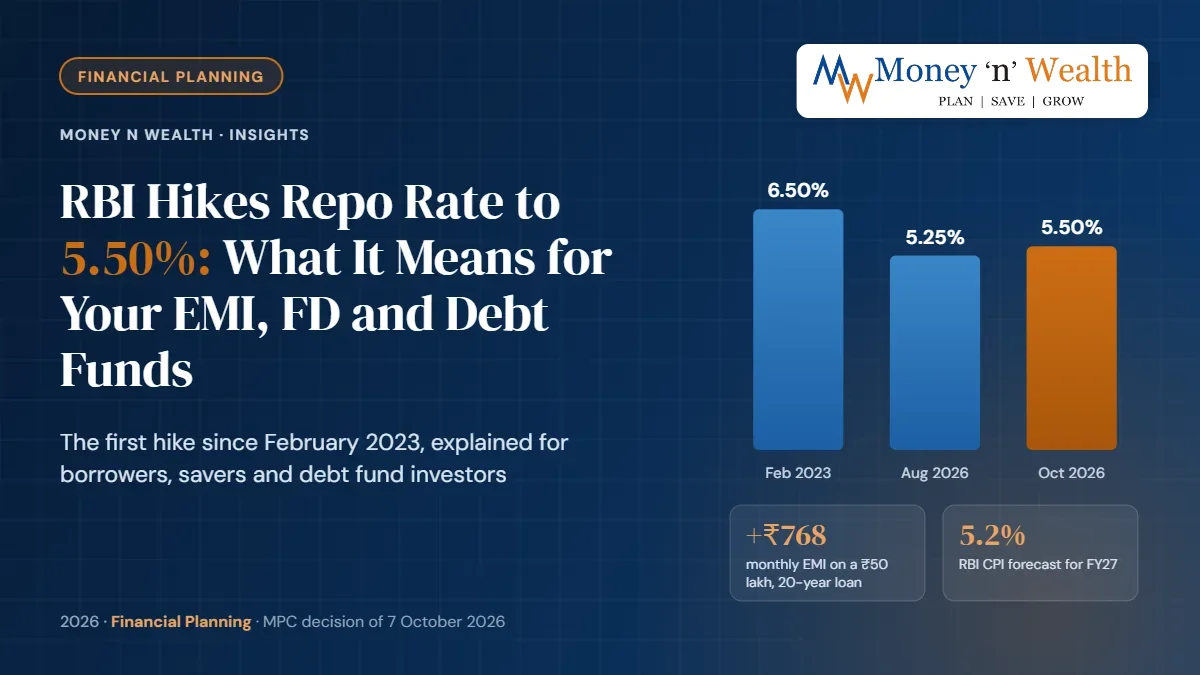
Quick answer: On 7 October 2026 the RBI raised the repo rate by 0.25 percentage points to 5.50%, its first hike since February 2023, and shifted its stance to "calibrated tightening". Floating-rate home loan EMIs will rise by roughly ₹15 per lakh borrowed, new FD rates should edge up, and long-duration debt funds may dip briefly before higher yields work in their favour.
Last updated: 13 October 2026 Quick answer: On 7 October 2026 the RBI raised the repo rate by 0.25 percentage points to 5.50%, its first hike since February 2023, and shifted its stance to "calibrated tightening". Floating-rate home loan EMIs will rise by roughly ₹15 per lakh borrowed, new FD rates should edge up, and long-duration debt funds may dip briefly before higher yields work in their favour. Key takeaways Policy rates: repo 5.50%, Standing Deposit Facility 5.25%, Marginal Standing Facility and Bank Rate 5.75%. Why: CPI inflation rose to 4.8% in August; the RBI now projects 5.2% for FY27, citing a weak monsoon, El Niño and high energy prices. Borrowers: on a ₹50 lakh, 20-year loan at 7.50%, the EMI rises by about ₹768. Extending the tenure instead costs about 2.5 times more interest. Savers: existing FDs keep their booked rate; ladder new deposits rather than locking everything at once. Debt funds: short-term funds are barely affected; gilt and long-duration funds can lose 2-3% on a 0.25% yield rise but earn more afterwards. Next meeting: 2-4 December 2026. The RBI has said rate cuts are off the table for now. For almost three years, Indian borrowers heard only one kind of rate news: cuts, or pauses. The repo rate fell from 6.50% in early 2023 to 5.25% by December 2025. That cycle has now turned. The Reserve Bank of India's Monetary Policy Committee (MPC) unanimously voted to raise the repo rate by 25 basis points to 5.50% at its meeting of 5-7 October 2026, and four of its six members voted to change the stance from neutral to "calibrated tightening". A quarter of a percentage point sounds small. Its effect on your money depends entirely on what you hold: a floating-rate home loan, a ladder of fixed deposits, a debt mutual fund, or an equity SIP. This guide works through each one with rupee examples, and ends with a checklist of what is worth doing now and what is better left alone. What exactly did the RBI decide on 7 October 2026? Policy measure Before After 7 Oct 2026 Repo rate 5.25% 5.50% Standing Deposit Facility (SDF) 5.00% 5.25% Marginal Standing Facility (MSF) and Bank Rate 5.50% 5.75% Stance Neutral Calibrated tightening (4-2 vote) FY27 GDP growth projection 6.7% 7.1% FY27 CPI inflation projection 5.0% 5.2% The repo rate is the rate at which the RBI lends overnight money to banks. When it rises, banks' cost of funds rises, and that flows through to loan and deposit rates. Governor Sanjay Malhotra said a near-term rate cut is no longer under consideration, so the next move is either another hike or a pause. SBI Research had called for 25 bps in October followed by a further 25 bps in December, which would take the repo rate to 5.75% by year-end; that is a forecast, not a certainty. Line chart of India Why did the RBI raise rates now? The trigger is inflation. Consumer price inflation climbed to 4.8% in August 2026 from 4.5% in July, and the RBI raised its full-year forecast to 5.2% from 5.0%. Core inflation, which strips out food and fuel, is projected at a calmer 4.4%. The MPC pointed to four risks: a deficient monsoon, El Niño conditions, elevated energy and commodity prices, and continuing supply-side pressures. Crucially, the economy is strong enough to absorb a hike. Growth came in at 7.8% in the April-June quarter, and the RBI lifted its FY27 growth projection to 7.1%. When growth is healthy and inflation is drifting up, central banks everywhere tend to act early rather than late. The logic is simple: it is cheaper to nudge rates up by 0.25% now than to fight entrenched inflation with large hikes later, as many central banks had to in 2022-23. How much will your home loan EMI go up? Most floating-rate home loans taken since October 2019 are linked to an external benchmark, usually the repo rate itself. Under RBI rules, these external benchmark lending rate (EBLR) loans must be reset at least once every three months, so the higher rate will reach your loan within a quarter. Several banks, including PNB, revised their repo-linked lending rates within a day of the decision. Older loans linked to MCLR or base rate change more slowly, on their own reset dates. As a rule of thumb, a 0.25% rise adds about ₹15 a month per lakh borrowed on a 20-year loan. Here is what that looks like for common loan sizes, assuming your rate moves from 7.50% to 7.75%: Loan EMI at 7.50% EMI at 7.75% Monthly rise If tenure is extended instead ₹30 lakh, 20 years ₹24,168 ₹24,628 ₹461 About 11 extra months ₹50 lakh, 20 years ₹40,280 ₹41,047 ₹768 About 11 extra months ₹75 lakh, 25 years ₹55,424 ₹56,650 ₹1,225 About 22 extra months Higher EMI or longer tenure: which should you pick? When rates rise, banks usually keep your EMI unchanged and quietly extend the tenure. That feels painless, but it is the expensive option. On the ₹50 lakh loan above, paying ₹768 more each month costs about ₹1.84 lakh in extra interest over the life of the loan. Keeping the EMI and stretching the tenure by 11 months costs about ₹4.56 lakh , roughly two and a half times as much. Grouped bar chart showing that extending loan tenure after a rate hike costs about 2.5 times more extra interest than raising the EMI, for loans of ₹30 lakh, ₹50 lakh and ₹75 lakh If your budget can absorb the higher EMI, write to your bank and ask for the EMI to be revised rather than the tenure. If cash flow is tight, a small part-prepayment each year can achieve the same result. Our debt management guide (/insights/debt-management-guide-india) explains how to prioritise prepayment across loans, and the EMI calculator (/tools) lets you run your own numbers. Should you lock in FDs now, or wait? Your existing fixed deposits are not affected: they keep the rate you booked until maturity. The hike matters for money you deposit or renew from here on. Banks tend to raise deposit rates more slowly and less fully than lending rates, so do not expect every bank to add 0.25% to its FD card overnight. The bigger question is timing. If the RBI hikes again in December, FD rates could rise further; if inflation cools, this may be close to the peak. Nobody knows which, so the practical answer is a ladder : split new money across 1-, 2- and 3-year deposits. As each one matures, you reinvest at whatever rates prevail then, which smooths out the guesswork. Check small finance banks and large banks side by side. Bank deposits are insured by the DICGC (https://www.dicgc.org.in/) up to ₹5 lakh per depositor per bank, which is useful when spreading money across banks. Remember the tax. FD interest is taxed at your slab rate every year, and banks deduct TDS above the threshold. Post-tax, a 7% FD earns 4.9% for someone in the 30% bracket. Senior citizens should compare FDs with the Senior Citizens' Savings Scheme and RBI Floating Rate Savings Bonds, whose rates are set by formula rather than bank discretion. What happens to debt mutual funds when rates rise? Bond prices move opposite to interest rates. When yields go up, the price of bonds a fund already holds goes down, and the size of that fall depends on the fund's modified duration . A rough rule: price change ≈ −duration × change in yield. After the announcement, the 10-year government bond yield rose to about 7.24-7.25% from roughly 7.19%. Horizontal bar chart of estimated NAV impact of a 0.25 percentage point rise in yields: liquid funds about −0.03%, short duration about −0.6%, gilt funds about −2.25%, long duration about −2.75% That fall is not the end of the story. The fund now reinvests maturing bonds and new money at higher yields, so its future accrual rises. For a fund with a two-year duration, the extra income typically recovers a 0.25% rate shock within about two years. Long-duration funds take the biggest hit when rates rise and gain the most when they eventually fall, which is why they suit only investors with a long horizon and a stomach for volatility. If you need the money in… Suitable categories What the hike means Under 1 year Overnight, liquid (/insights/overnight-liquid-funds) , money market, ultra short (/insights/ultra-short-funds) Minimal price impact; yields improve almost immediately 1-3 years Short duration, banking and PSU, corporate bond, arbitrage (/insights/arbitrage-funds) Small, temporary dip; higher accrual afterwards 5 years or more Gilt, dynamic bond, long duration (/insights/long-duration-funds) Larger near-term volatility; better entry yields for patient investors For a structured way to pick a debt fund on duration, credit quality and cost, see how to choose a debt mutual fund (/insights/how-to-choose-debt-mutual-fund-three-checks) , and for the post-tax comparison with deposits, FD vs debt mutual funds (/insights/fixed-deposit-vs-debt-mutual-funds-which-gives-better-post-tax-returns-now) . Does a rate hike hurt the stock market and your SIPs? Higher rates raise companies' borrowing costs and reduce the present value investors put on future earnings, so rate-sensitive sectors such as real estate, autos and NBFCs often react first. Banks can benefit in the short run as loan yields reset faster than deposit costs. But a single 0.25% move, made against a backdrop of 7%+ growth, is rarely what decides long-term equity returns. Earnings growth does that. If you run equity SIPs for goals ten or more years away, there is nothing to change. Rate cycles come and go several times over a working life; rupee-cost averaging means volatility actually helps a disciplined SIP investor buy more units when prices dip. Our SIP planning guide (/insights/sip-planning-guide-india) covers why consistency matters more than timing. What should you do this month? Your rate-hike checklist Related reading Debt management in India: how to get out of debt faster (/insights/debt-management-guide-india) Personal loan vs loan against mutual funds vs gold loan (/insights/personal-loan-vs-lamf-vs-gold-loan) Bonds 101: G-Secs, corporate and tax-free bonds (/insights/bonds-101-india) Emergency fund: how much and where to keep it (/insights/emergency-fund-guide-india) Bonds at Money n Wealth (/products/bonds) Frequently Asked Questions What is the current repo rate in India? The repo rate is 5.50%, effective from the RBI's policy announcement on 7 October 2026. The Standing Deposit Facility rate is 5.25%, and the Marginal Standing Facility rate and Bank Rate are 5.75%. When will my home loan EMI increase after the repo rate hike? If your loan is linked to the repo rate (an EBLR loan), the bank must reset it at least once every three months, so the change usually reaches you within a quarter. MCLR-linked loans change on their own reset date, typically every six or twelve months. Will the interest rate on my existing fixed deposit change? No. An existing FD earns the rate agreed when you booked it until maturity. Only new deposits and renewals are priced at the revised rates. Is it better to increase the EMI or the loan tenure when rates rise? Increasing the EMI is usually cheaper. On a ₹50 lakh, 20-year loan, a 0.25% rise costs about ₹1.84 lakh extra if you raise the EMI, but about ₹4.56 lakh if you keep the EMI and extend the tenure. Should I sell my debt mutual funds after the rate hike? Usually not. The price impact on liquid and short-duration funds is tiny, and higher yields raise future returns. Selling only makes sense if a fund's duration no longer matches when you need the money. When is the next RBI monetary policy meeting? The next MPC meeting is scheduled for 2-4 December 2026, and the minutes of the October meeting are due on 21 October 2026. Sources: Reserve Bank of India MPC statement, 7 October 2026 (via TeamLease RegTech (https://teamleaseregtech.com/updates/article/60123/rbi-mpc-hikes-repo-rate-to-550-and-adopts-a-calibrated-tightening-stan) ); Upstox (https://upstox.com/news/personal-finance/investing/rbi-october-mpc-repo-rate-hiked-for-the-first-time-in-nearly-4-years-what-it-means-for-fixed-deposit-investors/article-201422/) ; Bajaj Broking (https://www.bajajbroking.in/share-market-news/rbi-rate-hike-to-5-50percent-impact-on-bank-lending-rates-and-borrowers) ; rbi.org.in (https://www.rbi.org.in/) . EMI figures are Money n Wealth calculations. Wondering whether to prepay your loan or rebalance your debt funds? The right move depends on your loan, tax bracket and timelines. Talk to Money n Wealth (/contact) for a free portfolio review. This article is for general educational purposes only and does not constitute financial advice. Figures and examples are illustrative. Please consult a qualified financial adviser for guidance specific to your situation. Money n Wealth (Predics Fintech Services Pvt Ltd) is an AMFI-registered Mutual Fund Distributor (ARN-121995) and APMI-registered PMS Distributor (APRN07444); it is not a SEBI-registered investment adviser and may earn distribution commission on investments made through it.
Frequently Asked Questions
What is the current repo rate in India?
The repo rate is 5.50%, effective from the RBI's policy announcement on 7 October 2026. The Standing Deposit Facility rate is 5.25%, and the Marginal Standing Facility rate and Bank Rate are 5.75%.
When will my home loan EMI increase after the repo rate hike?
If your loan is linked to the repo rate (an EBLR loan), the bank must reset it at least once every three months, so the change usually reaches you within a quarter. MCLR-linked loans change on their own reset date, typically every six or twelve months.
Will the interest rate on my existing fixed deposit change?
No. An existing FD earns the rate agreed when you booked it until maturity. Only new deposits and renewals are priced at the revised rates.
Is it better to increase the EMI or the loan tenure when rates rise?
Increasing the EMI is usually cheaper. On a ₹50 lakh, 20-year loan, a 0.25% rise costs about ₹1.84 lakh extra if you raise the EMI, but about ₹4.56 lakh if you keep the EMI and extend the tenure.
Should I sell my debt mutual funds after the rate hike?
Usually not. The price impact on liquid and short-duration funds is tiny, and higher yields raise future returns. Selling only makes sense if a fund's duration no longer matches when you need the money.
When is the next RBI monetary policy meeting?
The next MPC meeting is scheduled for 2-4 December 2026, and the minutes of the October meeting are due on 21 October 2026.
Wondering whether to prepay your loan or rebalance your debt funds?
The right move depends on your loan, tax bracket and timelines. Talk to Money n Wealth for a free portfolio review.