Muhurat Trading 2026: Date, Timings and Whether It Really Matters
Last updated: 13 October 2026
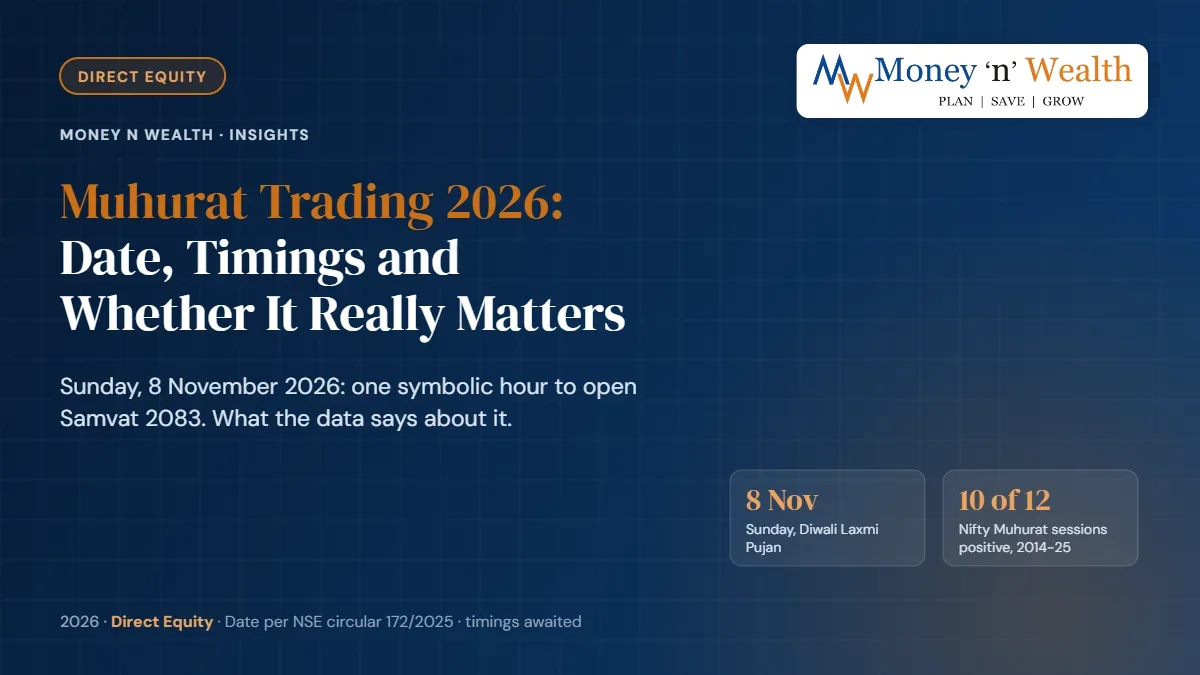
Quick answer: Muhurat trading 2026 will be held on Sunday, 8 November 2026, the Diwali Laxmi Pujan day, as confirmed in NSE's 2026 holiday circular. The exact session timings had not been announced as of 13 October 2026; the exchanges will notify them in a separate circular. Expect a one-hour normal-market window. Treat it as a symbolic start to Samvat 2083, not a trading signal.
Last updated: 13 October 2026 Quick answer: Muhurat trading 2026 will be held on Sunday, 8 November 2026 , the Diwali Laxmi Pujan day, as confirmed in NSE's 2026 holiday circular. The exact session timings had not been announced as of 13 October 2026; the exchanges will notify them in a separate circular. Expect a one-hour normal-market window. Treat it as a symbolic start to Samvat 2083, not a trading signal. Key takeaways Date: Sunday, 8 November 2026 (NSE circular 172/2025, dated 12 December 2025). Timings: still to be notified; 2025 ran 1:45–2:45 pm, 2024 ran 6:00–7:00 pm. Next holiday: markets are shut on Tuesday, 10 November for Diwali Balipratipada. Track record: Nifty 50 ended the Muhurat hour higher in 10 of the 12 sessions from 2014 to 2025, averaging about +0.3%. Reality check: Samvat 2082 began with a green Muhurat session, yet the Nifty is about 13.5% lower a year later. Last Diwali, the Nifty 50 closed the Muhurat session up 0.10% at 25,868.60. Twelve months on, on 12 October 2026, it closed at 22,363.35, about 15% below its record close of 26,328.55 on 2 January 2026. Both facts are true, and together they explain this guide's view: Muhurat trading is a lovely tradition, but a poor forecast. This guide covers the confirmed date of Muhurat trading 2026, what we know (and don't) about timings, how past sessions and Samvat years actually performed, how settlement and tax work, and a short checklist if you want to take part. When is Muhurat trading 2026? Muhurat trading is a special one-hour trading session that NSE and BSE hold on Diwali, during the Lakshmi Puja muhurat, to mark the start of the new Hindu accounting year (Samvat). In 2026 that day is Sunday, 8 November , and the new year is Samvat 2083. The date comes from NSE's trading-holiday circular for 2026 ( NSE/CMTR/71775 (https://nsearchives.nseindia.com/content/circulars/CMTR71775.pdf) , dated 12 December 2025). It lists Diwali Laxmi Pujan on 8 November as a weekend holiday and adds that Muhurat trading will be held that day, with timings to be notified later. BSE follows the same holiday calendar. Date (2026) Day Market status 6 November Friday Normal trading day 8 November Sunday Muhurat trading session (Diwali Laxmi Pujan); timings awaited 9 November Monday Normal trading day 10 November Tuesday Trading holiday (Diwali Balipratipada) 11 November Wednesday Normal trading day The Diwali week is therefore short. With a Sunday session and a Tuesday holiday, trading days and settlement dates shift a little, so check your broker's settlement calendar before relying on funds from a sale that week. What are the Muhurat trading timings for 2026? As of 13 October 2026, neither exchange had published the 2026 timing circular. Websites showing a definite time are guessing from past years. The pattern of the last three years shows why guessing is risky: the slot moved from evening to afternoon in 2025. The timing circular has historically arrived anywhere from about two to four weeks before Diwali. In 2025 NSE issued it on 22 September ( NSE/CMTR/70319 (https://nsearchives.nseindia.com/content/circulars/CMTR70319.pdf) ); in 2024 on 19 October ( NSE/CMTR/64628 (https://nsearchives.nseindia.com/content/circulars/CMTR64628.pdf) ). We will update this page once the 2026 circular is out. Comparison of Muhurat trading timings in 2023, 2024 and 2025 from NSE circulars Timings move around: evening sessions in 2023 and 2024, an afternoon slot in 2025. How a Muhurat session is structured The session mirrors a normal trading day, compressed. Using the 2025 circular as the template: Block deal window (15 minutes) for large negotiated trades. Pre-open session (15 minutes) for price discovery, with random closure in the last minute. Normal market (60 minutes): the actual Muhurat hour, when most investors trade. Closing session (10 minutes) for orders at the closing price. Trade modification cut-off shortly after. Derivatives, currency and commodity segments usually run alongside equities in the same slot. Newly listed and relisted stocks have their own special pre-open timing. What is Samvat, and why does the market open on Diwali? Many trading families, especially Gujarati and Marwari business communities, traditionally close old account books and open new ones (chopda pujan) on Diwali. Muhurat trading carries that idea onto the exchange floor. The custom is commonly traced to the BSE in 1957, with NSE holding its own session since soon after it started trading in the 1990s. The session marks the start of the Vikram Samvat year. Diwali 2026 opens Samvat 2083. For Indian market commentators, "Samvat returns" (Diwali to Diwali) have become a popular yardstick alongside calendar-year returns. Does Muhurat trading give good returns? What 12 years of data show The Muhurat hour does tend to close slightly green. Nifty 50 ended higher in 10 of the 12 sessions from 2014 to 2025, falling only in 2016 and 2017. But the average move was only about +0.3%, which is smaller than an ordinary day's swing in most years. Bar chart of Nifty 50 returns in Muhurat trading sessions from 2014 to 2025, positive in 10 of 12 years The Muhurat hour usually ends slightly higher, but the moves are tiny. Two reasons explain the mild positive bias, neither of which is magic. First, many participants buy token quantities as a ritual, while few sell on an auspicious day. Second, volumes are thin, so modest buying moves prices a little. Business Standard's five-year review found both indices ended higher in every session from 2020 to 2024, with gains between 0.41% and 0.88% ( Business Standard (https://www.business-standard.com/amp/markets/news/muhurat-trading-five-year-trend-shows-festive-optimism-will-it-continue-125101700085_1.html) ). Does a good Muhurat session predict a good Samvat year? No. Look at what followed each session. Samvat 2077 (Diwali 2020 to 2021) gave the Nifty about 38%, while Samvat 2081 gave only about 6%, even though both began with nearly identical Muhurat gains. Samvat 2082 is the starkest example. Samvat Muhurat date Nifty in Muhurat hour Nifty over the Samvat year 2077 14 Nov 2020 +0.47% about +38% 2078 4 Nov 2021 +0.49% about +9.4% 2079 24 Oct 2022 +0.88% about +10.5% 2080 12 Nov 2023 +0.52% about +25% 2081 1 Nov 2024 +0.41% about +6% 2082 21 Oct 2025 +0.10% about −13.5% (to 12 Oct 2026) Sources: Business Standard (Samvat 2077–2080), IANS (Samvat 2081 and the 2025 session), NSE closing data for Samvat 2082 so far (Money n Wealth calculation from 25,843.15 on 20 October 2025 to 22,363.35 on 12 October 2026). Bar chart of Nifty 50 returns in Samvat years 2077 to 2082 showing that a positive Muhurat trading session did not predict the year A green Muhurat hour did not stop Samvat 2082 from becoming a weak year. Samvat 2082 has been hurt by forces no festival hour could foresee: crude oil above $100 a barrel amid West Asia tensions, heavy foreign portfolio selling, a weaker rupee and the RBI's 25 bps repo hike to 5.50% on 7 October 2026. If you are worried about this fall, our market fall playbook (/insights/stock-market-fall-what-to-do) covers what history says about corrections and recoveries. Should you buy shares in Muhurat trading 2026? Buy on Muhurat only what you would happily buy on any ordinary Monday. The tradition is a fine nudge to review goals and invest with intention. It becomes harmful when it pushes people into hot tips, leverage or a "lucky" F&O trade. A good use of the day is to make a small, planned addition to a long-term holding, or to begin a SIP you had already decided on. If you are just starting with direct stocks, read our guide to direct equity costs and taxation (/insights/direct-equity-investing-india-taxation-guide) first, and consider whether a diversified fund suits you better ( SIP planning guide (/insights/sip-planning-guide-india) ). Checklist of five steps for investors planning to take part in Muhurat trading 2026 Practical points for the one-hour window Use limit orders. Liquidity is thinner than usual, so market orders in mid-caps and small-caps can fill at poor prices. Keep funds ready in advance. Add money to your trading account on a working day before 8 November; payment-gateway delays on a Sunday festival evening are common. Avoid derivatives as a ritual. SEBI's own studies have found that most individual F&O traders lose money; see our note on what SEBI's F&O loss data shows (/insights/fno-trading-sebi-loss-study) . Be wary of "Muhurat picks". Brokerage lists are research views, not guarantees. Know the difference between SEBI-registered research and stock tips (/insights/what-sebi-registered-equity-research-actually-involves) . How are Muhurat trades settled and taxed? A Muhurat trade is a normal trade. NSE's circulars state that all trades executed in the session result in settlement obligations, so purchases settle under the usual T+1 cycle and shares reach your demat as on any other day. Intraday positions must be squared off within the session. Tax is also ordinary. Selling listed shares held for 12 months or less attracts 20% short-term capital gains tax; longer holdings attract 12.5% on gains above ₹1.25 lakh a year (rates in force since 23 July 2024). Our guide to capital gains tax on shares and tax harvesting (/insights/capital-gains-tax-shares-tax-harvesting) explains how to use that ₹1.25 lakh exemption. Diwali is not a deadline, but it is a sensible reminder to plan harvesting before 31 March. The behavioural lesson of Muhurat trading Rituals help people act. Behavioural research, popularised by Daniel Kahneman and Richard Thaler, shows investors are easily swayed by stories, anchors and social signals. A Muhurat buy can harness that tendency for good: one deliberate action, taken calmly, towards a long-term goal. The same tendency can also hurt. Believing an auspicious hour protects a purchase is a classic illusion of control. In a year when the Nifty is well below its peak, the useful Diwali question is not "what will the market do on Sunday?" It is "is my asset allocation still right for my goals?" Our article on five behavioural mistakes that cost investors most (/insights/behavioural-finance-investor-mistakes) goes deeper. Related reading Market fall playbook: what to do when the Nifty drops 10% or more (/insights/stock-market-fall-what-to-do) Should you stop your SIP when markets fall? (/insights/should-you-stop-sip-when-markets-fall) Dhanteras 2026 gold guide: jewellery, coins, ETFs or gold funds (/insights/dhanteras-2026-gold-buying-guide) RBI hikes repo rate to 5.50%: what it means for you (/insights/rbi-repo-rate-hike-october-2026-emi-fd-debt-funds) Direct equity investing: taxation and costs (/insights/direct-equity-investing-india-taxation-guide) Frequently Asked Questions What is the date of Muhurat trading 2026? Muhurat trading 2026 is on Sunday, 8 November 2026, the day of Diwali Laxmi Pujan. NSE confirmed this in its 2026 trading holiday circular (NSE/CMTR/71775, dated 12 December 2025), which says the session will be held that day and that timings will be notified separately. It marks the start of Samvat 2083. What time is Muhurat trading in 2026? As of 13 October 2026, the exchanges had not announced the 2026 timings. Past sessions show the slot changes: 6:15–7:15 pm in 2023, 6:00–7:00 pm in 2024 and 1:45–2:45 pm in 2025. Wait for the NSE/BSE circular, usually issued two to four weeks before Diwali, and ignore unofficial times. Is the stock market open on 9 and 10 November 2026? Monday, 9 November is a normal trading day. Tuesday, 10 November is a trading holiday for Diwali Balipratipada, according to NSE's 2026 holiday list. Markets reopen on Wednesday, 11 November. Plan any fund transfers or sale proceeds for that week with the holiday in mind. Can I do intraday and F&O trading during Muhurat trading? Yes. Equity cash, equity derivatives and other segments usually trade in the same window. Intraday positions must be closed within the session, and normal margin rules apply. Given thin liquidity and SEBI's data showing most individual F&O traders lose money, a festival hour is a poor time for leveraged bets. Are Muhurat trading gains taxed differently? No. Trades in the Muhurat session are ordinary trades. Shares sold within 12 months attract 20% short-term capital gains tax, and longer holdings attract 12.5% on gains above ₹1.25 lakh in a financial year. Intraday profits are treated as speculative business income. Settlement follows the normal T+1 cycle. Does the market always go up on Muhurat trading? Not always. The Nifty 50 ended higher in 10 of the 12 sessions from 2014 to 2025 and fell in 2016 and 2017. The average gain was only about 0.3%. More importantly, the session's direction has said little about the following year: Samvat 2082 opened higher but is down about 13.5% so far. Can I invest in mutual funds during Muhurat trading? Muhurat trading is an exchange session for listed securities such as shares and ETFs. You can buy an ETF in the window. Ordinary mutual fund purchases are processed by the fund house on business days, so placing an order on Diwali Sunday has no special benefit. A SIP started any week works the same way. Sources: NSE trading holidays 2026 circular (https://nsearchives.nseindia.com/content/circulars/CMTR71775.pdf) ; NSE Muhurat 2025 circular (https://nsearchives.nseindia.com/content/circulars/CMTR70319.pdf) ; NSE Muhurat 2024 circular (https://nsearchives.nseindia.com/content/circulars/CMTR64628.pdf) ; NSE Muhurat 2023 circular (https://nsearchives.nseindia.com/content/circulars/CMTR59124.pdf) ; Business Standard Muhurat five-year trend (https://www.business-standard.com/amp/markets/news/muhurat-trading-five-year-trend-shows-festive-optimism-will-it-continue-125101700085_1.html) ; Business Standard on Samvat returns (https://www.business-standard.com/amp/markets/stock-market-news/nifty-50-index-ends-samvat-2080-with-25-gain-most-in-three-years-124103100983_1.html) ; IANS on Samvat 2081 (https://ianslive.in/nifty-sensex-end-samvat-2081-on-strong-note-with-6-pc-return--20251020181107) ; HDFC Sky Muhurat history (https://hdfcsky.com/news/history-of-muhurat-trading) . Worked examples are Money n Wealth calculations. Want a Diwali check-up of your equity portfolio? A year like Samvat 2082 is the right time to check allocation, tax harvesting and goals before adding more. Talk to Money n Wealth (/contact) for a free portfolio review. This article is for general educational purposes only and does not constitute financial advice. Figures and examples are illustrative. Please consult a qualified financial adviser for guidance specific to your situation. Money n Wealth (Predics Fintech Services Pvt Ltd) is an AMFI-registered Mutual Fund Distributor (ARN-121995) and APMI-registered PMS Distributor (APRN07444); it is not a SEBI-registered investment adviser and may earn distribution commission on investments made through it.
Frequently Asked Questions
What is the date of Muhurat trading 2026?
Muhurat trading 2026 is on Sunday, 8 November 2026, the day of Diwali Laxmi Pujan. NSE confirmed this in its 2026 trading holiday circular (NSE/CMTR/71775, dated 12 December 2025), which says the session will be held that day and that timings will be notified separately. It marks the start of Samvat 2083.
What time is Muhurat trading in 2026?
As of 13 October 2026, the exchanges had not announced the 2026 timings. Past sessions show the slot changes: 6:15–7:15 pm in 2023, 6:00–7:00 pm in 2024 and 1:45–2:45 pm in 2025. Wait for the NSE/BSE circular, usually issued two to four weeks before Diwali, and ignore unofficial times.
Is the stock market open on 9 and 10 November 2026?
Monday, 9 November is a normal trading day. Tuesday, 10 November is a trading holiday for Diwali Balipratipada, according to NSE's 2026 holiday list. Markets reopen on Wednesday, 11 November. Plan any fund transfers or sale proceeds for that week with the holiday in mind.
Can I do intraday and F&O trading during Muhurat trading?
Yes. Equity cash, equity derivatives and other segments usually trade in the same window. Intraday positions must be closed within the session, and normal margin rules apply. Given thin liquidity and SEBI's data showing most individual F&O traders lose money, a festival hour is a poor time for leveraged bets.
Are Muhurat trading gains taxed differently?
No. Trades in the Muhurat session are ordinary trades. Shares sold within 12 months attract 20% short-term capital gains tax, and longer holdings attract 12.5% on gains above ₹1.25 lakh in a financial year. Intraday profits are treated as speculative business income. Settlement follows the normal T+1 cycle.
Does the market always go up on Muhurat trading?
Not always. The Nifty 50 ended higher in 10 of the 12 sessions from 2014 to 2025 and fell in 2016 and 2017. The average gain was only about 0.3%. More importantly, the session's direction has said little about the following year: Samvat 2082 opened higher but is down about 13.5% so far.
Can I invest in mutual funds during Muhurat trading?
Muhurat trading is an exchange session for listed securities such as shares and ETFs. You can buy an ETF in the window. Ordinary mutual fund purchases are processed by the fund house on business days, so placing an order on Diwali Sunday has no special benefit. A SIP started any week works the same way.
Want a Diwali check-up of your equity portfolio?
A year like Samvat 2082 is the right time to check allocation, tax harvesting and goals before adding more. Talk to Money n Wealth for a free portfolio review.