Motor Insurance in 2026: IDV, No-Claim Bonus and Add-Ons Explained
Last updated: 13 October 2026
Quick answer: Motor insurance in India has two parts. Third-party cover is mandatory and its premium is fixed by the government. Own-damage cover protects your vehicle up to its IDV, which is the ex-showroom price less 5% to 50% depreciation by age. The no-claim bonus cuts the own-damage premium by 20% to 50%, and add-ons such as zero depreciation decide how much of a claim you actually get.
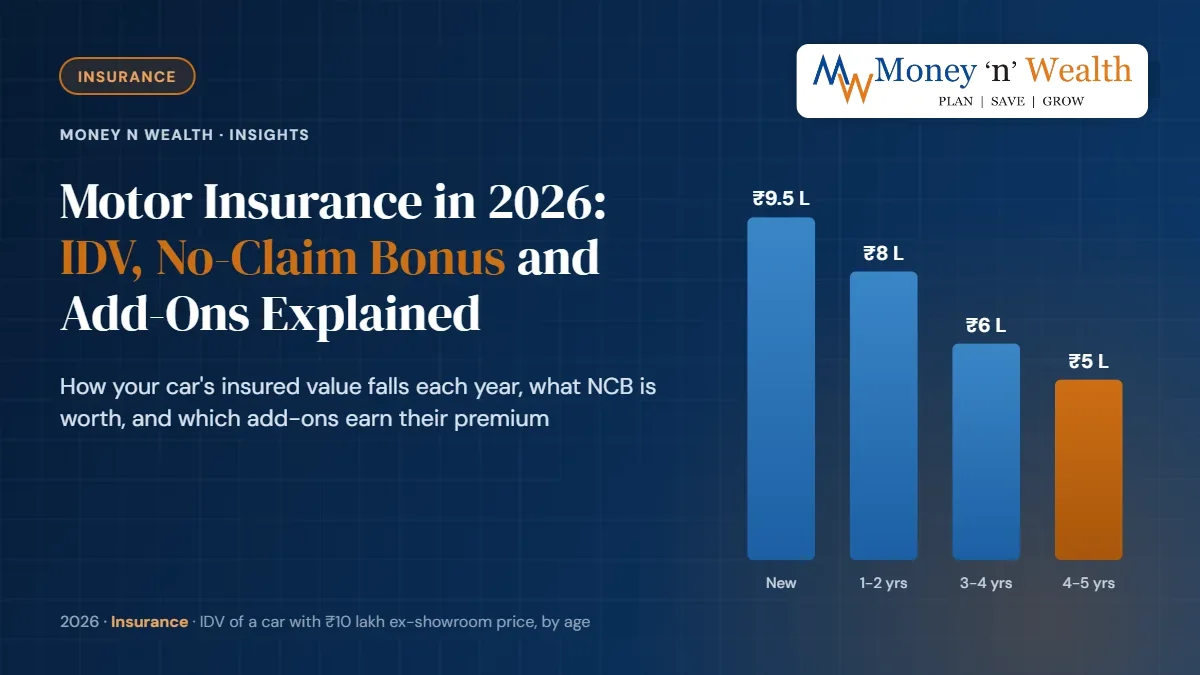
Last updated: 13 October 2026 Quick answer: Motor insurance in India has two parts. Third-party cover is mandatory and its premium is fixed by the government. Own-damage cover protects your vehicle up to its IDV, which is the ex-showroom price less 5% to 50% depreciation by age. The no-claim bonus cuts the own-damage premium by 20% to 50%, and add-ons such as zero depreciation decide how much of a claim you actually get. Key takeaways Third-party is the law: driving uninsured can mean a ₹2,000 fine (₹4,000 for a repeat offence) and up to three months in jail. IDV falls fast: a ₹10 lakh car is insured for ₹8 lakh in year two and ₹5 lakh by year five. NCB is 20% to 50%: it applies only to own-damage premium and lapses if you renew more than 90 days late. Zero-dep matters: on a ₹1.85 lakh repair to a 3.5-year-old car, depreciation alone can leave you paying ₹47,500. GST is still 18%: the September 2025 GST cut covered individual life and health policies, not motor. A Baner resident's three-year-old hatchback stalls in a waterlogged underpass during a September downpour. He restarts it, and the engine seizes. The repair estimate is ₹1.6 lakh, and the surveyor points to two lines in his policy: no engine protection add-on, and depreciation on every plastic and rubber part. His "comprehensive" motor insurance pays well under half. Most car owners renew on autopilot, chasing the lowest premium. This guide explains, as of October 2026, what you are actually buying: the third-party mandate, how IDV is fixed, how the no-claim bonus works, which add-ons earn their cost, and when a small claim is not worth making. What does motor insurance cover in India? Motor insurance is a contract that pays for damage caused by or to your vehicle. A standard private car or two-wheeler policy has two sections that are priced separately. Third-party (TP) liability pays others for injury, death or property damage caused by your vehicle. Section 146 of the Motor Vehicles Act, 1988 makes it compulsory for every vehicle used in a public place. Under section 196, as amended in 2019, driving without it can attract a ₹2,000 fine and up to three months' imprisonment, rising to ₹4,000 for a repeat offence. Own damage (OD) pays for your own vehicle. Typical policy wordings cover fire, explosion, self-ignition, lightning, theft, riot, earthquake, flood, cyclone, landslide, accidents, malicious acts, terrorism and damage in transit. It is optional, but it is what most people think of as "car insurance". Comparison of third-party, comprehensive and standalone own-damage motor insurance How much is the third-party premium? Unlike OD, the TP premium is not set by insurers. The Ministry of Road Transport and Highways notifies it in consultation with IRDAI. The rates below took effect on 1 June 2022 and are the latest notified base rates we could confirm. A further revision was being discussed in 2026, but no new rates had been notified when we checked, so confirm the figure on your renewal quote. Vehicle (petrol/diesel) Annual TP premium Long-term TP for new vehicle Car up to 1,000cc ₹2,094 ₹6,521 (3 years) Car 1,000–1,500cc ₹3,416 ₹10,640 (3 years) Car above 1,500cc ₹7,897 ₹24,596 (3 years) Two-wheeler up to 75cc ₹538 ₹2,901 (5 years) Two-wheeler 75–150cc ₹714 ₹3,851 (5 years) Two-wheeler 150–350cc ₹1,366 ₹7,365 (5 years) Two-wheeler above 350cc ₹2,804 ₹15,117 (5 years) Electric vehicles get about a 15% discount on these TP rates and hybrids 7.5%. New cars must be sold with three years of TP cover and new two-wheelers with five, which is why many owners buy a standalone OD policy each year to sit alongside the long-term TP. What is IDV in motor insurance, and how is it calculated? The Insured Declared Value (IDV) is the maximum the insurer pays if your vehicle is stolen or declared a total loss. It is the manufacturer's listed selling price (ex-showroom) less a fixed depreciation for the vehicle's age. Accessories fitted later are added separately, usually after their own depreciation. Age of vehicle IDV depreciation IDV of a ₹10 lakh car Up to 6 months 5% ₹9,50,000 6 months to 1 year 15% ₹8,50,000 1 to 2 years 20% ₹8,00,000 2 to 3 years 30% ₹7,00,000 3 to 4 years 40% ₹6,00,000 4 to 5 years 50% ₹5,00,000 Over 5 years or obsolete model Agreed with insurer Based on condition and market value Bar chart of motor insurance IDV depreciation for a ₹10 lakh car from new to five years old IDV caps what you receive if the car is stolen or written off. Should you lower the IDV to cut the premium? OD premium is a percentage of IDV, so a lower IDV means a cheaper policy. Online platforms often show a slider for this. The catch is that IDV is also your payout ceiling for theft or a write-off. Under-declare by ₹1.5 lakh to save a few hundred rupees, and that ₹1.5 lakh comes out of your pocket if the car is stolen. IDV does not cap a normal repair claim, though. For partial damage, the insurer pays the repair bill less depreciation on parts and the compulsory deductible. So the real cost of a low IDV shows up only in the worst case, which is exactly when you need the money. Return to invoice: closing the IDV gap Even a new car's IDV is 5% below the ex-showroom price, and it ignores road tax and registration. A return to invoice (RTI) add-on pays the gap between IDV and the invoice value on theft or total loss. Insurers usually offer it only for the first few years. It is worth considering if the car is on a loan, since the lender is paid first. How does the no-claim bonus (NCB) work? The no-claim bonus is a discount on the own-damage premium for every claim-free year. The slabs are the same across insurers. Claim-free years NCB on OD premium OD premium of ₹20,000 becomes 1 20% ₹16,000 2 25% ₹15,000 3 35% ₹13,000 4 45% ₹11,000 5 or more 50% ₹10,000 Four rules trip people up: OD only: NCB never reduces the third-party premium. 90-day window: renew more than 90 days after expiry and the NCB resets to zero. It belongs to you, not the car: when you sell a vehicle, get an NCB certificate from your insurer and carry the bonus to your next vehicle. A claim resets it: one OD claim usually takes the bonus back to zero the following year, unless you hold an NCB protector. Bar chart of motor insurance no-claim bonus slabs from 20% to 50% applied to an own-damage premium When is a small claim not worth making? Take an owner on a 35% NCB with an OD premium of about ₹20,000 before discounts. A ₹15,000 bumper-and-light claim this year resets the bonus. Over the next five years, the NCB path drops from 45, 50, 50, 50, 50% to 0, 20, 25, 35, 45%. That is about ₹24,000 of extra premium, assuming the base premium stays the same. In practice the base premium falls a little as IDV declines, so the loss is somewhat smaller. The rule of thumb still holds: for minor damage, compare the repair bill with roughly a year or two of lost NCB before claiming. Third-party claims, theft and major damage should always be reported. Paying small repairs yourself is easier when you hold a proper emergency fund (/insights/emergency-fund-guide-india) . Which motor insurance add-ons are worth buying? Add-ons, also called riders, change how much of a claim is paid. They cost extra and most are available only on comprehensive or standalone OD policies. Add-on What it does Most useful when Zero depreciation Pays parts without deducting depreciation Car is under about 5 years old Engine protection Covers engine damage from water ingress or oil leakage, which standard OD excludes as consequential You drive through monsoon waterlogging Return to invoice Pays invoice value, not IDV, on theft or total loss Car is new or on a loan Consumables Pays nuts, bolts, oil, coolant and similar items Paired with zero-dep NCB protector Keeps your NCB after a claim (limits apply) You have a high NCB to protect Roadside assistance Towing, battery jump-start, flat tyre, fuel delivery Frequent highway driving Key and tyre cover Replacement of lost keys or damaged tyres Expensive smart keys or tyres How zero depreciation changes a claim Without zero-dep, the insurer deducts depreciation from replaced parts. A standard own-damage wording deducts 50% on rubber, nylon and plastic parts, tyres, batteries and airbags; 30% on fibreglass; nil on glass; and 0% to 50% on other parts depending on age (25% for a car 3 to 4 years old). On paint, 50% applies to the material cost. For a 3.5-year-old car with a ₹1.85 lakh bill (metal parts ₹1 lakh, plastic ₹40,000, glass ₹10,000, paint ₹20,000, labour ₹15,000), the deductions are ₹25,000 on metal, ₹20,000 on plastic and ₹2,500 on paint. That is ₹47,500 out of your pocket. With zero-dep, it is close to nil apart from the compulsory deductible. Stacked bar comparing a car insurance claim with and without a zero depreciation add-on Many insurers cap zero-dep at two claims a year and stop offering it once a car crosses five years. Read the limits before paying for it. Our insurance desk (/products/insurance) can compare add-on terms across insurers for you. Engine protection in Pune and Mumbai monsoons Standard OD covers flood damage to the body and interiors. It typically excludes engine damage caused by trying to start or drive a car through water, which the industry calls hydrostatic lock. The engine protection add-on covers that. If you park in a basement or commute through low-lying roads, it is one of the cheaper ways to avoid a six-figure bill. Even with it, do not crank a flooded engine; call roadside assistance. Do you need personal accident cover with motor insurance? Every individual owner-driver must carry compulsory personal accident (CPA) cover of ₹15 lakh, a minimum IRDAI set in September 2018. It pays on death or permanent disability while driving or travelling in the vehicle. CPA follows the owner, so one CPA policy is enough even if you own several vehicles. You may opt out if you already hold a standalone personal accident policy of at least ₹15 lakh. For working people, a broader personal accident and disability policy (/insights/personal-accident-disability-insurance) that covers all accidents, not just motor ones, is usually better value. How much GST is charged on motor insurance in 2026? Motor premiums still carry 18% GST. The GST changes effective 22 September 2025 exempted individual life and health insurance, but motor insurance stayed in the 18% slab. On a ₹15,000 premium before tax, that is ₹2,700. How to buy or renew motor insurance well Start with cover, not price. Decide IDV, add-ons and CPA first, then compare quotes on the same basis. Check the IDV against the depreciation table. Avoid quotes that look cheap only because IDV is low. Verify your NCB. Make sure the right slab is applied, and renew before expiry. Match add-ons to the car's age. Zero-dep, RTI and consumables for newer cars; engine protect for flood-prone routes. Look at the cashless garage network near where you live and work, and at the insurer's claim record. Our guide to reading claim settlement ratios (/insights/claim-settlement-ratio-explained) explains what the numbers mean. Disclose modifications such as CNG kits or alloy wheels. Undisclosed changes are a common reason for claim disputes. Checklist of steps for renewing motor insurance: IDV, NCB, add-ons, CPA and cashless garages What about pay-as-you-drive policies? Since 2022, IRDAI has allowed telematics-based add-ons such as "pay as you drive" and "pay how you drive". If your car sits in the garage most weeks because you work from home or use the Metro, a usage-based OD cover can cost less. Check what data the insurer's device or app collects before signing up. Global perspective: how other countries handle it Compulsory third-party motor cover is near universal. The United Kingdom, for example, requires at least third-party cover by law, and many US states set minimum liability limits. What is distinctive in India is that the government fixes TP premiums by engine size rather than leaving them to insurers. That keeps TP affordable but means the real price competition, and the real fine print, sits in the own-damage section. Motor insurance is one line in a household's protection plan. Our insurance planning guide (/insights/insurance-planning-guide-india) covers life, health and property together, and the companion piece on home insurance and natural calamity cover (/insights/home-insurance-india-guide) explains the equivalent rules for your flat. If you are still deciding how to pay for the car itself, read car loan or pay cash? (/insights/car-loan-or-pay-cash) Related reading Car loan or pay cash? The real cost of each (/insights/car-loan-or-pay-cash) Personal accident and disability cover (/insights/personal-accident-disability-insurance) Home insurance: structure, contents and natural calamity cover (/insights/home-insurance-india-guide) Mis-selling red flags in insurance (/insights/mis-selling-red-flags-insurance-investments) How to complain: Bima Bharosa and the Insurance Ombudsman (/insights/how-to-complain-sebi-scores-odr-ombudsman) Insurance advisor in Pune: life, health and general (/insights/insurance-advisor-in-pune) Frequently Asked Questions Is third-party motor insurance mandatory in India? Yes. Section 146 of the Motor Vehicles Act, 1988 requires every vehicle used in a public place to have third-party insurance. Driving without it can attract a ₹2,000 fine and up to three months in jail for a first offence, and ₹4,000 for a repeat offence. Own-damage cover is optional but recommended for any vehicle you could not easily replace from savings. How is IDV calculated for a car? IDV is the ex-showroom price less a standard depreciation by age: 5% up to six months, 15% up to one year, 20% up to two years, 30% up to three, 40% up to four and 50% up to five years. Beyond five years, insurer and owner agree a value based on condition. Non-factory accessories are added separately after depreciation. Can I transfer my no-claim bonus to a new car? Yes. NCB belongs to the policyholder, not the vehicle. When you sell your old car, keep the NCB, get an NCB certificate or retention letter from your insurer, and present it when insuring the new vehicle. The certificate generally needs to be used within 90 days of the old policy's expiry. The new owner of your old car starts without your bonus. Do I lose my entire NCB if I make one claim? Usually, yes. An own-damage claim in a policy year typically resets the NCB to zero at the next renewal. An NCB protector add-on lets you keep it, generally for a limited number of claims and subject to conditions. Claims under third-party cover alone, or for items like windscreen glass under some policies, may be treated differently, so check your wording. Is zero depreciation insurance worth it for a 5-year-old car? For cars up to about five years old, zero-dep usually pays for itself in a single mid-sized claim, because plastic and rubber parts otherwise lose 50% and other parts up to 35% by that age. Many insurers stop offering it after five years. For older cars, weigh the higher premium against how often you claim and whether you would repair at an authorised workshop. Does car insurance cover flood damage? A comprehensive or own-damage policy covers flood, inundation and cyclone damage to the vehicle. It usually excludes engine damage caused by trying to start or drive the car in water. The engine protection add-on covers that. Third-party-only policies pay nothing for your own vehicle in a flood. What is the difference between comprehensive and standalone own-damage cover? A comprehensive policy bundles third-party and own-damage cover in one contract. A standalone OD policy covers only your vehicle and can be bought only if you already hold a valid third-party policy, such as the three- or five-year TP sold with new vehicles. Standalone OD lets you shop for a better own-damage insurer every year. Sources: Business Standard on notified TP rates from 1 June 2022 (https://www.business-standard.com/article/economy-policy/govt-notifies-new-vehicle-insurance-rates-will-be-applicable-from-june-1-122052600973_1.html) ; IFFCO Tokio IDV depreciation table (https://www.iffcotokio.co.in/content/dam/iffcotokio/iffco-pdf/sites/default/files/IDV-Depreciation-Table.pdf) ; IFFCO Tokio standalone own-damage policy wording (https://www.iffcotokio.co.in/content/dam/iffcotokio/policy-wordings/motor/standalone-motor-own-damage-policy-for-private-car.pdf) ; Tata AIG on NCB slabs and rules (https://www.tataaig.com/motor-insurance/car-insurance/no-claim-bonus-in-car-insurance) ; Zurich Kotak on CPA cover (https://www.zurichkotak.com/knowledge-center/car-insurance/compulsory-personal-accident-guide) ; ICICI Lombard on GST on car insurance (https://www.icicilombard.com/motor-insurance/car-insurance/blogs/why-car-insurance-still-attracts-18-gst-post-reform) . Worked examples are Money n Wealth calculations. Not sure your car and home are properly insured? The right IDV, add-ons and claim decisions depend on your vehicle, usage and budget. Talk to Money n Wealth for an insurance review (/contact) . This article is for general educational purposes only and does not constitute financial advice. Figures and examples are illustrative. Please consult a qualified financial adviser for guidance specific to your situation. Money n Wealth (Predics Fintech Services Pvt Ltd) is an AMFI-registered Mutual Fund Distributor (ARN-121995) and APMI-registered PMS Distributor (APRN07444); it is not a SEBI-registered investment adviser and may earn distribution commission on investments made through it. Insurance is the subject matter of solicitation.
Frequently Asked Questions
Is third-party motor insurance mandatory in India?
Yes. Section 146 of the Motor Vehicles Act, 1988 requires every vehicle used in a public place to have third-party insurance. Driving without it can attract a ₹2,000 fine and up to three months in jail for a first offence, and ₹4,000 for a repeat offence. Own-damage cover is optional but recommended for any vehicle you could not easily replace from savings.
How is IDV calculated for a car?
IDV is the ex-showroom price less a standard depreciation by age: 5% up to six months, 15% up to one year, 20% up to two years, 30% up to three, 40% up to four and 50% up to five years. Beyond five years, insurer and owner agree a value based on condition. Non-factory accessories are added separately after depreciation.
Can I transfer my no-claim bonus to a new car?
Yes. NCB belongs to the policyholder, not the vehicle. When you sell your old car, keep the NCB, get an NCB certificate or retention letter from your insurer, and present it when insuring the new vehicle. The certificate generally needs to be used within 90 days of the old policy's expiry. The new owner of your old car starts without your bonus.
Do I lose my entire NCB if I make one claim?
Usually, yes. An own-damage claim in a policy year typically resets the NCB to zero at the next renewal. An NCB protector add-on lets you keep it, generally for a limited number of claims and subject to conditions. Claims under third-party cover alone, or for items like windscreen glass under some policies, may be treated differently, so check your wording.
Is zero depreciation insurance worth it for a 5-year-old car?
For cars up to about five years old, zero-dep usually pays for itself in a single mid-sized claim, because plastic and rubber parts otherwise lose 50% and other parts up to 35% by that age. Many insurers stop offering it after five years. For older cars, weigh the higher premium against how often you claim and whether you would repair at an authorised workshop.
Does car insurance cover flood damage?
A comprehensive or own-damage policy covers flood, inundation and cyclone damage to the vehicle. It usually excludes engine damage caused by trying to start or drive the car in water. The engine protection add-on covers that. Third-party-only policies pay nothing for your own vehicle in a flood.
What is the difference between comprehensive and standalone own-damage cover?
A comprehensive policy bundles third-party and own-damage cover in one contract. A standalone OD policy covers only your vehicle and can be bought only if you already hold a valid third-party policy, such as the three- or five-year TP sold with new vehicles. Standalone OD lets you shop for a better own-damage insurer every year.
Not sure your car and home are properly insured?
The right IDV, add-ons and claim decisions depend on your vehicle, usage and budget. Talk to Money n Wealth for an insurance review .