SIF vs Mutual Fund vs PMS vs AIF: Where SIF Fits in 2026
Last updated: 13 October 2026
Quick answer: In the SIF vs mutual fund vs PMS vs AIF comparison, the SIF sits in the middle. It keeps mutual-fund structure, oversight and tax treatment, but needs ₹10 lakh and may short up to 25% of assets. PMS (₹50 lakh) offers a portfolio in your own name with trade-by-trade tax; a Category III AIF (₹1 crore) allows leverage and is generally taxed at fund level.
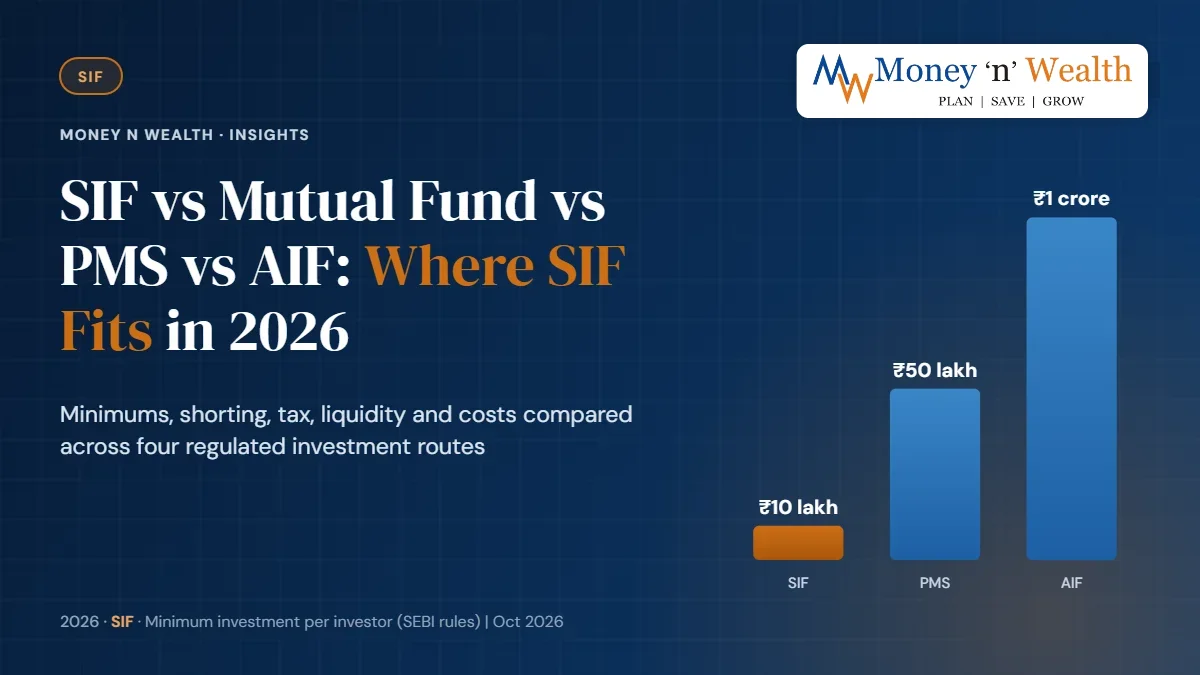
Last updated: 13 October 2026 Quick answer: In the SIF vs mutual fund vs PMS vs AIF comparison, the SIF sits in the middle. It keeps mutual-fund structure, oversight and tax treatment, but needs ₹10 lakh and may short up to 25% of assets. PMS (₹50 lakh) offers a portfolio in your own name with trade-by-trade tax; a Category III AIF (₹1 crore) allows leverage and is generally taxed at fund level. Key takeaways Minimums: mutual fund a few hundred rupees; SIF ₹10 lakh; PMS ₹50 lakh; AIF ₹1 crore. Shorting: MFs hedge only; SIFs up to 25% unhedged short; Cat III AIFs can use leverage up to 2x. Tax: MFs and SIFs pay no fund-level tax; PMS trades are taxed in your hands; Cat III AIFs generally pay tax inside the fund. Costs: SIFs follow mutual-fund expense rules with no performance fee; PMS and AIFs often charge one. Liquidity: many SIFs redeem only on set days, with notice of up to 15 working days. A Pune-based IT director with ₹40 lakh of fresh bonus and ESOP money recently asked us a fair question. "My relationship manager is pitching a PMS, my distributor mentioned a SIF, and a friend swears by a long-short AIF. Aren’t they all the same thing at different prices?" They are not, and the differences matter more than the minimum ticket. This guide puts the four regulated routes side by side as of October 2026: who regulates them, what they can invest in, how they are taxed, what they cost, how liquid they are and what you get to see. It ends with a simple framework for deciding which, if any, fits. For a primer on the newest product, start with what a Specialised Investment Fund is (/insights/what-is-specialised-investment-fund-sif-india) . SIF vs mutual fund vs PMS vs AIF: the comparison table Feature Mutual fund SIF PMS AIF (Cat III) Minimum investment A few hundred rupees (SIP) ₹10 lakh per PAN, per AMC’s SIFs ₹50 lakh ₹1 crore Regulation SEBI (Mutual Funds) Regulations, 2026 Same regulations, SIF chapter and Feb 2025 circular SEBI (Portfolio Managers) Regulations, 2020 SEBI (AIF) Regulations, 2012 Structure Pooled units Pooled units, separate brand Securities in your own demat Pooled, privately placed Shorting / leverage Derivatives for hedging and rebalancing; no leverage Unhedged short up to 25%; gross exposure capped at 100% Mainly long-only; derivatives largely for hedging Long-short allowed; leverage up to 2x NAV Liquidity Usually daily (except ELSS, closed-end) Daily to weekly by strategy; notice up to 15 working days Usually redeemable; exit charges per agreement Open or closed-ended; often monthly or quarterly Taxation No fund tax; you pay on redemption No fund tax; you pay on redemption, per equity/debt character Every trade, dividend and interest taxed in your hands Generally taxed at fund level; post-tax NAV Costs Expense ratio within SEBI caps Mutual-fund-style expense ratio; no performance fee Management fee, often plus performance fee Management fee plus performance fee Disclosure Monthly portfolio, risk-o-meter Portfolio every alternate month; 1–5 risk band; scenario analysis Holding-level statements of your own account Per placement memorandum; periodic NAV reports Two points stand out. First, a SIF is legally a mutual-fund product: it is launched under an existing mutual fund trust and inherits most mutual fund protections and the tax regime. Second, the PMS is the only route where you own the underlying shares directly, which brings both transparency and a more complicated tax return. Bar chart comparing minimum investment for mutual fund, SIF ₹10 lakh, PMS ₹50 lakh and AIF ₹1 crore How is a SIF different from a mutual fund? A mutual fund can use derivatives only to hedge and rebalance. A SIF may also take net short positions of up to 25% of net assets through exchange-traded derivatives, so the manager can profit from a stock or index falling. Within the seven SIF strategy types, asset allocation can also be more flexible than in equivalent mutual fund categories. In exchange, the SIF asks more of you: a ₹10 lakh minimum, fewer redemption days in many strategies, a separate brand to track, and a shorter operating history. The SEBI circular of 27 February 2025 (https://www.sebi.gov.in/legal/circulars/feb-2025/regulatory-framework-for-specialized-investment-funds-sif-_92299.html) also requires portfolio disclosure every alternate month rather than monthly, and replaces the riskometer with a 1-to-5 risk band. Many early SIFs, especially hybrid long-short strategies, behave more like conservative mutual fund categories than like hedge funds. NISM’s overview notes that most launches so far resemble balanced advantage (/insights/balanced-advantage) or equity savings funds. Before choosing a SIF, compare it honestly with those mutual fund alternatives and with arbitrage funds (/insights/arbitrage-funds) ; our explainer on hybrid long-short SIFs (/insights/hybrid-long-short-sif-explained) sets out the overlap. SIF vs PMS: which is better for ₹50 lakh and above? A PMS gives you a portfolio of stocks held in your own demat account, run by a SEBI-registered portfolio manager. The minimum is ₹50 lakh. You see every holding and can sometimes customise exclusions. Our PMS guide (/insights/pms-india) and how PMS works (/insights/how-pms-works-onboarding-funding-taxation-exit) explain onboarding and exit. The trade-off is tax and cost. Because you own the shares, every sale by the manager is a capital gain or loss in your hands, and dividends are taxed at slab. A SIF, by contrast, defers tax until you redeem units, much like a mutual fund. PMS fees are typically a fixed management fee, often with a performance fee above a hurdle; SIFs follow mutual fund expense rules with no performance fee. A worked example shows why tax structure matters. Suppose an equity PMS turns over half its portfolio a year and books ₹4 lakh of short-term gains on a ₹50 lakh portfolio. At 20%, that is ₹80,000 of tax paid that year. In an equity-oriented SIF, the same internal trading creates no tax until you redeem, and if you hold beyond 12 months, gains are taxed at 12.5% above the ₹1.25 lakh annual exemption (illustrative, before surcharge and cess). Our SIF taxation guide (/insights/sif-taxation-india) works through more cases. Strategy is the other difference. Most PMS offerings are long-only equity. If you want a short book or a hedged equity approach, a SIF can offer it at a fifth of the PMS minimum. If you want concentrated, personalised stock ownership, PMS remains the route. See PMS vs mutual funds above ₹1 crore (/insights/pms-vs-mutual-funds-1-crore-investors) for the larger-portfolio view. Comparison of SIF vs PMS vs Category III AIF on minimum, structure, shorting, tax and fees SIF vs AIF: how does a SIF compare with a long-short Category III AIF? Category III AIFs are India’s closest equivalent to hedge funds. They can run long-short, arbitrage and derivative strategies and can use leverage of up to two times NAV. The minimum is ₹1 crore (₹25 lakh for the manager’s employees and directors), and the fund is privately placed. Our Category III AIF guide (/insights/category-iii-aif-guide) covers the structure. Three differences matter most against a SIF: Risk ceiling: a SIF caps unhedged shorts at 25% and gross exposure at 100%; a Cat III AIF can go further with leverage. More flexibility means more potential return and more potential loss. Tax: Category III AIFs do not have pass-through status and are generally taxed inside the fund, often with business income at the maximum marginal rate. Investors receive post-tax NAV. SIFs pay no tax at fund level under the mutual fund exemption. Fees and access: AIFs usually charge a management fee plus a performance fee and may have lock-ins. SIFs have mutual-fund-style expense ratios and can be bought through any suitably certified mutual fund distributor or directly. Category I and II AIFs (private equity, venture, private credit, real estate) are a different animal: closed-ended with a minimum tenure of three years and pass-through taxation for non-business income. They do not compete with SIFs. See our guides to Category II AIFs (/insights/category-ii-aif-guide) and the AIF product page (/products/aif) . How does India’s approach compare with other countries? Other markets have also created a middle layer between retail funds and hedge funds. European UCITS funds cannot make uncovered short sales under Article 89 of the UCITS Directive (https://www.esma.europa.eu/publications-and-data/interactive-single-rulebook/ucits/article-89) , so long-short UCITS funds use derivatives for synthetic shorts, much like SIFs. In the US, "liquid alternative" mutual funds operate under the Investment Company Act and, since 2020, SEC Rule 18f-4’s value-at-risk limits on derivatives. Canada opened "alternative mutual funds" to retail investors in January 2019, permitting short selling up to 50% of NAV and leverage up to 300%. India’s SIF is more conservative than Canada’s model, with a 25% short cap and no leverage, and asks for a higher minimum than European or US retail funds. The international experience also counsels modest expectations: a Dimensional study of US liquid-alternative funds (https://www.dimensional.com/gb-en/insights/liquid-alternatives-panacea-or-just-a-pain) found that between June 2006 and June 2022 they trailed global stocks by 4.2 percentage points a year and global bonds by 1.7 points. Which should you choose: mutual fund, SIF, PMS or AIF? Start with what you need the money to do, not with the product. For most investors, including many with ₹1 crore or more, a well-built mutual fund portfolio does the core job at low cost with full liquidity. The other three are tools for specific needs. Decision steps to choose between mutual fund, SIF, PMS and AIF Build the core first. Emergency fund, insurance, retirement and goal portfolios in mutual funds, NPS or EPF. Our portfolio-first framework (/insights/how-to-choose-mutual-funds-portfolio-framework) explains how. Ask whether you need a different strategy. If you want lower volatility than equity with potentially better tax efficiency than debt, compare SIFs with balanced advantage and arbitrage funds. If you want a concentrated stock portfolio in your own name, look at PMS. Size the satellite. As a working rule, keep SIF, PMS and AIF exposure to a minority of your investable assets. Do not stretch to meet a minimum. Check liquidity and tax fit. Match redemption terms to your time horizon, and model the tax under your bracket before choosing between a SIF, a PMS and a Cat III AIF. Verify the intermediary. SIF distributors need NISM SIF certification and an ARN; PMS distributors should be APMI-registered. Our SIF suitability checklist (/insights/is-sif-right-for-you-checklist) lists the questions to ask. The boundaries are shifting. In September 2026, the SEBI board approved changes allowing AMCs offering SIFs, as well as AIF and PMS managers, to accredit investors directly, and a route for portfolio managers to offer direct mutual fund and SIF investments, Cafemutual reported (https://cafemutual.com/news/cafe-alt/38898-sebi-makes-accredited-investor-route-easier-aif-sif-and-pms-managers-can-now-accredit-clients) . Implementation details were awaited as of mid-October 2026. Money n Wealth distributes mutual funds, SIFs (/products/sif) , PMS (/products/pms) and AIFs, so we can compare all four for your situation. Related reading What Is a Specialised Investment Fund (SIF)? The 2026 Guide (/insights/what-is-specialised-investment-fund-sif-india) SIF Taxation in 2026: How Gains Are Taxed (/insights/sif-taxation-india) Equity Long-Short SIFs: How Shorting Works (/insights/equity-long-short-sif-explained) Portfolio Management Services: Complete 2026 Guide (/insights/pms-india) Category III AIF Guide (/insights/category-iii-aif-guide) Frequently Asked Questions Is a SIF better than a mutual fund? Not inherently. A SIF has more tools, such as short positions of up to 25%, but also a ₹10 lakh minimum, fewer redemption days in many strategies and a short track record. For most goals, a diversified mutual fund portfolio remains the core. A SIF can complement it for investors who understand long-short strategies and have surplus capital to commit. What is the main difference between SIF and PMS? In a SIF you hold units of a pooled fund, so tax arises only when you redeem. In a PMS you own the shares directly, so each sale, dividend and interest payment is taxed in your hands. A SIF needs ₹10 lakh and follows mutual fund expense rules; a PMS needs ₹50 lakh and often charges a performance fee. Is a SIF the same as a hedge fund? No. A SIF borrows some hedge-fund techniques, mainly limited shorting through derivatives, but cannot use leverage, caps unhedged shorts at 25% and operates under mutual fund rules. India’s closest hedge-fund equivalent is the Category III AIF, which can use leverage up to two times NAV and needs ₹1 crore. Which is more tax-efficient: SIF, PMS or Category III AIF? It depends on the strategy and your bracket. SIFs and mutual funds defer tax until redemption, and equity-oriented ones get 12.5% long-term rates after 12 months. PMS taxes every trade in your hands. Category III AIFs are generally taxed inside the fund, sometimes at the maximum marginal rate. Model your own case before choosing. Can I invest in a SIF with less than ₹10 lakh? Only if you are an accredited investor, who is exempt from the minimum. Everyone else must invest at least ₹10 lakh across one fund house’s SIF strategies, counted at PAN level. You can split it across that AMC’s different SIF strategies, but each AMC’s threshold is separate. Who should consider an AIF instead of a SIF? Investors with large portfolios, typically several crore, who want strategies a SIF cannot run, such as leveraged long-short, private equity, venture capital or private credit, and who can accept ₹1 crore minimums, lock-ins and performance fees. For most investors under that level, a SIF or mutual fund is simpler. Sources: SEBI SIF circular, 27 Feb 2025 (https://www.sebi.gov.in/legal/circulars/feb-2025/regulatory-framework-for-specialized-investment-funds-sif-_92299.html) ; SBI Magnum SIF product comparison (https://www.sbimf.com/magnumsif/longshorthybridfund) ; Cafemutual (https://cafemutual.com/news/cafe-alt/38898-sebi-makes-accredited-investor-route-easier-aif-sif-and-pms-managers-can-now-accredit-clients) ; NISM (https://www.nism.ac.in/blog/what-is-sif) ; ESMA UCITS rulebook (https://www.esma.europa.eu/publications-and-data/interactive-single-rulebook/ucits/article-89) ; Dimensional (https://www.dimensional.com/gb-en/insights/liquid-alternatives-panacea-or-just-a-pain) . Worked examples are Money n Wealth calculations. Mutual fund, SIF, PMS or AIF: which fits your portfolio? The right route depends on your existing allocation, tax bracket and liquidity needs, so the comparison is best done on your actual numbers. Talk to Money n Wealth (/contact) for a free portfolio review. This article is for general educational purposes only and does not constitute financial advice. Figures and examples are illustrative. Please consult a qualified financial adviser for guidance specific to your situation. Money n Wealth (Predics Fintech Services Pvt Ltd) is an AMFI-registered Mutual Fund Distributor (ARN-121995) and APMI-registered PMS Distributor (APRN07444); it is not a SEBI-registered investment adviser and may earn distribution commission on investments made through it.
Frequently Asked Questions
Is a SIF better than a mutual fund?
Not inherently. A SIF has more tools, such as short positions of up to 25%, but also a ₹10 lakh minimum, fewer redemption days in many strategies and a short track record. For most goals, a diversified mutual fund portfolio remains the core. A SIF can complement it for investors who understand long-short strategies and have surplus capital to commit.
What is the main difference between SIF and PMS?
In a SIF you hold units of a pooled fund, so tax arises only when you redeem. In a PMS you own the shares directly, so each sale, dividend and interest payment is taxed in your hands. A SIF needs ₹10 lakh and follows mutual fund expense rules; a PMS needs ₹50 lakh and often charges a performance fee.
Is a SIF the same as a hedge fund?
No. A SIF borrows some hedge-fund techniques, mainly limited shorting through derivatives, but cannot use leverage, caps unhedged shorts at 25% and operates under mutual fund rules. India’s closest hedge-fund equivalent is the Category III AIF, which can use leverage up to two times NAV and needs ₹1 crore.
Which is more tax-efficient: SIF, PMS or Category III AIF?
It depends on the strategy and your bracket. SIFs and mutual funds defer tax until redemption, and equity-oriented ones get 12.5% long-term rates after 12 months. PMS taxes every trade in your hands. Category III AIFs are generally taxed inside the fund, sometimes at the maximum marginal rate. Model your own case before choosing.
Can I invest in a SIF with less than ₹10 lakh?
Only if you are an accredited investor, who is exempt from the minimum. Everyone else must invest at least ₹10 lakh across one fund house’s SIF strategies, counted at PAN level. You can split it across that AMC’s different SIF strategies, but each AMC’s threshold is separate.
Who should consider an AIF instead of a SIF?
Investors with large portfolios, typically several crore, who want strategies a SIF cannot run, such as leveraged long-short, private equity, venture capital or private credit, and who can accept ₹1 crore minimums, lock-ins and performance fees. For most investors under that level, a SIF or mutual fund is simpler.
Mutual fund, SIF, PMS or AIF: which fits your portfolio?
The right route depends on your existing allocation, tax bracket and liquidity needs, so the comparison is best done on your actual numbers. Talk to Money n Wealth for a free portfolio review.