Multi-Asset Allocation Funds Explained: Rules, Tax and Who They Suit (2026)
Last updated: 13 October 2026
Quick answer: A multi-asset allocation fund is a hybrid mutual fund that must invest at least 10% in each of at least three asset classes, typically equity, debt and gold or silver. It offers diversification and automatic rebalancing in one product. Tax depends on the fund’s Indian equity share: 65% or more is taxed like an equity fund; below that, short-term gains are taxed at your slab rate.
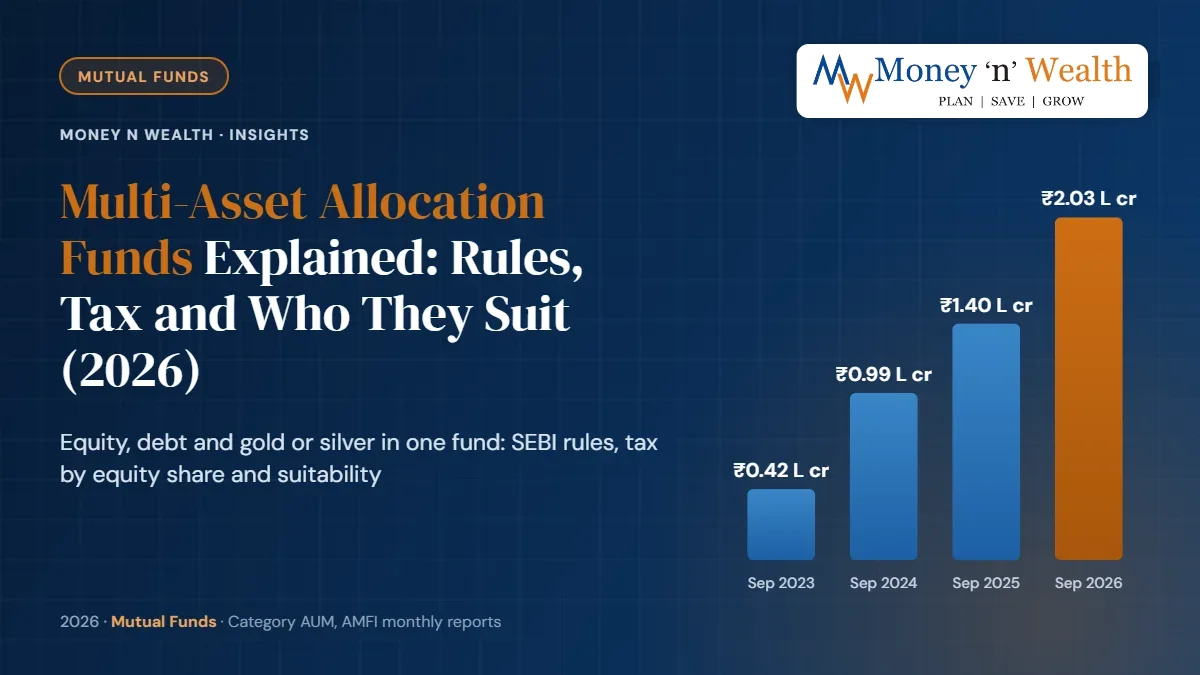
Last updated: 13 October 2026 Quick answer: A multi-asset allocation fund is a hybrid mutual fund that must invest at least 10% in each of at least three asset classes, typically equity, debt and gold or silver. It offers diversification and automatic rebalancing in one product. Tax depends on the fund’s Indian equity share: 65% or more is taxed like an equity fund; below that, short-term gains are taxed at your slab rate. Key takeaways SEBI rule: minimum three asset classes, at least 10% each; foreign shares do not count as a separate class (circular of 26 February 2026). Growth: category AUM rose from ₹42,018 crore (Sep 2023) to ₹2,02,828 crore (Sep 2026) across 37 schemes (AMFI). Flows: ₹3,667 crore net inflow in September 2026, while hybrid funds overall saw a net outflow of ₹457 crore. Tax varies: two funds in this category can fall in different tax buckets; check the equity range in the scheme document. Best fit: investors who want one diversified, rebalanced holding and will stay at least three to five years. September 2026 was a difficult month for hybrid mutual funds. Across the hybrid category, investors pulled out ₹457 crore more than they put in. Yet one sub-category bucked the trend: multi-asset allocation funds took in ₹3,667 crore net, according to AMFI. The appeal is easy to see after a year in which the Nifty 50 fell 8.09% (one year to 30 September 2026, price return) while Indian gold prices rose about 23%. A fund that owns equity, debt and gold, and rebalances between them, softens the ride. This guide explains how SEBI defines these funds, what they actually hold, how they are taxed (which depends heavily on design), and who should consider them. What is a multi-asset allocation fund? A multi-asset allocation fund is an open-ended hybrid mutual fund that invests in at least three asset classes, with a minimum of 10% in each. SEBI first created the category in its 2017 categorisation framework and retained the same core rule in its revised circular of 26 February 2026. The scheme’s “type” line in its documents must now name the three asset classes it uses. In practice, most Indian multi-asset funds combine: Indian equity , often a mix of unhedged shares and hedged arbitrage positions; Debt , such as government securities, corporate bonds and money market instruments; Precious metals , through gold and silver ETFs or exchange-traded commodity derivatives (ETCDs); In some cases, InvITs or other commodities within regulatory limits. SEBI’s 2026 circular adds an important clarification: foreign securities are not treated as a separate asset class. A fund cannot meet the three-asset test by holding Indian equity, debt and US equity. It needs a genuinely different third asset, which in India usually means gold or silver. Three SEBI rules for multi asset allocation funds: at least three asset classes, at least 10% in each, foreign securities not a separate class How are multi-asset funds different from other hybrid funds? Several of SEBI’s other hybrid categories also mix equity and debt, so the distinctions matter. Hybrid category Core SEBI rule Third asset required? Typical role Multi Asset Allocation At least 3 asset classes, minimum 10% each Yes One-fund diversification Dynamic Asset Allocation (balanced advantage) Equity and debt managed dynamically No (equity and debt only) Valuation-based equity shifting Aggressive Hybrid 65–80% equity, 20–35% debt No Equity-heavy, less volatile than pure equity Balanced Hybrid 40–60% equity, 40–60% debt No Middle-of-the-road mix Conservative Hybrid 10–25% equity, 75–90% debt No Debt-plus Equity Savings 65%+ equity incl. arbitrage, net equity 15–40%, 10%+ debt No Low-volatility, equity-taxed Arbitrage 65%+ in hedged equity No Short-term parking The key difference is the third asset. Gold and silver often move differently from Indian shares, especially in periods of global stress or rupee weakness. That low correlation is what gives a multi-asset fund its smoother path. For more on the equity-debt hybrids, see our guides to balanced advantage funds (/insights/balanced-advantage) , aggressive hybrid funds (/insights/aggressive-hybrid) and equity savings funds (/insights/equity-savings-dividend-yield-funds) . How fast have multi-asset allocation funds grown? Few categories have grown faster. AMFI data show net AUM roughly quintupled in three years, and the number of investor folios more than quadrupled, from 14.2 lakh in September 2023 to 61.6 lakh in September 2026. Bar chart of multi-asset allocation fund AUM rising from ₹0.42 lakh crore in 2023 to ₹2.03 lakh crore in 2026 Part of this is genuine demand for simplicity. Part is performance chasing: precious metals had a strong run, and multi-asset funds with large metal allocations looked good in recent one-year tables. Investors should be careful not to extrapolate that. A fund that gained because gold rose 20% can lag badly when gold falls and equity rallies. Why the same category can behave very differently SEBI sets only a floor of 10% per asset. Beyond that, the fund manager has wide freedom. One fund may hold 65–80% in equity with a token 10% in gold. Another may hold 35–40% equity, 30% debt and 25% or more in gold and silver. Their returns, volatility and tax can be very different, yet both are “multi-asset allocation funds”. Benchmarks also vary. Some funds use an equity index such as the BSE 500 TRI, others a composite of equity, debt and gold indices. A fund that “beats” an equity benchmark in a year when gold soared may simply have held more gold. Compare like with like. How are multi-asset allocation funds taxed? This is where most investors get caught out. Tax is decided not by the SEBI category but by the fund’s average holding of Indian listed equity, measured as an annual average of monthly figures under section 198 of the Income-tax Act, 2025. Comparison of multi asset fund taxation by equity share: equity-oriented, middle bucket and specified debt fund Bucket 1: equity-oriented (65% or more Indian listed equity). Several multi-asset funds keep their gross equity at or above 65%, often by holding part of it as hedged arbitrage. They are taxed like equity funds: 20% on gains from units held up to 12 months (section 196), and 12.5% on long-term gains above ₹1.25 lakh a year (section 198). Bucket 2: the middle (below 65% equity, not more than 65% debt). Funds with large gold and silver holdings often land here. Short-term gains, on units held up to 24 months, are taxed at your slab rate. After 24 months, gains are taxed at 12.5% without indexation, with no ₹1.25 lakh exemption. Bucket 3: specified mutual fund (over 65% in debt and money market). Rare for multi-asset funds, since equity plus metals usually exceeds 35%. Gains are taxed at slab rate however long you hold. Our guide to capital gains tax on mutual funds (/insights/capital-gains-tax-mutual-funds-2026) covers each bucket in detail. A worked example Say you invest ₹10 lakh and it grows to ₹12 lakh. You are in the 30% slab and have not used your ₹1.25 lakh equity exemption elsewhere this year. Bar chart comparing tax on a multi asset fund gain: ₹9,375 if equity-oriented versus ₹60,000 at slab rate Equity-oriented fund, sold after 18 months: long-term. Tax = 12.5% of (₹2,00,000 − ₹1,25,000) = ₹9,375, plus cess. Middle-bucket fund, sold after 18 months: still short-term. Tax = 30% of ₹2,00,000 = ₹60,000, plus cess. Middle-bucket fund, sold after 25 months: long-term. Tax = 12.5% of ₹2,00,000 = ₹25,000, plus cess. The lesson: if you might need the money within two years, the fund’s tax bucket matters as much as its returns. The scheme information document and the AMC’s tax reckoner state which treatment applies. Is the equity-tax design better? Not automatically. A fund that uses arbitrage to stay above 65% equity gets better tax treatment, but the hedged slice earns roughly money-market returns and adds no equity upside. Its actual “net” equity, and its gold allocation, may be smaller than in a middle-bucket fund. Judge the fund on its real risk mix first, and tax second. Who should invest in a multi-asset allocation fund? These funds solve a real problem: most investors find it hard to hold several asset classes in sensible proportions and to rebalance when one runs ahead. A multi-asset fund does this inside the fund, and rebalancing inside a fund does not trigger capital gains tax for you. They tend to suit: First-time or hands-off investors who want a single diversified holding rather than four or five funds; Moderate-risk goals three to seven years away , where pure equity is too volatile and pure debt too low-returning; Retirees running a withdrawal plan , as one component of an income portfolio. See our guide to SWP withdrawals from mutual funds (/insights/swp-systematic-withdrawal-plan-guide) ; Investors without a gold allocation , who want some precious-metal exposure without buying separate ETFs. They are less useful if you already manage a well-diversified portfolio with separate equity, debt and gold funds. Adding a multi-asset fund then mostly duplicates what you own and makes your true allocation harder to track. Our portfolio-first framework (/insights/how-to-choose-mutual-funds-portfolio-framework) explains how to set target weights before choosing products. What are the risks of multi-asset funds? Manager allocation risk. Returns depend heavily on the manager’s calls between assets. A wrong call on gold or equity can cost several percentage points. Metal price risk. Gold and silver can fall or stagnate for years. Silver in particular is volatile. Our comparison of gold vs silver (/insights/gold-vs-silver-investment-india) explains why. Hidden duplication. If you also own gold ETFs or a balanced advantage fund, your overall gold or equity exposure may be higher than you think. Interest rate risk on the debt slice. After the RBI’s 25 bps repo hike to 5.50% on 7 October 2026, longer-duration bonds in the debt portion may see price falls. See our note on the October 2026 rate hike (/insights/rbi-repo-rate-hike-october-2026-emi-fd-debt-funds) . Costs. Expense ratios can be higher than buying index funds and ETFs separately. Compare direct and regular plans and check what you are paying for advice. How to choose a multi-asset allocation fund Without naming schemes, here is a framework that works. Start with the scheme document and the latest factsheet, not the one-year return table. Five checks for choosing a multi asset allocation fund: equity range, third asset, arbitrage, benchmark, cost Match the equity range to your risk. A fund that can run up to 80% equity is an equity-like product with a gold kicker; one at 35–50% is much more conservative. Look at the actual third asset. Check how much is in gold, silver, InvITs or commodity derivatives now, and the permitted range. Separate net and gross equity. The factsheet usually shows unhedged equity separately from arbitrage. Net equity drives your risk. Compare rolling returns over several periods against a blended benchmark, and check how the fund behaved in falling markets such as 2020 and 2026. Check tax fit for your horizon. If you may redeem within two years, the equity-oriented design is usually more tax-efficient. Our step-by-step guide to reading a factsheet (/insights/how-to-read-mutual-fund-factsheet) helps with steps 2 and 3. If you are considering a new launch, apply the checks in how to evaluate an NFO (/insights/how-to-evaluate-nfo) . Related reading Balanced advantage funds (/insights/balanced-advantage) Equity savings and dividend yield funds (/insights/equity-savings-dividend-yield-funds) How much commodity exposure should you have? (/insights/commodity-allocation-portfolio-india) Gold ETFs explained (/insights/gold-etf) Life cycle funds: SEBI’s new goal-dated category (/insights/life-cycle-funds-sebi-new-category) Frequently Asked Questions What is the minimum allocation in a multi-asset allocation fund? SEBI requires at least 10% in each of at least three asset classes. The scheme must name those asset classes in its documents. Beyond that floor, the manager can vary the mix within the ranges stated in the scheme information document. SEBI’s circular of 26 February 2026 also clarified that foreign securities are not a separate asset class for this test. Are multi-asset funds taxed as equity or debt? It depends on the fund. If it holds at least 65% in Indian listed equity on average, including hedged arbitrage, it is taxed as an equity fund. If it holds less equity and not more than 65% in debt, short-term gains (up to 24 months) are taxed at slab rate and long-term gains at 12.5%. Check the scheme’s tax reckoner. Is a multi-asset fund better than a balanced advantage fund? They do different jobs. A balanced advantage (dynamic asset allocation) fund moves between equity and debt only, usually based on valuations. A multi-asset fund must also hold a third asset, typically gold or silver, which can cushion falls in Indian equity. Choose based on whether you want precious-metal exposure in the same fund. Can I use a multi-asset fund instead of buying gold? It can provide some gold exposure, but the amount varies by fund and over time, and you do not control it. If you want a specific gold allocation, say 10% of your portfolio, a separate gold ETF or gold fund gives you more precise control. A multi-asset fund suits those who prefer convenience over precision. How long should I stay invested in a multi-asset allocation fund? Plan for at least three to five years. Shorter periods can be dominated by swings in one asset, such as a fall in gold. For funds outside the equity tax bucket, holding beyond 24 months also moves gains from your slab rate to 12.5%. Do multi-asset funds invest in REITs? SEBI’s circular of 26 February 2026 names InvITs, gold and silver ETFs and ETCDs as permitted residual investments for hybrid schemes; it does not mention REITs. Few multi-asset funds hold REITs in meaningful amounts. Check the asset allocation table in the scheme document for what a particular fund can hold. Is SIP suitable for a multi-asset allocation fund? Yes. Because the fund already diversifies and rebalances, a monthly SIP is a simple way to build a moderate-risk portfolio over time. Remember that each SIP instalment has its own holding period for tax, so redeeming within 12 or 24 months of later instalments may be taxed at short-term rates. Sources: SEBI circular on categorisation and rationalisation of mutual fund schemes, 26 February 2026 (https://www.sebi.gov.in/sebi_data/attachdocs/feb-2026/1772079826878.pdf) ; AMFI monthly report, September 2026 (https://portal.amfiindia.com/spages/amsep2026repo.pdf) and September 2023 (https://portal.amfiindia.com/spages/amsep2023repo.pdf) ; Income Tax Department, section 198, Income-tax Act, 2025 (https://www.incometaxindia.gov.in/w/section-198-76) ; section 196 (https://www.incometaxindia.gov.in/w/section-196-76) ; NSE Indices, Nifty 50 factsheet, 30 September 2026 (https://www.niftyindices.com/Factsheet/ind_nifty50.pdf) . Worked examples are Money n Wealth calculations. Does a multi-asset fund fit your portfolio, or duplicate it? The answer depends on what you already hold and when you need the money. Talk to Money n Wealth (/contact) for a free portfolio review. This article is for general educational purposes only and does not constitute financial advice. Figures and examples are illustrative. Please consult a qualified financial adviser for guidance specific to your situation. Money n Wealth (Predics Fintech Services Pvt Ltd) is an AMFI-registered Mutual Fund Distributor (ARN-121995) and APMI-registered PMS Distributor (APRN07444); it is not a SEBI-registered investment adviser and may earn distribution commission on investments made through it.
Frequently Asked Questions
What is the minimum allocation in a multi-asset allocation fund?
SEBI requires at least 10% in each of at least three asset classes. The scheme must name those asset classes in its documents. Beyond that floor, the manager can vary the mix within the ranges stated in the scheme information document. SEBI’s circular of 26 February 2026 also clarified that foreign securities are not a separate asset class for this test.
Are multi-asset funds taxed as equity or debt?
It depends on the fund. If it holds at least 65% in Indian listed equity on average, including hedged arbitrage, it is taxed as an equity fund. If it holds less equity and not more than 65% in debt, short-term gains (up to 24 months) are taxed at slab rate and long-term gains at 12.5%. Check the scheme’s tax reckoner.
Is a multi-asset fund better than a balanced advantage fund?
They do different jobs. A balanced advantage (dynamic asset allocation) fund moves between equity and debt only, usually based on valuations. A multi-asset fund must also hold a third asset, typically gold or silver, which can cushion falls in Indian equity. Choose based on whether you want precious-metal exposure in the same fund.
Can I use a multi-asset fund instead of buying gold?
It can provide some gold exposure, but the amount varies by fund and over time, and you do not control it. If you want a specific gold allocation, say 10% of your portfolio, a separate gold ETF or gold fund gives you more precise control. A multi-asset fund suits those who prefer convenience over precision.
How long should I stay invested in a multi-asset allocation fund?
Plan for at least three to five years. Shorter periods can be dominated by swings in one asset, such as a fall in gold. For funds outside the equity tax bucket, holding beyond 24 months also moves gains from your slab rate to 12.5%.
Do multi-asset funds invest in REITs?
SEBI’s circular of 26 February 2026 names InvITs, gold and silver ETFs and ETCDs as permitted residual investments for hybrid schemes; it does not mention REITs. Few multi-asset funds hold REITs in meaningful amounts. Check the asset allocation table in the scheme document for what a particular fund can hold.
Is SIP suitable for a multi-asset allocation fund?
Yes. Because the fund already diversifies and rebalances, a monthly SIP is a simple way to build a moderate-risk portfolio over time. Remember that each SIP instalment has its own holding period for tax, so redeeming within 12 or 24 months of later instalments may be taxed at short-term rates.
Does a multi-asset fund fit your portfolio, or duplicate it?
The answer depends on what you already hold and when you need the money. Talk to Money n Wealth for a free portfolio review.