Mutual Fund Expense Ratio, Exit Load and Other Costs: The 2026 Guide
Last updated: 13 October 2026
Quick answer: A mutual fund expense ratio is the yearly cost a scheme deducts from its NAV. Since the SEBI (Mutual Funds) Regulations, 2026 took effect on 1 April 2026, it has two parts: a Base Expense Ratio (BER) capped by fund size, plus brokerage and statutory levies charged at actuals. You may also pay an exit load (up to 3%), stamp duty of 0.005% on purchases and STT on equity fund redemptions.
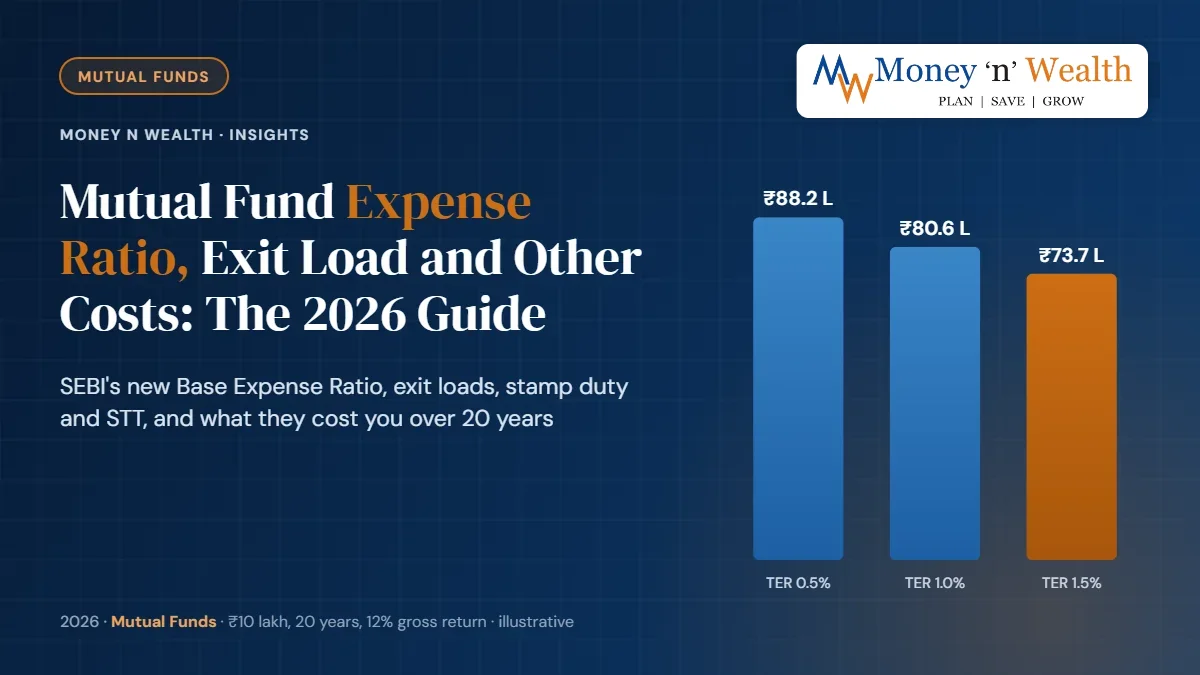
Last updated: 13 October 2026 Quick answer: A mutual fund expense ratio is the yearly cost a scheme deducts from its NAV. Since the SEBI (Mutual Funds) Regulations, 2026 took effect on 1 April 2026, it has two parts: a Base Expense Ratio (BER) capped by fund size, plus brokerage and statutory levies charged at actuals. You may also pay an exit load (up to 3%), stamp duty of 0.005% on purchases and STT on equity fund redemptions. Key takeaways New structure: TER = BER + brokerage + regulatory levies + statutory levies (GST, STT, stamp duty). Lower caps: the equity BER runs from 2.10% (small funds) to 0.95% (above ₹50,000 crore). Brokerage caps cut: 6 bps in cash and 2 bps in derivatives, excluding levies. Exit load: the regulations cap it at 3% of NAV; it goes back into the scheme. Compounding: on ₹10 lakh over 20 years, 1.5% vs 0.5% cost is about ₹14.5 lakh less. Two investors put ₹10 lakh each into equity funds that earn the same 12% a year before costs. One pays 0.5% a year, the other 1.5%. After 20 years the first has about ₹88 lakh and the second about ₹74 lakh. Nothing about the market was different. Only the cost was. Costs are one of the few things in investing you can see in advance and control. This guide explains every charge on an Indian mutual fund as of October 2026: the expense ratio and SEBI's new Base Expense Ratio framework, exit loads, stamp duty, STT, and how to decide whether a cost is worth paying. It does not recommend any scheme. What is a mutual fund expense ratio? The Total Expense Ratio (TER) is the annual percentage of a scheme's assets used to run it. It pays for fund management, registrar and custodian services, audit, marketing and, in regular plans, distributor commission. The SEBI (Mutual Funds) Regulations, 2026 define TER as the ratio of all expenses charged to the scheme's investors. You never receive a bill. The fund deducts the cost a little every day, so the published NAV is already net of expenses. That is why costs are easy to ignore and why they matter so much over long periods. Every scheme has two plans with the same portfolio. The direct plan has no distributor commission and so a lower TER. The regular plan includes commission paid to the distributor who services your account. Our article on direct vs regular mutual funds (/insights/direct-vs-regular-mutual-funds-what-the-higher-return-claim-leaves-out) covers when that difference is worth paying. What changed in SEBI's expense ratio rules in 2026? At its meeting on 17 December 2025, the SEBI Board approved a review of the 1996 mutual fund regulations. A central part was a revised expense framework, which now sits in the SEBI (Mutual Funds) Regulations, 2026, in force from 1 April 2026. Three changes matter to investors. 1. The cap is now a Base Expense Ratio, excluding levies The old limits included statutory levies such as GST on management fees. The new limits, called the Base Expense Ratio (BER), exclude all statutory levies. STT, GST, stamp duty, SEBI fees and exchange fees are now charged at actuals on top. SEBI's formula is simple: TER = BER + brokerage + regulatory levies + statutory levies. The new BER caps are lower than the old caps, but the headline TER you see may not fall by the same amount, because levies are now added separately. Compare like with like when you look at older factsheets. 2. Lower caps at every fund size The caps still fall as a scheme grows, so large funds must charge less. The table shows the new limits for open-ended schemes. Scheme AUM Equity-oriented: old → new BER Other schemes: old → new BER Up to ₹500 crore 2.25% → 2.10% 2.00% → 1.85% ₹500–750 crore 2.00% → 1.90% 1.75% → 1.65% ₹750–2,000 crore 1.75% → 1.60% 1.50% → 1.40% ₹2,000–5,000 crore 1.60% → 1.50% 1.35% → 1.25% ₹5,000–10,000 crore 1.50% → 1.40% 1.25% → 1.15% ₹10,000–15,000 crore 1.45% → 1.35% 1.20% → 1.10% ₹15,000–20,000 crore 1.40% → 1.30% 1.15% → 1.05% ₹20,000–25,000 crore 1.35% → 1.25% 1.10% → 1.00% ₹25,000–30,000 crore 1.30% → 1.20% 1.05% → 0.95% ₹30,000–35,000 crore 1.25% → 1.15% 1.00% → 0.90% ₹35,000–40,000 crore 1.20% → 1.10% 0.95% → 0.85% ₹40,000–45,000 crore 1.15% → 1.05% 0.90% → 0.80% ₹45,000–50,000 crore 1.10% → 1.00% 0.85% → 0.75% Above ₹50,000 crore 1.05% → 0.95% 0.80% → 0.70% The slabs apply to each tranche of assets, so a ₹12,000 crore fund's overall cap is a blend. Other categories also moved: Index funds and ETFs: 1.00% → 0.90%. FoFs investing in liquid funds, index funds or ETFs: 1.00% → 0.90%. FoFs with over 65% in equity-oriented schemes: 2.25% → 2.10%. Other FoFs: 2.00% → 1.85%. Close-ended equity schemes: 1.25% → 1.00%; other close-ended schemes 1.00% → 0.80%. Bar chart comparing old TER caps with new Base Expense Ratio caps for equity mutual funds by AUM slab 3. Brokerage caps tightened, and an extra charge removed Funds pay brokerage when they trade. The cap for cash-market trades fell from 12 bps including levies to 6 bps excluding levies. For derivatives it fell from 5 bps to 2 bps, also excluding levies. SEBI also removed the extra 5 bps that schemes with exit loads could charge as a temporary measure. For a buy-and-hold investor, these changes trim costs at the margin. They matter more in high-turnover funds such as arbitrage funds, where trading costs are a large share of the expense. How much does a 1% difference in expense ratio cost you? Costs compound against you in the same way returns compound for you. The chart takes ₹10 lakh invested for 20 years at a 12% gross return and changes only the annual cost. Bar chart showing how mutual fund expense ratio of 0.5%, 1% and 1.5% turns ₹10 lakh into ₹88.2 lakh, ₹80.6 lakh and ₹73.7 lakh over 20 years Annual cost Net return Value after 10 years Value after 20 years 0.5% 11.5% ₹29.7 lakh ₹88.2 lakh 1.0% 11.0% ₹28.4 lakh ₹80.6 lakh 1.5% 10.5% ₹27.1 lakh ₹73.7 lakh A SIP shows the same effect. ₹10,000 a month for 20 years grows to about ₹86.6 lakh at 11.5% net, against about ₹76.8 lakh at 10.5% net. The gap of roughly ₹10 lakh comes from one percentage point a year. Returns are uncertain; costs are not. A fund's future performance cannot be known when you invest, but its expense ratio can, and it is deducted every single day whether the fund does well or badly. Does a lower expense ratio always mean a better fund? No. Compare costs within the same category, never across. A small-cap fund will cost more than a large-cap index fund, and that is expected. The real question is whether the extra cost buys something. Active vs passive: an active fund has to beat its index by more than its extra cost. In large caps, many have struggled to do so consistently. Our guide to index funds (/insights/index-funds) covers this. Fund size: large funds have lower caps, but size can hurt agility in small and mid caps. Debt funds: cost matters more because returns are lower. A 0.8% TER takes a big bite from a 7% yield. See how to choose a debt fund (/insights/how-to-choose-debt-mutual-fund-three-checks) . Advice: in a regular plan, part of the TER pays for a distributor's service. That is worth it only if you actually receive help, for example staying invested in a crash. Cafemutual's October 2026 analysis of about 320 index funds put the average regular-minus-direct TER gap at 0.43% for large-cap index funds and 0.31% for debt index funds. That gap is the price of distribution. Know what you pay and what you receive for it. What is an exit load and how is it charged? An exit load is a charge on redemptions made before a set period ends. It discourages short-term money in long-term funds and protects remaining investors from the cost of sudden outflows. Under Regulation 44 of the 2026 Regulations, the exit load on an open-ended scheme cannot exceed 3% of NAV, and the amount collected must be credited back to the scheme, not kept by the AMC. Typical patterns, which vary by scheme, look like this: Category Common exit load pattern Equity funds Often 1% if redeemed within 12 months ELSS None, but a 3-year lock-in applies Liquid funds Small graded load for exits within 7 days Overnight funds Usually none Arbitrage funds Often a small load for exits within 15–30 days Life Cycle Funds (new) 3% within 1 year, 2% within 2 years, 1% within 3 years Worked example: you invest ₹5 lakh in an equity fund with a 1% exit load for 12 months. You redeem after 10 months when the value is ₹5.4 lakh. The load is ₹5,400. Waiting two more months would have avoided it. Exit loads apply unit by unit on a first-in, first-out basis. With a SIP, each instalment has its own clock. Redeeming the whole folio may trigger a load on recent instalments even if early ones are free. The same applies to an STP (/insights/sip-vs-lumpsum-vs-stp) or SWP (/insights/swp-systematic-withdrawal-plan-guide) from a fund with a load. A fund cannot raise the exit load on units you already hold. Any change applies only to new purchases. When a scheme changes fees, expenses or other fundamental attributes, investors must get notice and an option to exit without load. What other costs do mutual fund investors pay? Summary tiles of mutual fund costs: expense ratio, exit load, stamp duty, STT, brokerage cap and entry load Stamp duty: 0.005% on purchases Since 1 July 2020, stamp duty of 0.005% applies when mutual fund units are issued to you. It covers lump sums, each SIP instalment, switch-ins and reinvested IDCW. It is deducted from the amount invested. On ₹1 lakh you pay ₹5. Redemptions do not attract stamp duty. Securities Transaction Tax on equity fund redemptions When you redeem units of an equity-oriented fund, STT of 0.001% of the redemption value is deducted. On ₹10 lakh that is ₹10. Debt fund redemptions do not attract STT. Inside the fund, trades attract their own STT, which is now charged to the scheme at actuals outside the BER. Budget 2026 raised STT on futures and options from 1 April 2026, which slightly raises costs for arbitrage and hedged strategies. Entry load: none SEBI abolished entry loads in August 2009. No fund can deduct a charge when you invest, apart from stamp duty. If anyone asks you for an upfront fee to buy a mutual fund through them, ask what it is for and get it in writing. Tax: usually the biggest cost of all For many investors, tax on redemption costs far more than every other charge combined. Equity fund gains held over 12 months are taxed at 12.5% above ₹1.25 lakh a year (section 198 of the Income-tax Act, 2025); short-term gains at 20%. Debt fund gains are taxed at slab rates. A poorly timed switch can cost more in tax than a decade of expense ratio savings. Our guide to capital gains tax on mutual funds in 2026 (/insights/capital-gains-tax-mutual-funds-2026) explains the rules. How do you check a fund's expense ratio? AMCs must publish each scheme's TER on their websites and update it when it changes. You will also find it in the monthly factsheet, which our guide on how to read a mutual fund factsheet (/insights/how-to-read-mutual-fund-factsheet) explains. Your Consolidated Account Statement shows the commission paid to your distributor, as required by Regulation 34. Five steps to check mutual fund expense ratio, exit load and tax costs Look at the TER for your exact plan and option. Direct and regular plans differ, and the figure can change month to month as a fund's size moves between slabs. How costs compare: mutual funds, PMS, SIF and ULIPs Mutual funds are among the most cost-regulated investment products in India. A PMS (/insights/pms-india) charges fixed and often performance fees, and every trade is taxed in your hands. Under the new PMS rules SEBI approved in September 2026, the 0.5% a year cap on operating expenses will exclude statutory levies. SIFs (/insights/what-is-specialised-investment-fund-sif-india) follow mutual fund-style expense rules but with their own disclosure. ULIPs have premium allocation, policy administration and mortality charges on top of fund management. Our comparison of SIF, mutual fund, PMS and AIF (/insights/sif-vs-mutual-fund-vs-pms-vs-aif) sets these out side by side. Related reading Direct vs regular mutual funds (/insights/direct-vs-regular-mutual-funds-what-the-higher-return-claim-leaves-out) How to shortlist SIP funds in 2026 (/insights/how-to-shortlist-sip-funds-2026) ETFs vs index funds (/insights/etf-vs-index-fund-india) Fund of funds and international FoFs (/insights/fund-of-funds-international-fof) XIRR vs CAGR vs absolute return (/insights/xirr-vs-cagr-vs-absolute-return) Frequently Asked Questions What is a good expense ratio for a mutual fund in India? It depends on the category. Index funds and ETFs are capped at 0.90% BER, and many charge far less. Active equity funds can charge from 2.10% (small funds) down to 0.95% (very large funds), plus levies. Compare a fund only with peers in the same SEBI category and plan type, and ask whether any extra cost has been earned through better risk-adjusted returns. What is the Base Expense Ratio (BER)? The Base Expense Ratio is SEBI's new cap on a scheme's running costs, introduced with the SEBI (Mutual Funds) Regulations, 2026 from 1 April 2026. Unlike the old TER cap, it excludes statutory levies such as GST, STT and stamp duty, which are charged at actuals. Total Expense Ratio now equals BER plus brokerage, regulatory levies and statutory levies. Is the expense ratio deducted from my investment every year? It is deducted daily from the scheme's assets, so the NAV you see is already net of costs. You will not see a separate debit in your statement. A 1% TER means roughly 1/365th of 1% of the scheme's assets is charged each day. Can a fund increase its expense ratio after I invest? Yes, within SEBI's caps, and a fund's TER also changes as its size moves between slabs. AMCs must disclose TER changes in advance on their websites. Changes to fees and expenses that count as fundamental attribute changes require notice to unitholders and an option to exit at NAV without exit load. Do SIPs attract exit load? Yes. Each SIP instalment is treated as a separate purchase with its own exit load period. If a fund has a 1% load for 12 months and you redeem everything, units bought in the last 12 months will attract the load while older units will not. Redemptions are matched on a first-in, first-out basis. Is stamp duty charged on mutual fund redemptions? No. Stamp duty of 0.005% applies only when units are issued: lump sums, SIP instalments, switch-ins and reinvested IDCW. Redemptions and switch-outs do not attract it. On a ₹10,000 SIP instalment, the stamp duty is 50 paise. Why does a fund of funds cost more? A fund of funds invests in other schemes, which have their own costs. SEBI's caps for FoFs, such as 2.10% for equity-oriented FoFs and 0.90% for FoFs of index funds or ETFs, are meant to limit the total. For overseas FoFs, check the scheme documents for the underlying foreign fund's fees. Sources: SEBI Board meeting decisions, 17 December 2025 (https://www.sebi.gov.in/sebi_data/attachdocs/dec-2025/1765977060104.pdf) ; SEBI (Mutual Funds) Regulations, 2026 (https://www.sebi.gov.in/legal/regulations/jul-2026/securities-and-exchange-board-of-india-mutual-funds-regulations-2026-last-amended-on-july-7-2026-_102780.html) ; SEBI Master Circular for Mutual Funds, 20 March 2026 (https://www.sebi.gov.in/legal/master-circulars/mar-2026/master-circular-for-mutual-funds_100491.html) ; SEBI circular on categorisation, 26 February 2026 (https://www.sebi.gov.in/sebi_data/attachdocs/feb-2026/1772079826878.pdf) ; SEBI Board decisions, 24 September 2026 (https://www.sebi.gov.in/sebi_data/attachdocs/sep-2026/1790259036651.pdf) ; Cafemutual, index fund TER analysis (https://cafemutual.com/news/passives/38972-index-funds-with-highest-distributable-ter) ; Income Tax Department, section 198 (https://www.incometaxindia.gov.in/w/section-198-76) . Worked examples are Money n Wealth calculations. Paying more than you need to on your funds? A review can show what each fund really costs you, including tax on any switch, before you change anything. Talk to Money n Wealth (/contact) for a free portfolio review. This article is for general educational purposes only and does not constitute financial advice. Figures and examples are illustrative. Please consult a qualified financial adviser for guidance specific to your situation. Money n Wealth (Predics Fintech Services Pvt Ltd) is an AMFI-registered Mutual Fund Distributor (ARN-121995) and APMI-registered PMS Distributor (APRN07444); it is not a SEBI-registered investment adviser and may earn distribution commission on investments made through it.
Frequently Asked Questions
What is a good expense ratio for a mutual fund in India?
It depends on the category. Index funds and ETFs are capped at 0.90% BER, and many charge far less. Active equity funds can charge from 2.10% (small funds) down to 0.95% (very large funds), plus levies. Compare a fund only with peers in the same SEBI category and plan type, and ask whether any extra cost has been earned through better risk-adjusted returns.
What is the Base Expense Ratio (BER)?
The Base Expense Ratio is SEBI's new cap on a scheme's running costs, introduced with the SEBI (Mutual Funds) Regulations, 2026 from 1 April 2026. Unlike the old TER cap, it excludes statutory levies such as GST, STT and stamp duty, which are charged at actuals. Total Expense Ratio now equals BER plus brokerage, regulatory levies and statutory levies.
Is the expense ratio deducted from my investment every year?
It is deducted daily from the scheme's assets, so the NAV you see is already net of costs. You will not see a separate debit in your statement. A 1% TER means roughly 1/365th of 1% of the scheme's assets is charged each day.
Can a fund increase its expense ratio after I invest?
Yes, within SEBI's caps, and a fund's TER also changes as its size moves between slabs. AMCs must disclose TER changes in advance on their websites. Changes to fees and expenses that count as fundamental attribute changes require notice to unitholders and an option to exit at NAV without exit load.
Do SIPs attract exit load?
Yes. Each SIP instalment is treated as a separate purchase with its own exit load period. If a fund has a 1% load for 12 months and you redeem everything, units bought in the last 12 months will attract the load while older units will not. Redemptions are matched on a first-in, first-out basis.
Is stamp duty charged on mutual fund redemptions?
No. Stamp duty of 0.005% applies only when units are issued: lump sums, SIP instalments, switch-ins and reinvested IDCW. Redemptions and switch-outs do not attract it. On a ₹10,000 SIP instalment, the stamp duty is 50 paise.
Why does a fund of funds cost more?
A fund of funds invests in other schemes, which have their own costs. SEBI's caps for FoFs, such as 2.10% for equity-oriented FoFs and 0.90% for FoFs of index funds or ETFs, are meant to limit the total. For overseas FoFs, check the scheme documents for the underlying foreign fund's fees.
Paying more than you need to on your funds?
A review can show what each fund really costs you, including tax on any switch, before you change anything. Talk to Money n Wealth for a free portfolio review.