Term Plan / Term Insurance Advisor in Pune: How Much Cover You Need and How to Choose
Last updated: 12 October 2026
Quick answer: Term insurance is pure life cover: if you die during the policy term, your family receives the sum assured, with no maturity value. Most families need at least 10 times annual income, more with a home loan or young children; a 32-year-old earning ₹15 lakh often needs ₹1.5-2 crore. Individual term premiums carry no GST from 22 September 2025.
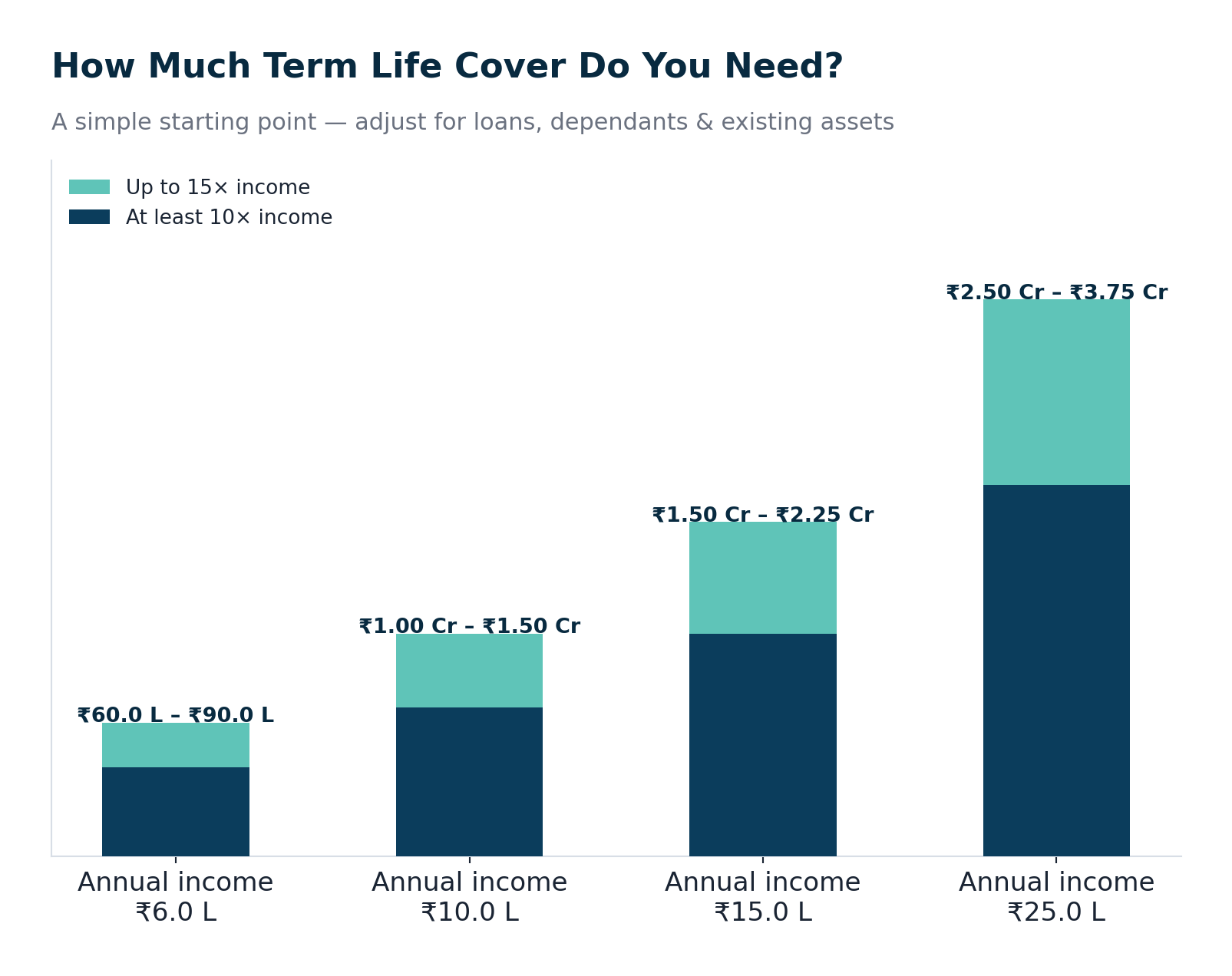
Last updated: 12 October 2026 Quick answer: Term insurance is pure life cover: if you die during the policy term, your family receives the sum assured, with no maturity value. Most families need at least 10 times annual income, more with a home loan or young children; a 32-year-old earning ₹15 lakh often needs ₹1.5-2 crore. Individual term premiums carry no GST from 22 September 2025. Key takeaways Cover size: 10 times income is a floor; add loans and goals, subtract existing assets. Illustrations from this guide: ₹80 lakh-₹1 crore at 28 on ₹8 lakh income; ₹2.5-3.5 crore at 38 on ₹25 lakh with two children and a home loan. Premium is fixed: a level-term plan's premium is locked at entry, so buying younger and healthier costs less for the whole term. No GST: individual term premiums are GST-exempt from 22 September 2025 (earlier 18%). Claims hinge on disclosure: accurate health, smoking and income details matter more than a small premium difference. A term plan is the simplest financial product to explain and one of the easiest to underbuy: pay a premium, and if you pass away during the policy term, your family receives the sum assured — no maturity value, no investment component, which is exactly why it's the most cost-efficient way to protect a family's income. Yet it's a common blind spot even among diligent investors. Why Term Insurance Matters More Than Any Single Investment Term insurance protects the person who generates the financial plan's inputs — your income. A SIP, an emergency fund and a retirement portfolio all assume a working income continues for 20–30 more years; term insurance makes sure that assumption holds even if you don't. A young family with a home loan and a five-year-old that skips term insurance to "invest more instead" is optimising the wrong variable — protection comes first because it's the only part of the plan that can't be rebuilt after the fact. How Much Term Cover Do You Actually Need? The common "10x annual income" rule is a floor, not a target. A more accurate "human life value" approach looks at outstanding liabilities (home/car loans), years of income replacement needed, existing savings that offset the requirement, and future goals like children's education. Profile (illustrative) Annual income Rough term cover target 28, unmarried, no dependents, some loans ₹8 lakh ₹80 lakh – ₹1 crore 32, married, one child, home loan ₹15 lakh ₹1.5 – 2 crore 38, married, two children, home loan + goals ₹25 lakh ₹2.5 – 3.5 crore 45, married, children nearing independence ₹30 lakh ₹1.5 – 2 crore Illustrative starting points for a conversation, not a substitute for a proper needs-based calculation. Term Plan vs Traditional/Endowment vs ULIP Traditional and ULIP plans are sold more aggressively than term plans (higher commissions) even though they solve a different problem. Term insurance vs traditional endowment vs ULIP compared on purpose, cover per rupee of premium, investment returns and typical use, from a term insurance advisor in Pune Term plan vs traditional plan vs ULIP Term Plan Traditional/Endowment ULIP Purpose Pure risk protection Insurance + guaranteed/bonus savings Insurance + market-linked investment Cover per premium Very high Low Low to moderate Investment returns None (by design) Modest, often below inflation-adjusted equity Market-linked, net of charges Typical guidance Buy adequate cover first Evaluate surrender vs continue if already held Same as endowment A common approach: buy term insurance for protection and mutual funds/SIPs for wealth creation, rather than one product trying to do both — usually more cover and better returns for the same outlay. What to Compare Before Buying a Term Plan Claim settlement ratio for individual death claims over multiple years, not just the headline number. Claim settlement time and documentation history. Premium at your target cover across 3–4 insurers — it varies meaningfully for identical cover. Riders worth adding: critical illness, accidental death benefit, waiver of premium on disability; avoid duplicating cover you have elsewhere. Policy term running until liabilities/goals resolve (often age 60–65). Payout option — lump sum, staggered income, or a combination. Accurate disclosure of health/smoking/income — the single biggest cause of claim rejection. Term Insurance Costs and Tax in 2026 No GST on premiums. Since 22 September 2025, individual life insurance premiums, including term plans, are exempt from GST. Earlier, term premiums carried 18%, so the same cover now costs less. Deduction only in the old regime. Term premiums count within the ₹1.5 lakh deduction for old-regime taxpayers. The new regime, which is the default, gives no deduction for life insurance premiums. Payout to the family. The death benefit received by the nominee is generally tax-free, which is why the sum assured can be sized directly against loans and goals. Premiums still depend on age, health, smoking status and the insurer, so compare quotes for identical cover and term. Why Use an Advisor Instead of Buying Term Insurance Directly Online Online term plans are competitively priced and easy to compare yourself. An advisor adds value by sizing cover correctly from your actual liabilities and goals, helping structure disclosures so a claim isn't contested later, and assisting during the actual claim process — the part families remember most, and something a direct online purchase doesn't include. Related reading on Money n Wealth Insurance planning in India: how much cover you need (/insights/insurance-planning-guide-india) Insurance planning in Pune: life, health and general (/insights/insurance-advisor-in-pune) Child education planning: protecting the goal (/insights/child-education-planning-guide-india) Insurance through Money n Wealth (/products/insurance) Frequently Asked Questions What is the ideal age to buy a term plan? As early as possible once dependents or liabilities exist — premiums are lower when younger and healthier, and cover gets harder or costlier once health conditions develop. Is a term plan enough, or do I also need health insurance? Both — term insurance replaces income if you pass away; health insurance covers treatment costs if you fall ill. A complete plan needs both. Can I increase my term cover later? Some plans allow increases at life milestones without fresh medical tests; otherwise a new policy later costs more based on age/health then. Sizing correctly from the start is usually more efficient. Do term insurance premiums increase every year? No — for a standard level-term plan the premium is fixed for the entire term at purchase, based on age and health at entry. Is GST charged on term insurance premiums in 2026? No. From 22 September 2025, premiums on individual term insurance, like other individual life policies, are exempt from GST; earlier they carried 18%. A renewal premium due after that date is billed without GST. Group term cover bought by an employer is not part of this exemption. Is the term insurance payout taxable for my family? The death benefit paid to the nominee under a life insurance policy is generally tax-free in India. Premiums count within the ₹1.5 lakh deduction only if you file under the old tax regime; the new regime gives no deduction. Keep the policy document and nominee details updated so the claim is straightforward. What happens if I miss a term insurance premium? Policies give a grace period, usually 15 days for monthly mode and 30 days otherwise, during which cover continues. After that the policy lapses and has no value. Most insurers allow revival within a set period by paying arrears and, often, a fresh health declaration. Auto-debit avoids the problem. Not sure how much term cover you need? Talk to our team (/contact) for a needs-based calculation, or explore our insurance planning guide (/insights/insurance-planning-guide-india) . Money n Wealth (Predics Fintech Services Pvt Ltd) is an AMFI-registered Mutual Fund Distributor (ARN-121995) and APMI-registered PMS Distributor (APRN07444); it is not a SEBI-registered investment adviser and may earn distribution commission on investments made through it. Insurance is the subject matter of solicitation.