Insurance Planning in India: A Complete Guide to Term, Health and Life Cover
Insurance is the least exciting pillar of a financial plan and, for most families, the most important one to get right. Insurance planning in India is about one job: making sure a death, a hospitalisation, or a disability doesn’t undo years of budgeting, saving and investing in a single event. This guide covers how much cover you actually need, term vs traditional life insurance, health insurance, and what to look for when choosing a policy.
The most expensive mistake in Indian insurance buying is treating a life insurance policy as a savings product. Traditional endowment and money-back plans bundle a small amount of life cover with a low-return savings component, and the combination usually performs worse than buying term insurance and investing the difference separately — while also leaving you underinsured, because the premium for meaningful cover in a traditional plan is far higher than for term insurance. Keep the two jobs — protection and investing — separate, and each one performs better. For the investing side, see our SIP planning and mutual fund planning guides.
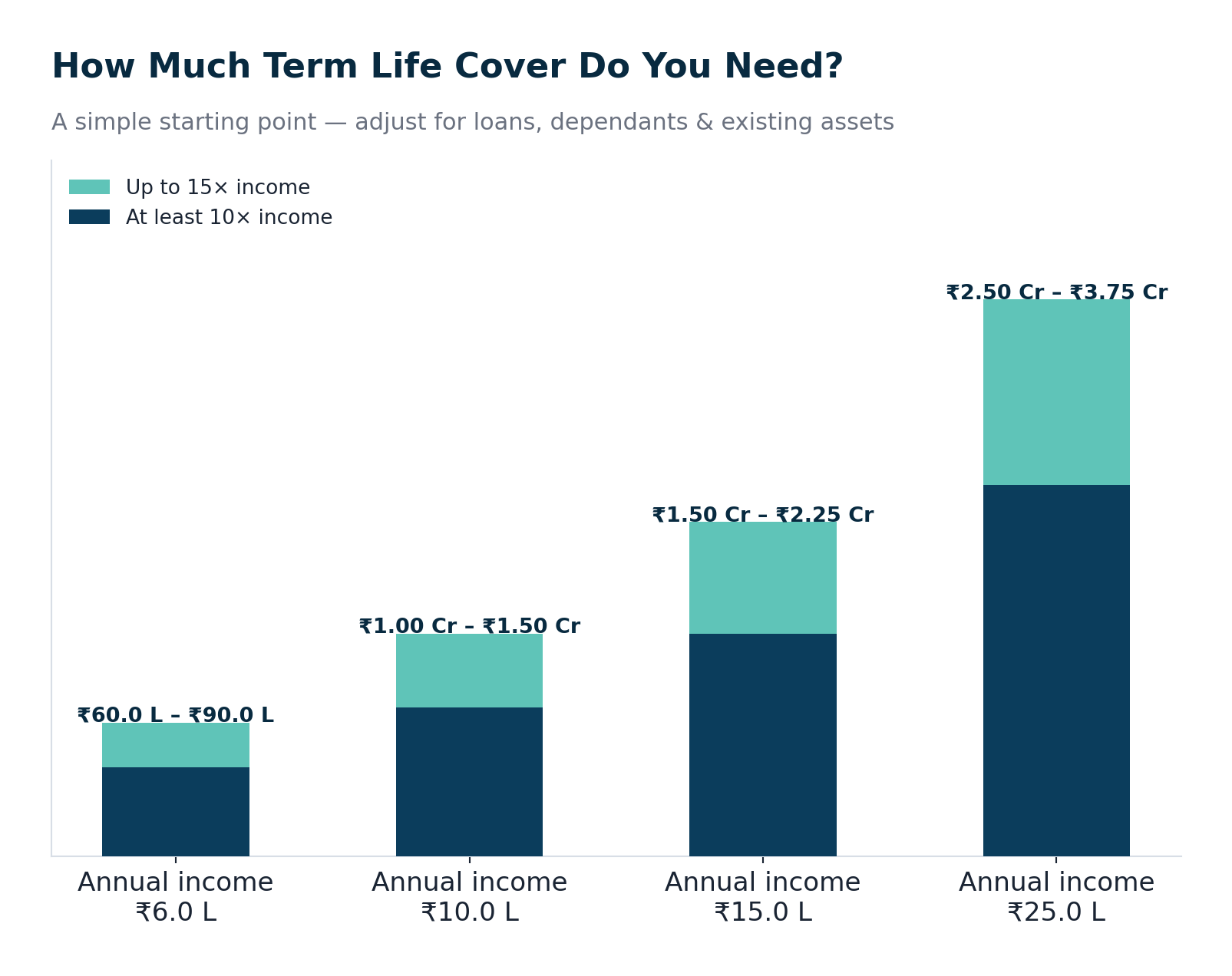
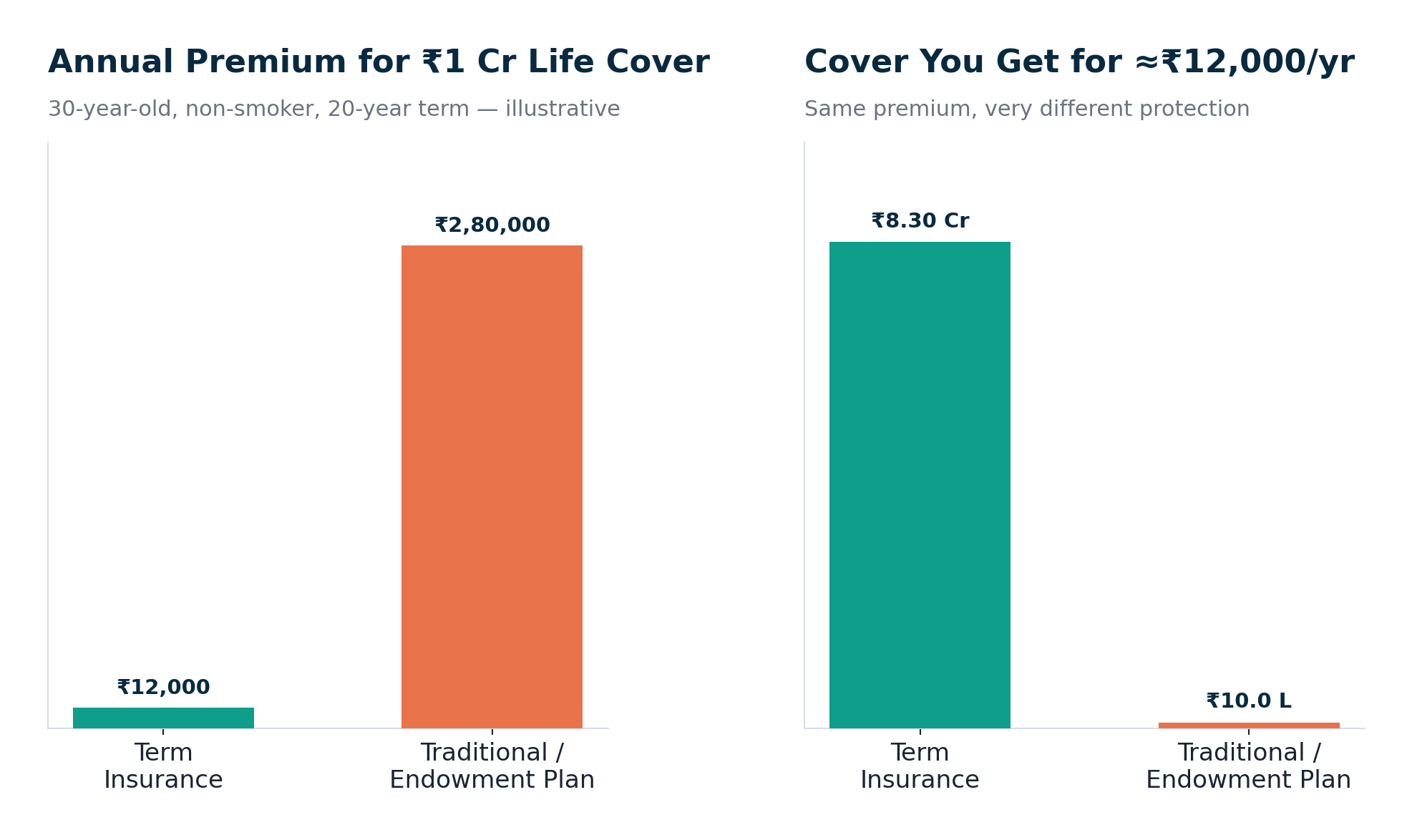
Insurance is the least exciting pillar of a financial plan and, for most families, the most important one to get right. Insurance planning in India is about one job: making sure a death, a hospitalisation, or a disability doesn’t undo years of budgeting, saving and investing in a single event. This guide covers how much cover you actually need, term vs traditional life insurance, health insurance, and what to look for when choosing a policy. Insurance Is Protection, Not Investment — and That Distinction Matters The most expensive mistake in Indian insurance buying is treating a life insurance policy as a savings product. Traditional endowment and money-back plans bundle a small amount of life cover with a low-return savings component, and the combination usually performs worse than buying term insurance and investing the difference separately — while also leaving you underinsured, because the premium for meaningful cover in a traditional plan is far higher than for term insurance. Keep the two jobs — protection and investing — separate, and each one performs better. For the investing side, see our SIP planning (/insights/sip-planning-guide-india) and mutual fund planning (/insights/mutual-fund-planning-guide-india) guides. How Much Term Life Insurance Do You Need? Bar chart: recommended term insurance cover ranges from 10x to 15x annual income, shown for four income levels A starting point — adjust for loans, dependants and existing assets. The standard starting rule of thumb is 10 to 15 times your annual income . To refine it for your own situation, work through this quick version of the “human life value” approach: Start with 10–15× your annual income. Add any outstanding loans (home loan, car loan) that your family would otherwise have to repay from other assets. Add future goals you’d want funded regardless — a child’s education, for instance. Subtract existing investments, savings and any life cover you already hold that could be liquidated to support your family. Who needs term insurance? Anyone whose death would create a financial gap for someone else — a spouse, children, or dependent parents. If no one depends on your income, term insurance is a lower priority (though still worth considering once dependants enter the picture). Buy it as early as possible — premiums are locked in largely by your age and health at purchase, so a 25-year-old and a 40-year-old buying the same cover pay very different premiums for the rest of the policy term. Term Insurance vs Traditional (Endowment) Plans Two charts comparing annual premium and cover amount for term insurance versus a traditional endowment plan for the same premium Illustrative example for a 30-year-old, non-smoker, 20-year term. The gap between the two is large enough that it’s worth seeing in numbers. For a 30-year-old buying ₹1 crore of cover over a 20-year term, a pure term plan typically costs a fraction of what a traditional plan charges for the same sum assured — and conversely, the same premium that buys ₹1 crore of term cover might only buy a fraction of that in a traditional plan. The trade-off: term insurance pays out only on death (or, with riders, disability/critical illness) and has no maturity value if you outlive the term — which is, in a sense, the outcome you actually want. Traditional plans return a maturity benefit, but at the cost of dramatically lower cover and, historically, mediocre effective returns compared to investing the premium difference in a diversified portfolio. Health Insurance: Don’t Rely on Your Employer Alone Employer-provided group health insurance is a useful benefit, but it has three structural weaknesses as your only cover: it usually ends the day you leave the job (exactly when you might need continuity most), the cover amount is often decided by your employer, not your family’s actual needs, and it typically doesn’t build any continuity benefits (like a waiting-period credit) that a personal policy accumulates over the years. How much cover do you need? As a starting benchmark, ₹5–10 lakh individual cover is reasonable in a smaller city, rising to ₹10–25 lakh in a metro given how fast healthcare costs have climbed. A cost-efficient way to get to a much higher cover is a base health policy plus a super top-up policy , which activates after a deductible and provides a large additional cover for a comparatively small extra premium. Family floater vs individual policies. A family floater covers the whole family under one shared sum insured at a lower combined premium — efficient when family members are young and unlikely to claim simultaneously. Individual policies cost more in total but mean one member’s large claim doesn’t reduce the cover available to everyone else that year. Many families use a floater for children and a separate individual policy for older parents, whose health risk (and premium) is very different. Good news on cost: individual life and health insurance premiums — including term insurance, endowment plans, ULIPs and family floater health policies — have been exempt from GST since 22 September 2025 , which meaningfully reduced the effective premium compared to the 18% GST charged earlier. (Group health and group term policies still attract GST.) Other Insurance Worth Considering Critical illness cover pays a lump sum on diagnosis of specified conditions (certain cancers, heart conditions, and similar), useful because it covers income loss during treatment and recovery, not just hospital bills. Personal accident cover pays out for accidental death or disability, often at a very low premium, and is a useful supplement — not a replacement — for term life insurance. Home insurance is inexpensive relative to the asset it protects and is frequently skipped simply because it isn’t mandatory the way a car loan’s insurance is. How to Choose an Insurer Beyond price, the metric worth checking is the claim settlement ratio — the percentage of claims an insurer actually pays out. Leading life insurers in India report individual death claim settlement ratios in the 99%+ range in recent years; a widely used rule of thumb is to favour insurers with a consistent ratio of 95% or higher, and to check the ratio’s trend over several years rather than a single year in isolation. This data is published annually and is publicly available from insurers and industry sources. Beyond the ratio, check the claim settlement process (cashless network hospital coverage for health insurance), policy exclusions and waiting periods, and whether premiums are guaranteed or reviewable over the policy term. Common Insurance Mistakes Buying cover equal to a round number, not a calculated need. ₹50 lakh or ₹1 crore “because that’s what everyone buys” often under- or over-insures. Use the calculation above instead. Letting insurance lapse over a missed payment. A lapsed term policy means zero cover exactly when premiums stop — set up auto-debit and keep a buffer in your emergency fund (/insights/emergency-fund-guide-india) for premium months. Relying entirely on employer group cover. As above — it typically disappears the day you change or lose a job. Under-insuring health cover because “I’m young and healthy.” Premiums are cheapest when you’re young and healthy — cover bought later, after a diagnosis, may come with exclusions, loadings, or be unavailable altogether. Skipping riders that matter for your situation. An accidental death or critical illness rider on a term plan can meaningfully increase protection for a modest additional premium — worth evaluating case by case rather than by default inclusion or exclusion. Where Insurance Fits in Your Plan Insurance is what protects the emergency fund and investments you’ve already built — see our emergency fund guide (/insights/emergency-fund-guide-india) for the cash buffer that works alongside it. It’s also closely tied to estate planning (/insights/estate-planning-guide-india) , since life insurance proceeds are often a key part of what your family inherits and depends on. For the full picture, see the complete financial planning guide (/insights/financial-planning-in-india-complete-guide) . How much term cover: a quick sizing table Item Example Your number Annual income to replace × years until youngest child is independent ₹15 lakh × 15 = ₹2.25 crore ₹ Plus outstanding loans ₹50 lakh home loan ₹ Plus major goals not yet funded ₹40 lakh education ₹ Minus existing investments and cover ₹60 lakh ₹ Cover needed About ₹2.55 crore ₹ A needs-based estimate; the common "10–15 times income" rule is a floor, not a target. Health insurance tax deduction (Section 80D, old regime) Premium paid for Age below 60 Age 60 or above Self, spouse, children Up to ₹25,000 Up to ₹50,000 Parents (additional) Up to ₹25,000 Up to ₹50,000 Preventive health check-up Within the above limits, up to ₹5,000 Same Not available in the new tax regime. Local guides: term insurance (/insights/term-insurance-advisor-pune) , health insurance (/insights/health-insurance-advisor-in-pune) , why group cover isn't enough (/insights/health-insurance-for-corporate-employees-pune) and our free insurance checkup (/free-insurance-checkup) . Frequently Asked Questions How much term insurance cover do I need? A common starting benchmark is 10–15 times your annual income, adjusted upward for outstanding loans (like a home loan) and the number of years your dependants will need support, and adjusted downward for existing savings and investments that could also support them. Is term insurance better than a traditional life insurance policy? For pure protection, term insurance gives far more cover per rupee of premium than traditional endowment or money-back plans, because it doesn’t bundle in a low-return savings component. Most financial planners recommend buying term insurance for protection and mutual funds separately for growth, rather than a combined product. How much health insurance cover do I need in India? As a starting point, ₹5–10 lakh individual cover in a smaller city and ₹10–25 lakh in a metro is a reasonable base given rising healthcare costs, ideally topped up with a super top-up policy for a much larger cover at a low additional premium. Don’t rely solely on employer group health cover, which typically ends when you leave the job. Is GST charged on life and health insurance premiums in India? No. Individual life and health insurance premiums — including term insurance, endowment plans, ULIPs, and family floater health plans — have been exempt from GST since 22 September 2025, following a decision by the GST Council. Group health and group term policies still attract GST. Not sure how much cover you actually need, or which policy fits? The right cover depends on your income, dependants, loans and existing assets — not a generic number. Talk to Money n Wealth (/contact) for a free insurance and portfolio review. This article is for general educational purposes only and does not constitute insurance or investment advice. Figures and examples are illustrative and premiums vary by insurer, age, health and other factors. Please read policy documents carefully and consult a qualified adviser before purchasing insurance. Money n Wealth (Predics Fintech Services Pvt Ltd) is an AMFI-registered Mutual Fund Distributor (ARN-121995) and APMI-registered PMS Distributor (APRN07444); it is not a SEBI-registered investment adviser and may earn distribution commission on investments made through it. Insurance is the subject matter of solicitation.